
Skip to content
The Encyclopedia of Horology

Pocket watch · Automaton pair-cased pocket watch

Pair-cased pocket watch with naval scene automaton dial

Partially verified

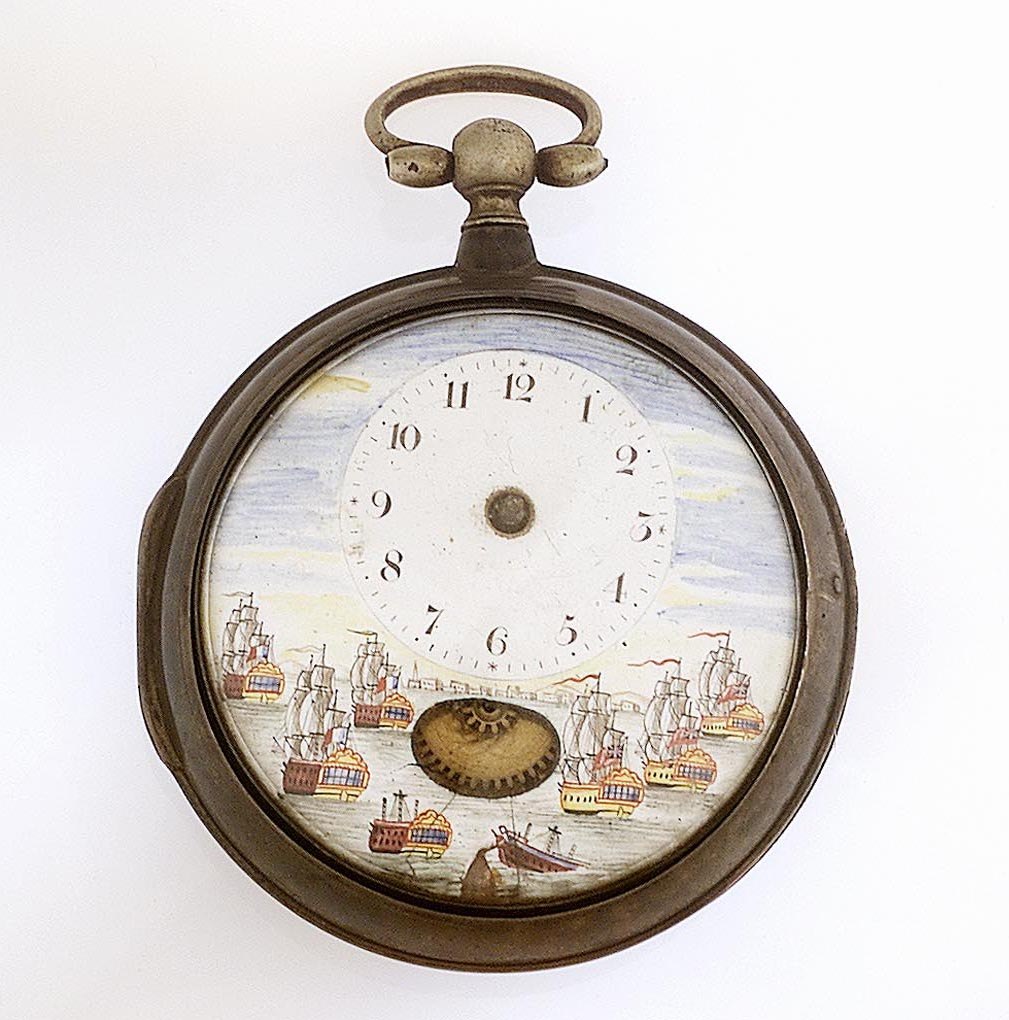
This pair-cased pocket watch, dated to circa 1800, features a white enamel dial with an offset Arabic hour ring set above a hand-painted naval scene. The dial illustrates British and French warships alongside a damaged vessel and a sinking ship. An oval aperture at the lower portion reveals a revolving automaton disc that the source reports is painted with a ship and an early steam locomotive. According to the source, the mechanism is a 30-hour single-train gilt brass fusee movement with verge escapement and a Tompion-style regulator. The silver pair case bears London hallmarks for 1800–1801 and the incuse maker's mark 'WL'.

Dial view of the pair-cased pocket watch with naval scene and automaton aperture
Dial view of the pair-cased pocket watch with naval scene and automaton aperture — National Maritime Museum, Greenwich, London, Sutcliffe-Smith Collection. Rights pending — permission not yet requested. Original source

Catalogue identity

Source
www.rmg.co.uk
Category
Pocket watch · Automaton pair-cased pocket watch
Maker / attribution
Anonymous; case maker possibly William Lewis
Reference
JEW0261
Catalogue / lot identifier
Source URL identifies the listing
Source-reported date
circa 1800
Country
United Kingdom

Source-reported attribution and specifications are not independent authentication. A listing does not establish present ownership, current display, availability or permission to reproduce.

Object description

Dial and Automaton Features

The watch features a white enamel dial with an offset Arabic hour ring. The lower half displays a detailed naval scene, reported to include three British men of war, three French ships, one partly disabled ship, and one sinking ship.

An oval aperture at the bottom of the dial reveals a revolving disc. The source states that this disc is painted with a ship and an early steam locomotive.

Evidence for this section
  • “White enamel dial with Arabic hour numerals offset above painted scene depicting three British men of war, three French ships, one partly disabled ship and one sinking ship.”
  • “The dial has an oval aperture through which a painted revolving disc can be viewed depicting a ship and an early steam locomotive.”

Case Construction

The object is housed in a silver pair case measuring 82 x 60 x 23 mm. The exterior features a circular, tall pendant (recorded as possibly nickel) with a stirrup-shaped bow situated at 12 o'clock.

The case is hallmarked for London, 1800–1801, with an incuse maker’s mark 'WL'. Additional stamped characters 'C' and 'B' are present, and the inner case contains multiple numerical scratches.

Evidence for this section
  • “The silver pair case is hallmarked 'London 1800-1801' with a makers incuse stamp 'WL' (William Lewis?) with stamped 'C' and 'B'.”
  • “Circular section tall (nickel?) pendant with stirrup bow.”
  • “The inner case is scratched inside with '3285/68', '1125/66', '1023/65' and '126/64'.”

Movement and Mechanism

The watch contains a thirty-hour, single-train, gilt brass four-pillar fusee movement with a verge escapement. The balance cock is pierced and engraved.

The movement employs a Tompion-style regulator with a silver regulating disc marked '1 2 3'. A stop piece operates on the contrate wheel at 4 o'clock.

Evidence for this section
  • “Thirty hour duration, single train, gilt brass four pillar fusee movement with verge escapement. Pierced and engraved balance cock.”
  • “Tompion style regulator with silver regulating disc marked '1 2 3'. Stop piece operating on contrate wheel at 4 o'clock.”

Open research questions

  • What is the significance of the stamped 'C' and 'B' markings on the silver case?
  • Do the scratched internal numbers correspond to documented historical watch repair records in London?

Source evidence

Recorded claims and source quotations for Pair-cased pocket watch with naval scene automaton dial
FieldSource-reported valueSource quotation
Escapement and Movement TypeThirty-hour duration, single-train gilt brass four-pillar fusee movement with verge escapement“Thirty hour duration, single train, gilt brass four pillar fusee movement with verge escapement.”
Dial ScenePainted naval engagement depicting British and French ships with an automaton aperture“White enamel dial with Arabic hour numerals offset above painted scene depicting three British men of war, three French ships, one partly disabled ship and one sinking ship. The dial has an oval aperture through which a painted revolving disc can be viewed”
Case HallmarkLondon hallmark for 1800-1801 with maker's mark 'WL'“The silver pair case is hallmarked 'London 1800-1801' with a makers incuse stamp 'WL' (William Lewis?)”
RegulatorTompion-style regulator marked 1 2 3“Tompion style regulator with silver regulating disc marked '1 2 3'.”
Dimensions82 x 60 x 23 mm overall“Overall: 82 x 60 x 23 mm”
Internal Case ScratchesNumerical records scratched into the inner case“The inner case is scratched inside with '3285/68', '1125/66', '1023/65' and '126/64'.”

Visible details

  • Offset white enamel subdial with black Arabic numerals and small star or dot markings
  • Painted naval battle scene filling the lower half of the dial, depicting multiple sailing vessels flying ensigns
  • Oval automaton aperture positioned beneath the subdial displaying part of a toothed or decorated revolving disc
  • Central hand arbor is visible without hands installed
  • Metallic pair case fitted with a rounded pendant and stirrup-shaped bow at 12 o'clock

Research qualifications

  • The internal movement details, balance cock, and case hallmarks are source-reported and not visible in the dial view
  • Source queries the attribution of maker's mark 'WL' to William Lewis

Photograph identity and source facts were screened before import; rights clearance remains pending.

Consulted source

Watch | Royal Museums Greenwich

Reviewed 2026-10-25 · Record 239f40e45b

Terms in this record

Glossary explanations for terms named in this object’s record.