
Skip to content
The Encyclopedia of Horology

Pocket watch · Oval watch

Oval watch signed WA

Partially verified

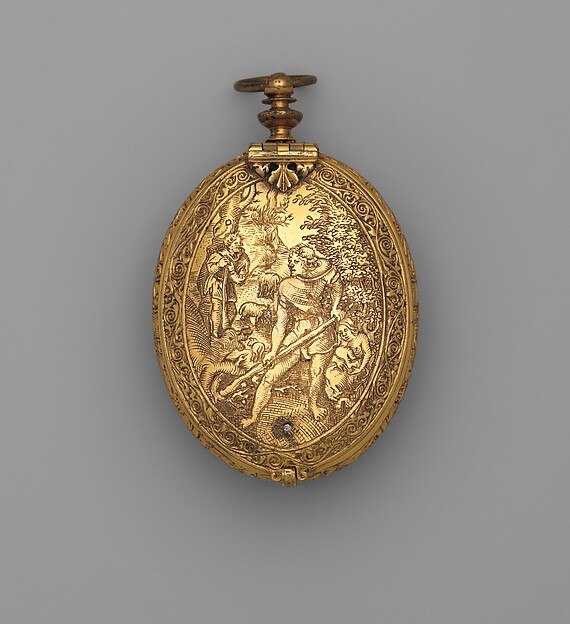
This 1571 spring-driven oval watch is signed by a maker identified only as "W.A." Constructed of gilded brass and steel, the timepiece is an early example of the oval format. The movement features two plates held by cylindrical floral-decorated pillars, with a mainspring barrel, a fusee, and a verge escapement regulated by a hog's-bristle device. The dial is engraved with the year 1571, an armorial shield, and a central hour chapter with touch pins. The case, featuring hinged covers, is decorated with intricate engravings, including scenes of Adam and Eve and bust-length figures of women.

Exterior view of the engraved case back depicting Adam at work, with the pendant visible at the top.
Exterior view of the engraved case back depicting Adam at work, with the pendant visible at the top. — The Metropolitan Museum of Art. Rights pending — permission not yet requested. Original source

Catalogue identity

Source
www.metmuseum.org
Category
Pocket watch · Oval watch
Maker / attribution
W.A.
Reference
Not recorded
Catalogue / lot identifier
17.190.1548
Source-reported date
1571
Source-reported place
Antwerp (attributed)

Source-reported attribution and specifications are not independent authentication. A listing does not establish present ownership, current display, availability or permission to reproduce.

Object description

Movement and Construction

The movement is composed of two oval plates fashioned from gilded brass, secured by three cylindrical pillars adorned with fine floral details. The drive system utilizes a large mainspring housed in a brass barrel with steel caps, which connects via a fusee assembly consisting of ten turns, providing a power reserve of approximately twelve hours. The escapement is a verge type, incorporating a polished steel escape wheel and a balance wheel.

Regulation of the balance is achieved through a hog's-bristle device, which includes a decorative pointer for adjustment. A primitive cock, pinned to a stud on the back plate, supports the balance staff, secured by a blued-steel fleur-de-lis. Chiseled and blued steel revolving latches hold the movement securely within the case. The winding square features a small ornamental cross finish.

Evidence for this section
  • “The movement consists of two oval plates of gilded brass that are held apart by three cylindrical pillars”
  • “It contains three polished-steel wheels that end in a verge escapement with a polished steel escape wheel and a balance wheel regulated by a hog’s-bristle device”

Dial and Case Decoration

The dial is a cast and gilded brass plate fixed to the movement via three pinned feet. It features a central chapter ring numbered I-XII, including star markings for half-hours and integrated touch pins. An armorial shield sits above the chapter, while a decorative human head and the date 1571 appear below, all set within strapwork and arabesque ornament. A single blued-steel hand provides time indication.

The oval case features molded details and two hinged covers. The engravings on these covers are of high quality, with one side depicting Adam and Eve and the other a scene inspired by a print by Jacob Binck. The interior of the covers depicts bust-length female portraits, which may carry allegorical significance related to contemporary literary themes in the Low Countries.

Evidence for this section
  • “The dial, a separate plate of cast and gilded brass, is attached to the top plate of the watch by means of three pinned-on feet.”
  • “the exterior side of the cover for the dial of the watch is a close copy of a print by the German-born painter and engraver Jacob Binck”

Attribution and History

The maker's identity remains uncertain, linked only by the initials "WA" found on the movement. Historical research has proposed various associations, including Walter Arsenius, a known astrolabe maker in Antwerp, though this remains speculative. The piece was formerly in the collection of J. Pierpont Morgan, who acquired it from Carl H. Marfels. Past misattributions to English maker William Anthony have been corrected in modern scholarship.

The watch is currently dated to 1571. Its rarity is partly attributed to the economic and social upheaval in the Low Countries during the late sixteenth century, which led to the loss of many horological records and items.

Evidence for this section
  • “Little is known about the maker whose mark was “WA,” except what is inferred from the surviving timepieces he produced”
  • “The devastation left by the revolt, war, and the periodic destruction of the Flemish economy probably accounts for the fact that so little sixteenth-century Flemish horology has survived.”

Open research questions

  • What is the definitive identity of the maker marked 'W.A.'?
  • Is there further evidence linking the female portraits on the interior case to specific allegorical publications in 1570s Antwerp?

Source evidence

Recorded claims and source quotations for Oval watch signed WA
FieldSource-reported valueSource quotation
Maker markW.A.“The initials “WA” appear below and to the right of the top latch”
Date1571“The dial of the watch is engraved with the year 1571.”
Case materialGilded brass“Case and dial: gilded brass”
EscapementVerge escapement“It contains three polished-steel wheels that end in a verge escapement with a polished steel escape wheel”
Dial featuresChapter ring with I-XII numerals and touch pins“It has a central chapter of hours (I–XII) with star markings for the half hours and touch pins for telling the time in darkness.”
Movement constructionTwo oval plates with cylindrical pillars“The movement consists of two oval plates of gilded brass that are held apart by three cylindrical pillars”
Attributed originAntwerp“the attribution of the clock, and by extension the watch, to Antwerp seems likely to be correct.”

Visible details

  • Case features two hinged covers with detailed engravings
  • Dial contains a central hour chapter with I-XII numerals and star half-hour markers
  • Movement is contained between two oval gilded brass plates

Research qualifications

  • The balance wheel and verge are potential replacements
  • The identity of the maker W.A. remains unverified

Photograph identity and source facts were screened before import; rights clearance remains pending.

Consulted source

Watch

Reviewed 2026-10-26 · Record 4174a107d9

Terms in this record

Glossary explanations for terms named in this object’s record.