
Skip to content
The Encyclopedia of Horology

Pocket watch · Verge calendar watch with sundial

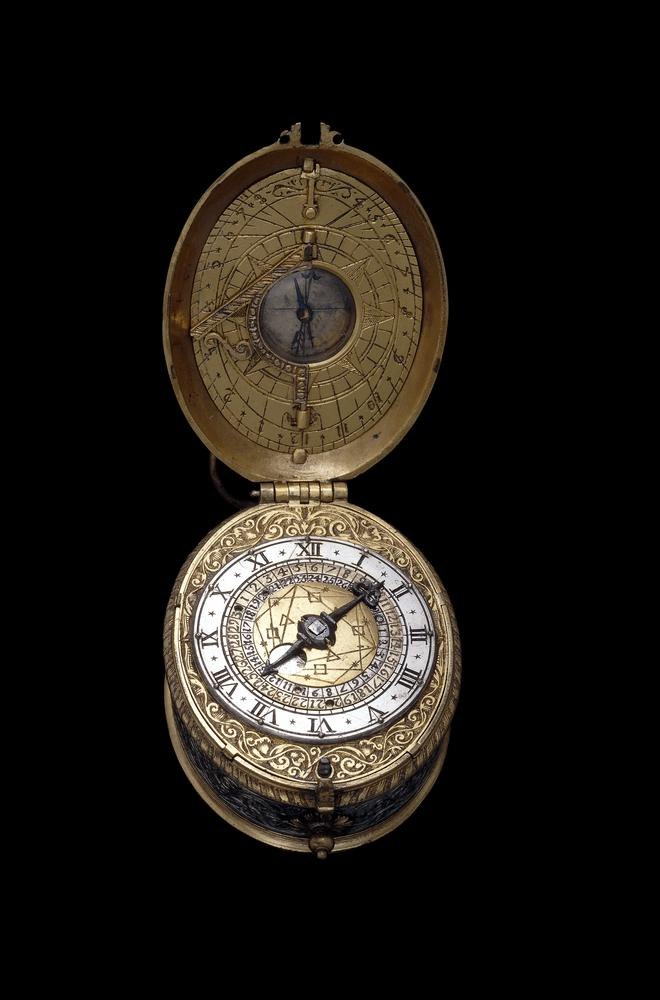
Oval gilt-brass and silver cased verge watch with calendar dial and sundial

Partially verified

This early seventeenth-century oval watch is reported by the British Museum to have been made by Coenrad Jacobs in Leeuwarden between 1610 and 1620. Constructed with a gilt-brass case featuring an applied silver foliate band, the interior lid retains a removable horizontal sundial with a folding gnomon and central orientation compass. The gilt-brass dial plate exhibits foliate scroll engraving, an applied silver chapter ring with touch-pins, concentric rings for the date and moon's age, and a central aspectarium displaying lunar phase indications. The movement incorporates a fusee, three-wheel going train, and a pre-balance spring verge escapement.

Open view of the oval verge watch showing the dial indications and the internal sundial and compass mounted inside the lid
Open view of the oval verge watch showing the dial indications and the internal sundial and compass mounted inside the lid — British Museum. Rights pending — permission not yet requested. Original source

Catalogue identity

Source
www.britishmuseum.org
Category
Pocket watch · Verge calendar watch with sundial
Maker / attribution
Coenrad Jacobs
Reference
1888,1201.176
Catalogue / lot identifier
Source URL identifies the listing
Source-reported date
1610-1620
Country
Netherlands

Source-reported attribution and specifications are not independent authentication. A listing does not establish present ownership, current display, availability or permission to reproduce.

Object description

Case and Integrated Sundial

The object is an oval gilt-brass case featuring an integral plain back and an applied silver band decorated with foliate scrolls.

The interior of the lid contains a removable horizontal sundial, which is equipped with a folding gnomon and a central compass for orientation.

Evidence for this section
  • “Oval gilt-brass case with integral plain back and an applied silver band decorated with foliate scrolls.”
  • “Inside the lid ia a removeable horizontal sundial with folding gnomon and a compass in the centre for orientation.”

Dial Configuration

The gilt-brass dial plate is decorated with foliate scroll engraving. It includes an applied silver chapter ring featuring Roman numerals (I-XII), star half-hour marks, and touch-pins at the hours.

The dial includes a gilt-brass ring calibrated 1-31 for the date and a silver ring calibrated 1-29½ for the moon's age, with a central aspectarium aperture to display lunar phases.

Evidence for this section
  • “Gilt-brass dial plate with foliate scroll engraved ornament around the outside. Applied silver chapter ring with hour I-XII, star half-hour marks and touch-pins at the hours.”
  • “Within the chapter ring a gilt-brass ring calibrated 1-31 for the date. Within this a silver ring calibrated 1-29½ for the moon's age. At the centre an engraved aspectarium with an aperture to show the phase of the moon.”

Movement and Mechanism

The movement features oval gilt-brass plates with four baluster pillars, a fusee with standard stop-work, a three-wheel going train, and a pre-balance spring verge escapement with a two-arm steel balance.

The motion work is driven by an integral pinion on the fusee/great-wheel arbor. The lunar disc and date-ring are friction-tight to allow for user adjustment.

Evidence for this section
  • “Oval gilt-brass plates with four baluster pillars.”
  • “Verge escapement with two-arm steel balance.”
  • “The moon's phase does not, of course, keep step with the months and so when setting the watch the user would first set the friction-tight date-ring correctly, and then the friction-tight lunar disc.”

Open research questions

  • What are the technical specifications for the 'three-wheel going train' used in early 17th-century verge watches?
  • How does the motion work on this specific movement compare to other examples of Coenrad Jacobs' work?

Source evidence

Recorded claims and source quotations for Oval gilt-brass and silver cased verge watch with calendar dial and sundial
FieldSource-reported valueSource quotation
MakerCoenrad Jacobs“Made by: Coenrad Jacobs”
Production PlaceLeeuwarden“Made in: Leeuwarden”
Production Date1610-1620“1610-1620”
Escapementpre-balance spring verge“pre-balance spring verge”
Museum Number1888,1201.176“1888,1201.176”
MakerCoenrad Jacobs“Made by: Coenrad Jacobs”
Production PlaceLeeuwarden“Made in: Leeuwarden”
Production Date1610-1620“1610-1620”

Visible details

  • Hinged lid opened to display an internal horizontal sundial with a central compass and folding gnomon.
  • Main dial plate features engraved scrolling foliage surrounding an applied silver Roman numeral chapter ring with star half-hour markers and touch-pins.
  • Inner dial contains calibrated concentric rings for dates 1 to 31 and moon's age 1 to 29½, enclosing a central aspectarium disc.
  • Visible case band shows an applied pierced or chased dark silver scrollwork band on the gilt-brass body.

Research qualifications

  • Source notes the sundial inside the lid is removable.
  • Country of origin is reported as Leeuwarden (modern-day Netherlands).

Photograph identity and source facts were screened before import; rights clearance remains pending.

Consulted source

calendar watch; sundial watch; watch-case | British Museum

Reviewed 2026-10-25 · Record 9ca4329f1b

Terms in this record

Glossary explanations for terms named in this object’s record.