
Skip to content
The Encyclopedia of Horology

Pocket watch · Split-seconds chronograph pocket chronometer

Omega Decimal-Second Split-Seconds Chronograph Observatory Chronometer

Partially verified

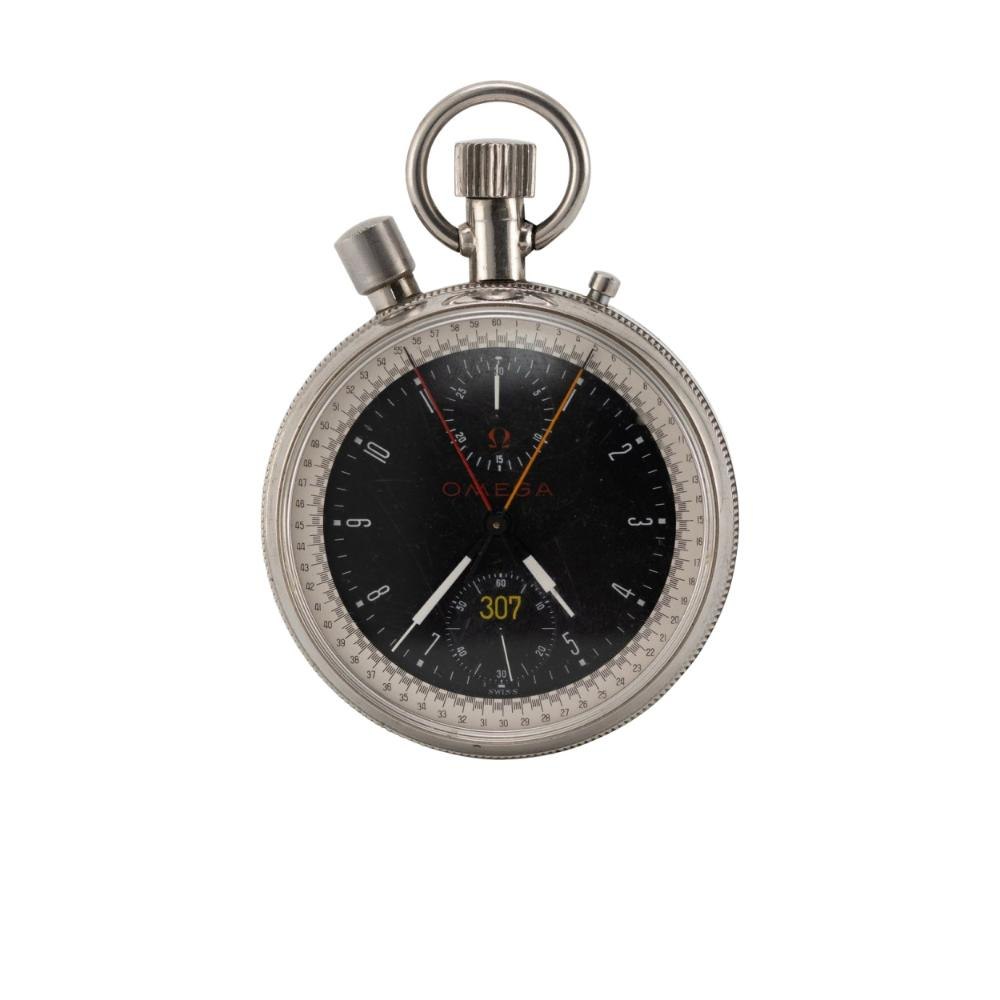
This steel split-seconds chronograph pocket chronometer, reference CK1155, was manufactured by Omega circa 1956. Measuring 65 mm in diameter, the steel case features a screw back and soft iron protective cap, housing calibre 205 with a 2/3 plate movement, lever escapement, and Glucydur screw balance. Auction documentation states that the watch was entered into the 1956 Neuchâtel observatory chronometer testing in the pocket chronometer category, placing 111th among 213 entries. The black dial presents central chronograph timing hands, a 30-minute register, continuous seconds, and the bold yellow designation 307.

Dial and case front of the Omega reference CK1155 split-seconds pocket chronometer
Dial and case front of the Omega reference CK1155 split-seconds pocket chronometer — Auktionen Dr. Crott. Rights pending — permission not yet requested. Original source

Catalogue identity

Source
www.invaluable.com
Category
Pocket watch · Split-seconds chronograph pocket chronometer
Maker / attribution
Omega
Reference
CK1155
Catalogue / lot identifier
172
Source-reported date
circa 1956
Country
Switzerland
Source-reported serial
13648828

Source-reported attribution and specifications are not independent authentication. A listing does not establish present ownership, current display, availability or permission to reproduce.

Object description

Object Identity and Provenance

This split-seconds chronograph pocket chronometer is identified by reference CK1155 and movement number 13648828, manufactured circa 1956. The watch is documented as having participated in the 1956 Neuchâtel observatory chronometer testing within the 'Chronomètres de Poche' category, where it achieved 8.9 points and was ranked 111th out of 213 entries.

The object is accompanied by an extract from the chronometer archives by Andreas Hidding. The provided source text mentions the inclusion of an original red bakelite transportation bag, though this item is not present in the provided visual records.

Evidence for this section
  • “Movm. No. 13648828, Ref. CK1155, Cal. 205, Dimensions 65 mm, circa 1956”
  • “In 1956 this watch took part in the chronometer test at the Neuchâtel observatory (which was unusual for such a olymic chronograph), category "Chronomètres de Poche" and achieved N = 8,9 points, which made it 111th of 213 chronometers”
  • “with extract from the chronometer archives by Andreas Hidding”
  • “A rare precision decimal-second split seconds chronograph for olympic sports timing in its original red bakelite transportation bag.”

Construction and Case Features

The pocket chronometer measures 65 mm in diameter and features a steel case with a screw back and a soft iron protective cap. The winding crown and suspension bow are located at the 12 o'clock position, with chronograph pushers positioned on the flanks of the case.

The auction catalogue describes the condition of the case as 'very good, worn'.

Evidence for this section
  • “Dimensions 65 mm”
  • “Case: Steel, screw back, soft iron protective cap.”
  • “Case: very good, worn.”

Dial and Mechanism

The watch is powered by a calibre 205 movement, which incorporates a 2/3 plate architecture, a lever escapement, and a Glucydur screw balance. The movement condition is noted as 'very good, capable of running', with a recommendation for cleaning.

The black dial includes a 30-minute counter and the numeral '307'. It is fitted with two central split-seconds hands, described as having contrasting red and orange tips.

Evidence for this section
  • “Cal. 205”
  • “Movm.: 2/3 plate movement, lever escapement, Glucydur screw balance.”
  • “Movm.: very good, capable of running, cleaning recommended.”
  • “Dial: Black, 30 min. counter, numbered "307".”
  • “Two central split-seconds hands terminating in contrasting red and orange painted tips”

Open research questions

  • What specific maintenance is required to address the recommendation for 'cleaning'?
  • Can the '307' numbering on the dial be verified against internal archival records for this specific serial number?
  • Does the provenance extract provide further details regarding the 'olympic' usage mentioned in the description?

Source evidence

Recorded claims and source quotations for Omega Decimal-Second Split-Seconds Chronograph Observatory Chronometer
FieldSource-reported valueSource quotation
ReferenceCK1155“Ref. CK1155”
Movement Number13648828“Movm. No. 13648828”
Calibre205“Cal. 205”
Dimensions65 mm“Dimensions 65 mm”
Case DescriptionSteel, screw back, soft iron protective cap“Case: Steel, screw back, soft iron protective cap.”
OriginSwitzerland“Origin Schweiz”
Total Weight263 g“Weight 263 g”

Visible details

  • Black dial displaying red Omega text and insignia, with yellow numeral 307 inscribed above 6 o'clock
  • Outer decimal calibrated chapter ring graduated from 1 to 60 along a lighter outer flange
  • Chronograph pushers flanking the central winding crown and suspension bow at the 12 o'clock position
  • Two central split-seconds hands terminating in contrasting red and orange painted tips

Research qualifications

  • Movement and interior casing details are not visible in the provided image.
  • The referenced red bakelite transportation container and archive extract are not depicted.

Photograph identity and source facts were screened before import; rights clearance remains pending.

Consulted source

At Auction: Omega - Observatory Chronometer 1956

Reviewed 2026-10-25 · Record 3fbfbaad32

Terms in this record

Glossary explanations for terms named in this object’s record.