
Skip to content
The Encyclopedia of Horology

Wristwatch · Manual wind tourbillon wristwatch

Omega Chronomètre à Tourbillon wristwatch

Partially verified

This Omega Chronomètre à Tourbillon is one of twelve examples originally produced for observatory precision trials. The manual-wind movement, caliber 30.I.1947 with 25 jewels, was manufactured in 1947 and features a tourbillon cage designed to reduce positional error. In 1987, the movement underwent an overhaul, receiving rhodium-plating, anglage, polishing, and Cotes de Genève decoration. The movement was finished and assembled by Franck Muller. The watch is housed in an 18k yellow gold case featuring a transparent case back and a push-button mechanism for time-setting, protected by an olivette. The case was manufactured by Jean-Pierre Hagmann, and the dial was produced by Tille. This specific example carries the movement number 10595941 and is equipped with an anonymous 18k yellow gold deployant clasp.

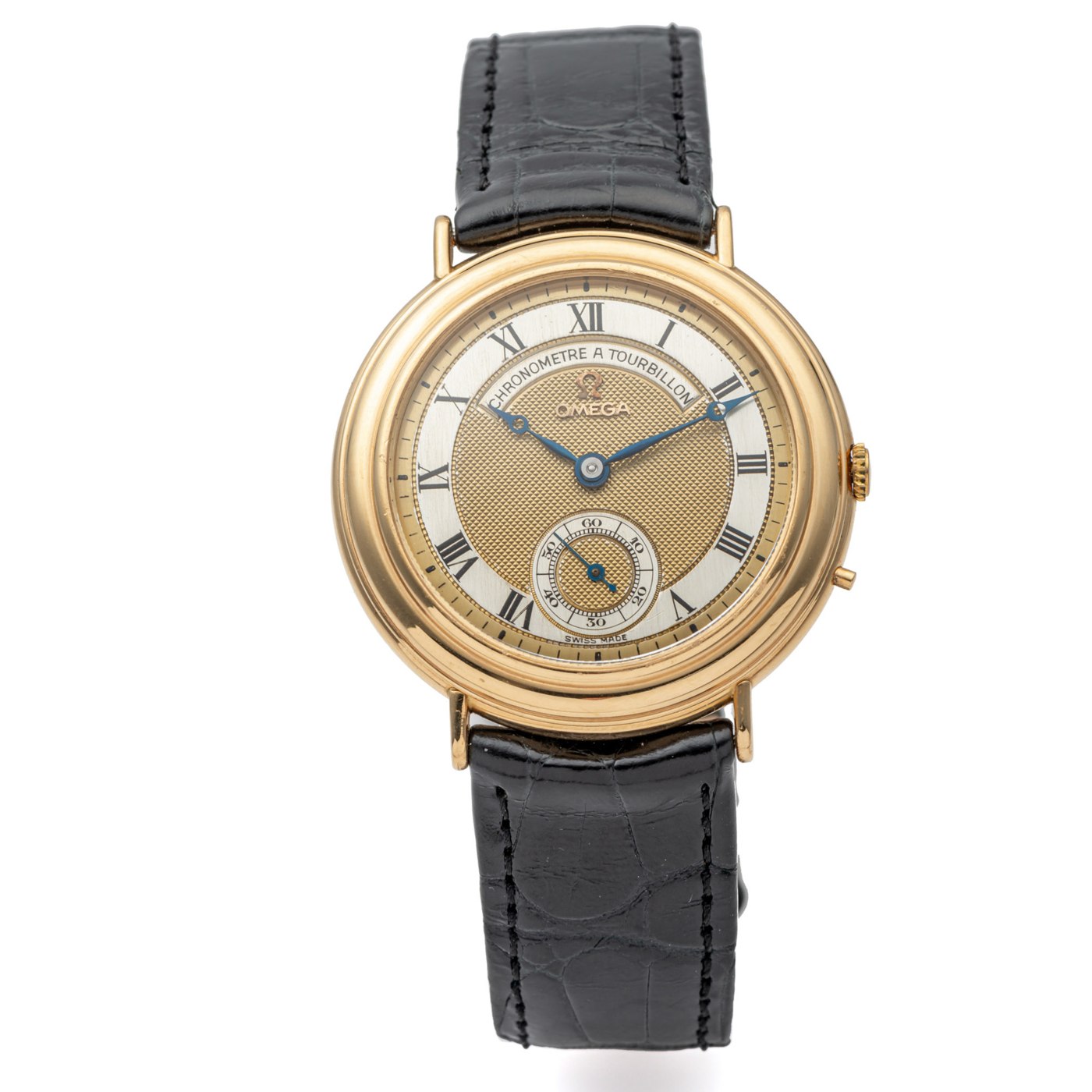
Front view of the Omega Chronomètre à Tourbillon showing the guilloché dial and 18k yellow gold case.
Front view of the Omega Chronomètre à Tourbillon showing the guilloché dial and 18k yellow gold case. — Antiquorum. Rights pending — permission not yet requested. Original source

Catalogue identity

Source
catalog.antiquorum.swiss
Category
Wristwatch · Manual wind tourbillon wristwatch
Maker / attribution
Omega
Reference
Not recorded
Catalogue / lot identifier
444
Source-reported date
Movement 1947, cased 1987
Source-reported place
Switzerland
Source-reported serial
10595941

Source-reported attribution and specifications are not independent authentication. A listing does not establish present ownership, current display, availability or permission to reproduce.

Object description

Movement and Tourbillon

Originally designed for observatory precision contests, the movement incorporates a tourbillon cage, which functions by rotating the escapement parts and balance to minimize positional errors.

In 1987, seven movements from the original series were modified. This process included rhodium-plating, anglage, polishing, and the application of Cotes de Genève decoration to the 2/3 plate. Documentation indicates that Franck Muller performed the finishing and assembly of this movement during the 1980s.

Evidence for this section
  • “the “tourbillon” is a rotating cage containing all the escapement parts, with the balance at its center”
  • “In 1987, seven of this series of chronometers had their 2/3 plate movement entirely overhauled, rhodium-plated, angled, polished, decorated with “Cotes de Genève””
  • “this movement was owned by Mr Franck Muller himself and that he was the one that finished and assembled the movement”

Case and Dial

The movement is set within an 18k yellow gold case that features a transparent case back to allow viewing of the tourbillon movement. The case includes a side-mounted push-button for setting the time, which is protected by an olivette. The case was manufactured by the casemaker Jean-Pierre Hagmann.

The dial features a guilloché pattern in the center and is marked with Roman numerals. The auction description notes that the hands are later replacements. Tille is credited with the production of the dial.

Evidence for this section
  • “fitted with an 18K gold or silver case with transparent back and push-button for time-setting protected by an olivette”
  • “the case was ordered to the famous casemaker of Patek Philippe cases, among others, to Mr Jean-Pierre Hagmann”
  • “Mr Muller had the dial made by Tille”

Provenance and History

These chronometers were designed by Jean-Pierre Matthey-Claudet based on plans by Marcel Vuilleumier, the director of the Ecole d’Horlogerie of the Vallée de Joux, and regulated by Alfred Jaccard. The watches competed in observatory trials in Kew Teddington, Neuchatel, and Geneva between 1947 and 1952.

The watch underwent its modern housing and assembly in 1987. Archival information from the Omega Museum indicates the movement was previously owned and finished by Franck Muller before being cased for this series.

Evidence for this section
  • “made by Jean-Pierre Matthey-Claudet according to plans drawn by Marcel Vuilleumier”
  • “some of these watches obtained excellent results from 947 to 1952 in Kew Teddington (London), Neuchatel and Geneva”
  • “We would like to thank the Omega Museum for their help in researching this piece.”

Open research questions

  • What specific evidence exists for the movement performance in observatory trials between 1947 and 1952?
  • How many of the remaining 12 examples were also completed by Franck Muller in the 1980s?

Source evidence

Recorded claims and source quotations for Omega Chronomètre à Tourbillon wristwatch
FieldSource-reported valueSource quotation
MakerOmega“OMEGA, CHRONOMETRE A TOURBILLON”
Movement Serial Number10595941“Movement No. 10595941”
Caliber30.I.1947, 25 jewels“Caliber 30.I.1947, 25 jewels”
Case Material18k yellow gold“18k yellow gold chronometer tourbillon wristwatch”
Production Total12“made in only 12 examples for observatory trials”
Movement FinisherFranck Muller“this movement was owned by Mr Franck Muller himself and that he was the one that finished and assembled the movement”
Case MakerJean-Pierre Hagmann“the case was ordered to the famous casemaker of Patek Philippe cases, among others, to Mr Jean-Pierre Hagmann”

Visible details

  • Guilloché-patterned dial center with Roman numeral indices
  • Visible tourbillon carriage through the transparent case back
  • 18k yellow gold case with lateral push-button
  • Stripe-decorated movement plates

Research qualifications

  • The dial is reported as having later hands.
  • The auction house reports that the movement requires an overhaul at the buyer's expense.

Photograph identity and source facts were screened before import; rights clearance remains pending.

Consulted source

OMEGA, CHRONOMETRE A TOURBILLON, YELLOW GOLD

Reviewed 2026-10-26 · Record 72b6e706dd

Terms in this record

Glossary explanations for terms named in this object’s record.