
Skip to content
The Encyclopedia of Horology

Clock · Bracket clock

Musical bracket clock with painted case

Partially verified

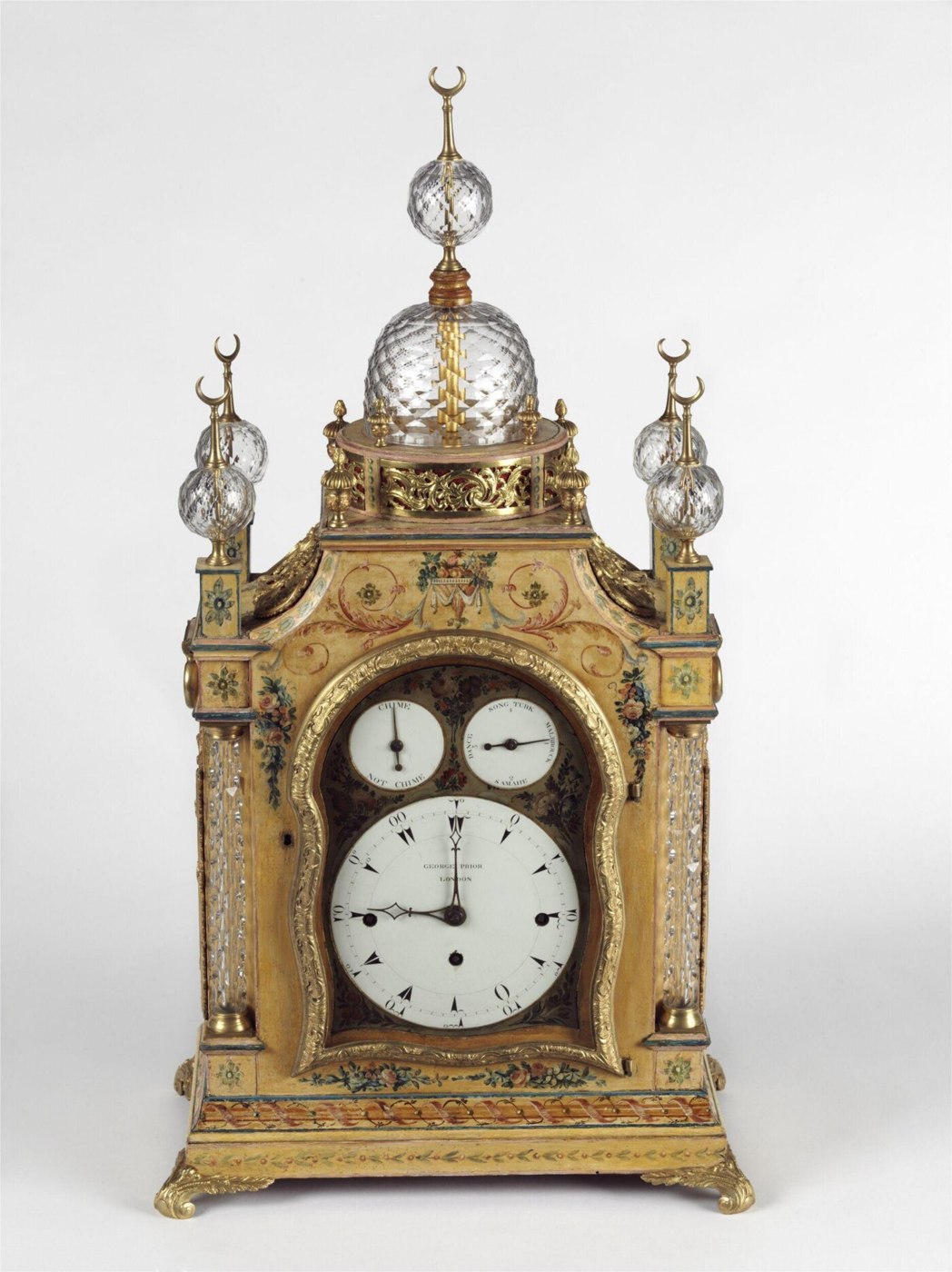
This bracket clock, produced around 1790 for the Turkish market, features a painted wooden case embellished with floral motifs in pastel colors on a cream ground. The structure incorporates cut-glass spheres and a dome, crowned by brass crescent-moon finials, reflecting a design style tailored to Turkish export preferences. The clock dial, inscribed 'GEORGE PRIOR/LONDON', displays Arabic numerals and two auxiliary dials for chime and tune selection. It is powered by a brass movement with a verge escapement, signed 'I.Thwaites 9', indicating manufacture by John Thwaites. The movement includes two trains, one for striking and one for a ten-bell musical mechanism. The case is further decorated with gilt-brass panels, columns, and urns. It stands on four scrolled feet, with carrying handles on the sides.

The musical bracket clock shown from the front, featuring its cream painted case, cut-glass columns, and crescent-moon finials.
The musical bracket clock shown from the front, featuring its cream painted case, cut-glass columns, and crescent-moon finials. — V&A Museum. Rights pending — permission not yet requested. Original source

Catalogue identity

Source
collections.vam.ac.uk
Category
Clock · Bracket clock
Maker / attribution
George Prior, John Thwaites
Reference
W.1:1, 2-1971
Catalogue / lot identifier
W.1:1, 2-1971
Source-reported date
ca. 1790-1810
Source-reported place
London
Source-reported serial
9

Source-reported attribution and specifications are not independent authentication. A listing does not establish present ownership, current display, availability or permission to reproduce.

Object description

Case and Decoration

The bracket clock case is constructed primarily from painted deal, featuring a complex decorative scheme that incorporates cream-colored paint with delicate floral swags and scrolls in pastel shades. The exterior is accented with cut-glass spheres and a dome, all mounted with gilt-brass fittings, including distinctive upturned crescent-moon finials. These design elements were intended to align with the visual preferences of the Turkish market, evoking an architectural style reminiscent of minarets.

Additional decorative features include pierced gilt-brass panels and flaming urn finials at the corners. The front corners are fitted with vertical facetted glass columns. The side panels, which may be later replacements, feature intricate Rococo-style scrolling motifs and are lined internally with red plush fabric. The entire structure rests upon four ornate, scrolled feet, and includes brass carrying handles for transport.

Evidence for this section
  • “The clock case is painted with floral swags and scrolls in pastel colours on a cream background.”
  • “The reflective gilt-brass fittings and the pastel painted decorative scheme also give a light and airy impression.”
  • “The gilt-brass side panels, possibly later replacements, are decorated with Rococo motifs including scrollwork, flowers and leaves.”

Movement and Mechanisms

The brass movement is housed within the carcase and secured by internal brackets. It utilizes a verge escapement and is designed with dual trains to support both the striking function and a ten-bell musical mechanism. The front plate of the movement is inscribed 'I.Thwaites 9', identifying it as the work of John Thwaites, a London-based maker known for supplying mechanisms for export clocks.

The back plate is visible through an arched glazed rear door and bears the engraved signature of George Prior along with various scratched marks, interpreted as records of historical repairs. The clock face itself includes a primary dial for timekeeping and two smaller auxiliary dials, which provide controls for chime activation and the selection of tunes. The Arabic numerals on the main dial are designed with thick, wedge-shaped uprights to ensure visibility from a distance.

Evidence for this section
  • “The brass movement is held in place inside the case by brackets bolted to the sides of the case. It has a verge escapement and bells are in two trains”
  • “The brass front plate, which cannot be seen when the movement is fitted into the case, is signed 'I.Thwaites 9'. This probably refers to John Thwaites.”
  • “The back plate, which is visible through a glass door, is engraved in script 'George Prior/London' and is scratched in the corners with at least three sets of marks, probably to record repairs.”

Provenance and Historical Context

This object reflects the late 18th-century trade in British horological goods destined for the Ottoman Empire. George Prior was a prominent exporter who frequently retailed movements sourced from independent workshops, such as those of the Thwaites family in Clerkenwell. The clock was later bequeathed to the V&A by Lady Loraine, wife of the British diplomat Sir Percy Loraine, who held postings in Constantinople and Ankara during the early 20th century.

Although the exact acquisition circumstances remain undocumented, the historical context strongly suggests the clock was obtained during the couple's time in Turkey.

Evidence for this section
  • “The clock was beqeathed by Lady Loraine (1893-1970), wife of the diplomat Sir Percy Lyham Loraine (1880-1961).”
  • “George Prior was one of the most significant clockmakers who took part in this trade.”
  • “In 1989 the considerable overpainting and varnishing which had been carried out before it came to the V&A was removed, and the gaps filled and repainted.”

Open research questions

  • Can the specific musical tunes programmed into the ten-bell mechanism be definitively identified?
  • Are there surviving workshop ledgers from John Thwaites that confirm the specific date of manufacture for movement number 9?

Source evidence

Recorded claims and source quotations for Musical bracket clock with painted case
FieldSource-reported valueSource quotation
MakerPrior, George (made by); Thwaites, John (made)“Prior, George (made by); Thwaites, John (made)”
Dateca. 1790“ca. 1790”
Place of originLondon“London (made)”
Accession numberW.1:1, 2-1971“W.1:1, 2-1971”
Movement signatureI.Thwaites 9“The brass front plate, which cannot be seen when the movement is fitted into the case, is signed 'I.Thwaites 9'.”
Dial signatureGEORGE PRIOR/LONDON“The white enamel clock face, protected by a shaped glass cover, is inscribed 'GEORGE PRIOR/LONDON'.”

Visible details

  • Arabic numerals on white enamel dial
  • Cut-glass domes and spheres with crescent-moon finials
  • Gilt-brass side panels with Rococo-style scrollwork
  • Visible chime and tune selection dials above the main clock face

Research qualifications

  • The gilt-brass side panels are noted as potentially later replacements
  • Provenance to Turkey is attributed based on owner history rather than documented origin records

Photograph identity and source facts were screened before import; rights clearance remains pending.

Consulted source

Bracket clock

Reviewed 2026-10-26 · Record 6252130863

Terms in this record

Glossary explanations for terms named in this object’s record.