
Skip to content
The Encyclopedia of Horology

Movement · Pocket watch movement

Morris Tobias & Co Pocket Watch Movement

Partially verified

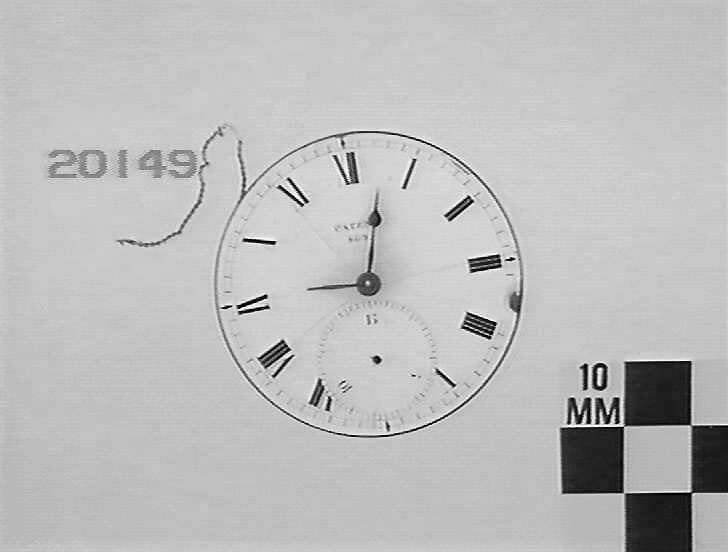
This gents pocket watch movement, bearing the serial number 869, was produced by Morris Tobias & Co in London, circa 1800. The movement features a key-wound mechanism, a fusee and chain, and a rack lever escapement. The construction includes an enamel dial displaying black Roman numerals and a subsidiary seconds dial positioned at 6 o'clock. Inscriptions on the back plate include "Morris Tobias Hos, London, no. 869, Patent" and a decorative design, while the works cover is marked "Tobias, Hos, Patent." The object is part of a collection of movements donated by Ingram Brothers in 1937, which were preserved after their original cases were melted for bullion value during the 1930s. The movement measures approximately 4.7 cm in diameter and 1.7 cm in width.

Rear view of the pocket watch movement, showing the ornate engraving and the inscription 'Morris Tobias Hos, London, no. 869, Patent' on the back plate.
Rear view of the pocket watch movement, showing the ornate engraving and the inscription 'Morris Tobias Hos, London, no. 869, Patent' on the back plate. — Museums Victoria. Rights pending — permission not yet requested. Original source

Catalogue identity

Source
collections.museumsvictoria.com.au
Category
Movement · Pocket watch movement
Maker / attribution
Morris Tobias & Co
Reference
Not recorded
Catalogue / lot identifier
ST 20149
Source-reported date
circa 1800
Source-reported place
England
Source-reported serial
869

Source-reported attribution and specifications are not independent authentication. A listing does not establish present ownership, current display, availability or permission to reproduce.

Object description

Mechanical Construction

The movement is a key-wound mechanism utilizing a fusee and chain for power distribution. The escapement is specified as a rack lever type. The overall diameter of the movement is 4.7 cm, with a thickness of 1.7 cm. The inclusion of a fusee indicates the use of a device to equalize the force delivered from the mainspring as it unwinds.

The white enamel dial is marked with black Roman numerals for the hours and features a subsidiary dial for seconds at the 6 o'clock position. The movement includes a scale for rate adjustment, denoted as fast to slow.

Evidence for this section
  • “Key wound spring; rack lever escapement. Fusee and chain. Scale fast to slow.”
  • “White enamel dial has black roman numerals and seconds dial at 6.”

Inscriptions and Marks

The movement is identified by the serial number 869, which appears on the dial and the back plate. The back plate is decorated with an ornate design and bears the inscription "Morris Tobias Hos, London, no. 869, Patent". The works cover provides further information with the mark "Tobias, Hos, Patent".

The significance of the term 'Hos' and the specific patent referenced on the movement are not further elaborated in the documentation provided by the source, though the presence of the number 869 serves as a clear identifier for this specific piece.

Evidence for this section
  • “Back plate has ornate design and is inscribed 'Morris Tobias Hos, London, no. 869, Patent'. Works cover is marked 'Tobias, Hos, Patent'. Dial is marked 'Patent 869'.”

Provenance and History

This movement was acquired by the museum via a donation from J. Ingram on February 18, 1937. It was part of a group of watch movements provided by Ingram Brothers, who were jewelers.

While the jeweler melted down the cases for the value of the precious metals, the firm opted to retain the movements of watches considered to be of historical interest, thereby preserving them from destruction.

Evidence for this section
  • “One of several watch movements donated by Ingram Brothers jewelers in 1937.”
  • “Ingrams (and other jewelers) melted down the cases to sell the metal, but kept the movements of historically interesting watches.”

Open research questions

  • What is the historical significance or technical detail associated with the 'Patent' designation on this specific Tobias movement?
  • What does the abbreviation 'Hos' in the engraving refer to in the context of late 18th or early 19th-century London watchmaking?

Source evidence

Recorded claims and source quotations for Morris Tobias & Co Pocket Watch Movement
FieldSource-reported valueSource quotation
MakerMorris Tobias & Co“Morris Tobias & Co”
Serial Number869“no 869”
Datecirca 1800“circa 1800”
EscapementRack lever“rack lever escapement”
Movement detailsKey wound with fusee and chain“Key wound spring; rack lever escapement. Fusee and chain.”
InscriptionsMorris Tobias Hos, London, no. 869, Patent“Back plate has ornate design and is inscribed 'Morris Tobias Hos, London, no. 869, Patent'”
ProvenanceDonation from J. Ingram, 1937“Donation from J. Ingram, 18 Feb 1937”

Visible details

  • Enamel dial with seconds sub-dial
  • Rack lever escapement assembly visible
  • Fusee chain tension mechanism
  • Ornate engraving on back plate

Research qualifications

  • Interpretation of the abbreviation 'Hos' in the inscription is not defined
  • Specific function of the patent indicated on the movement is not detailed

Photograph identity and source facts were screened before import; rights clearance remains pending.

Consulted source

Pocket Watch Movement - Morris Tobias & Co, London, circa 1800.

Reviewed 2026-10-26 · Record 8ba24457d8

Terms in this record

Glossary explanations for terms named in this object’s record.