
Skip to content
The Encyclopedia of Horology

Clock · Longcase regulator clock

Month-Going Regulator Clock

Partially verified

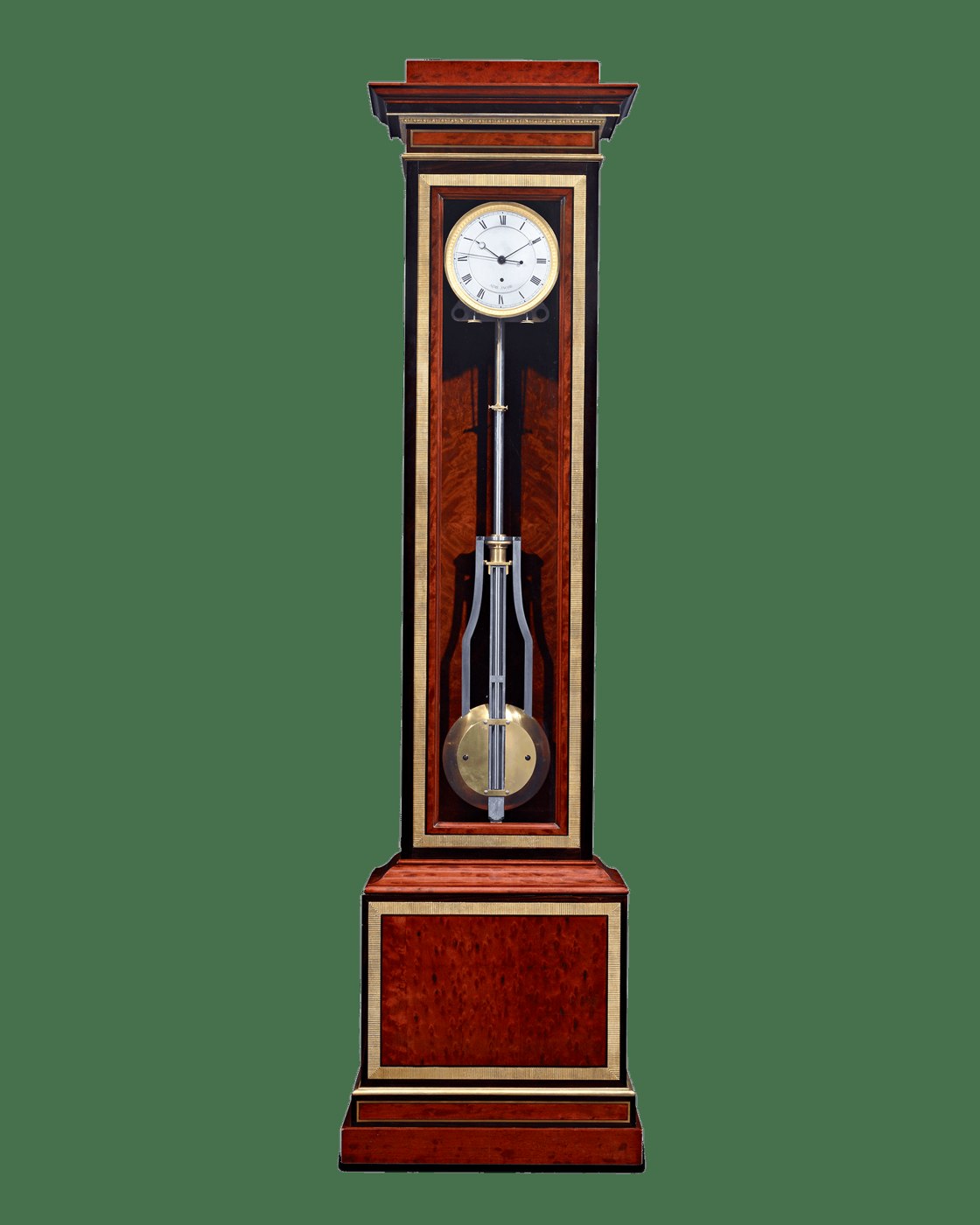
This month-going regulator clock is constructed with a weight-driven movement featuring a deadbeat Graham escapement. Signed by the French horologist Jean-Aimé Jacob, the movement is housed within a tall case crafted from plum pudding mahogany. The case architecture incorporates ebony and gilded metal accents, a design characteristic attributed to the atelier of the ébéniste Adam Weisweiler. The clock measures approximately 22 3/4 inches in width, 12 5/8 inches in depth, and 84 1/2 inches in height. Designed for high-precision timekeeping, the regulator follows an architectural style associated with neoclassical cabinetmaking. It stands on a pedestal base with a full-length glazed door allowing for a view of the internal pendulum mechanism and dial. The piece dates to circa 1830, a period following the active years of the senior Weisweiler, whose workshop continued operation under the direction of his son until 1844.

Full-length view of the month-going regulator clock in its plum pudding mahogany and gilded case.
Full-length view of the month-going regulator clock in its plum pudding mahogany and gilded case. — M.S. Rau. Rights pending — permission not yet requested. Original source

Catalogue identity

Source
rauantiques.com
Category
Clock · Longcase regulator clock
Maker / attribution
Jean-Aimé Jacob
Reference
Not recorded
Catalogue / lot identifier
Source URL identifies the listing
Source-reported date
circa 1830
Source-reported place
France

Source-reported attribution and specifications are not independent authentication. A listing does not establish present ownership, current display, availability or permission to reproduce.

Object description

Movement and Mechanism

The clock is built as a weight-driven regulator intended for long-term timekeeping, specifically designed to function for one month on a single winding. A primary feature of the mechanical construction is the inclusion of a deadbeat, or Graham, escapement. This mechanism is intended to eliminate the recoil associated with anchor escapements, thereby increasing the precision of the timekeeping.

The movement is signed by the horologist Jean-Aimé Jacob. Regulator clocks of this configuration were originally produced to serve as reference instruments in public and government buildings, facilitating the calibration of other horological objects. The mechanical components are housed behind a full-length glass door, providing a view of the pendulum and weight system.

Evidence for this section
  • “features a weight-driven movement with a deadbeat, or “Graham,” escapement”
  • “Crafted and signed by Jean-Aimé Jacob”
  • “Once primarily found in prominent public and government buildings, regulator clocks have been the most accurate of the weight-driven clocks”

Cabinetry and Design

The exterior case is constructed from plum pudding mahogany, a material noted for its mottled finish. The design incorporates ebony and gilded metal accents to complement the mahogany surfaces. The structure is built in a tall, neoclassical form that features a rectangular base and a tall glazed trunk to house the pendulum.

The case is attributed to the atelier of Adam Weisweiler. While the senior Weisweiler was an ébéniste active during the Louis XVI period, his workshop continued under the management of his son until 1844. The design aesthetic reflects styles established by the elder Weisweiler, who was known for creations favored by the French court and European aristocracy.

The proportions of the case utilize ebony and gilded trim to accentuate the architectural lines of the clock. This construction is described as being consistent with neoclassical furniture production methods associated with the Weisweiler workshop.

Evidence for this section
  • “case is attributed to the atelier of Adam Weisweiler”
  • “The incorporation of ebony and gilded accents is also typical of his work”
  • “This clock case typifies the ebony and gilded neoclassical aesthetics”

Context and Attribution

The clock is dated to circa 1830. The attribution of the case to the Weisweiler workshop aligns with the historical output of that firm, which maintained a reputation for the use of high-quality materials and precise construction.

Regulator clocks were produced in limited numbers due to the high cost associated with their mechanical complexity. As keepers of time, they were essential tools for institutional and scientific settings. This specific regulator is categorized as a mechanical object that retains the characteristics of precision horology prevalent in the early 19th century.

Evidence for this section
  • “Circa 1830”
  • “Today, Weisweiler’s furniture can be found in all of the most important museums around the world”

Open research questions

  • What is the specific movement serial number, if present on the backplate or plates?
  • Are there secondary marks or stamps on the mahogany case, such as a signature or inventory mark associated with the Weisweiler atelier?

Source evidence

Recorded claims and source quotations for Month-Going Regulator Clock
FieldSource-reported valueSource quotation
MakerJean-Aimé Jacob“Crafted and signed by Jean-Aimé Jacob”
EscapementDeadbeat“features a weight-driven movement with a deadbeat, or “Graham,” escapement”
CabinetmakerAttributed to Adam Weisweiler atelier“the case is attributed to the atelier of Adam Weisweiler”
DateCirca 1830“Circa 1830”
Dimensions22 3/4" x 12 5/8" x 84 1/2"“22 3/4" wide x 12 5/8" deep x 84 1/2" high”

Visible details

  • Dial signed 'Aimé Jacob'
  • Glazed longcase front panel
  • Deadbeat or 'Graham' escapement mechanism
  • Plum pudding mahogany veneer with ebony and gilded accents

Research qualifications

  • Case attribution to the atelier of Adam Weisweiler remains a suggestion rather than a confirmed provenance
  • The source suggests the clock type follows styles that 'prevailed during the last decades of the Ancien Régime', despite the date of circa 1830

Photograph identity and source facts were screened before import; rights clearance remains pending.

Consulted source

رگولاتور ژان امه ژاکوب و آدام وایس‌وایلر

Reviewed 2026-11-02 · Record fe7e0a8dd4

Terms in this record

Glossary explanations for terms named in this object’s record.