
Skip to content
The Encyclopedia of Horology

Clock · Longcase regulator clock

Scottish Late Regency Mahogany Longcase Regulator Clock by William Anderson

Partially verified

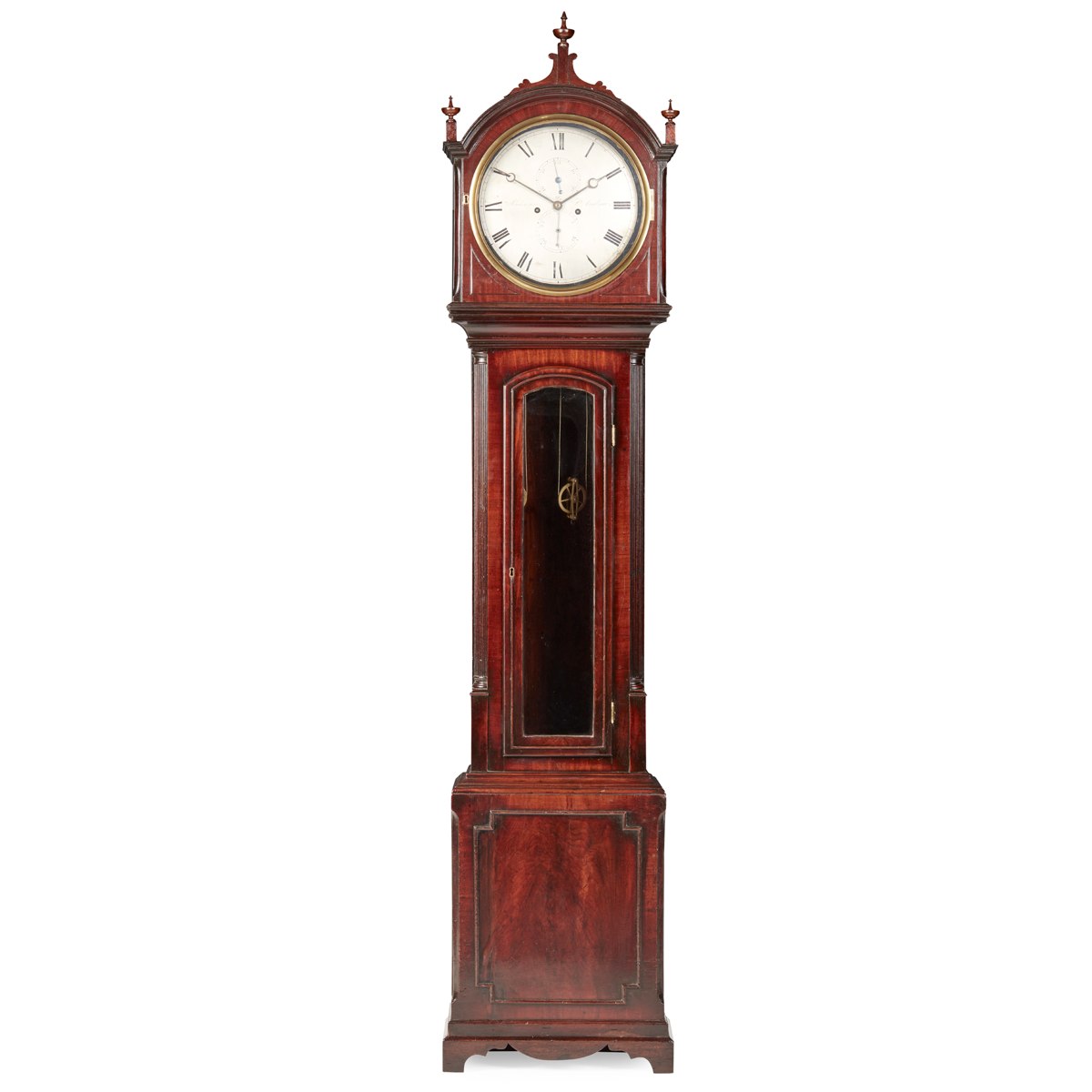
This Scottish late Regency mahogany longcase regulator clock is documented by the auction source as being made by William Anderson of St Andrews, dating to the early 19th century. The breakarch hood is surmounted by three turned urn finials and houses a 12-inch silvered circular dial displaying Roman numerals, moon hands, and subsidiary dials for seconds and date. The mahogany case features an arched glazed trunk door flanked by fluted quarter columns over a panelled plinth base with bracket feet. According to the source, the clock is driven by a twin-train movement with an anchor escapement striking on a bell.

Front view of the Scottish late Regency mahogany longcase regulator clock by William Anderson
Front view of the Scottish late Regency mahogany longcase regulator clock by William Anderson — Lyon & Turnbull. Rights pending — permission not yet requested. Original source

Catalogue identity

Source
www.lyonandturnbull.com
Category
Clock · Longcase regulator clock
Maker / attribution
William Anderson
Reference
Not recorded
Catalogue / lot identifier
157
Source-reported date
Early 19th century
Source-reported place
Scotland

Source-reported attribution and specifications are not independent authentication. A listing does not establish present ownership, current display, availability or permission to reproduce.

Object description

Case Construction

The mahogany case features a breakarch hood topped by three turned urn finials. The trunk includes an arched glazed door flanked by fluted quarter columns, and the structure sits on a panelled plinth base with bracket feet.

Visual observations confirm the presence of these architectural elements, with the glazed section of the trunk exposing the pendulum rod and bob.

Evidence for this section
  • “the breakarch hood surmounted by three turned urn finials”
  • “the trunk with glazed arched door and moulding, flanked by fluted quarter columns, on a panelled plinth base with bracket feet”

Dial Configuration

The clock houses a 12-inch silvered circular dial featuring Roman numerals. Additional features include subsidiary dials for seconds and date, and moon hands.

The dial is described by the source as signed 'Anderson, St. Andrews'.

Evidence for this section
  • “enclosing a 12 inch silvered circular dial with Roman numerals, subsidiary second and date dials, signed ‘Anderson, St. Andrews’, with moon hands”

Mechanism and Attribution

The clock is attributed to William Anderson of St Andrews. The internal movement is described by the source as a twin-train movement with an anchor escapement striking a bell.

These internal mechanical details are not visible in the provided imagery.

Evidence for this section
  • “the twin- train movement with anchor escapement, striking a bell”
  • “BY WILLIAM ANDERSON, ST ANDREWS”

Open research questions

  • Does the serial or internal cabinet marking verify the specific production date within Anderson's working life?
  • Is the silvered dial original to the movement, or does it show evidence of later refurbishment or replacement?

Source evidence

Recorded claims and source quotations for Scottish Late Regency Mahogany Longcase Regulator Clock by William Anderson
FieldSource-reported valueSource quotation
MakerWilliam Anderson, St Andrews“BY WILLIAM ANDERSON, ST ANDREWS”
PeriodEarly 19th Century“EARLY 19TH CENTURY”
Dial description12 inch silvered circular dial signed 'Anderson, St. Andrews'“12 inch silvered circular dial with Roman numerals, subsidiary second and date dials, signed ‘Anderson, St. Andrews’”
MovementTwin-train movement with anchor escapement, striking a bell“the twin- train movement with anchor escapement, striking a bell”
Dimensions214cm high, 44cm wide, 23cm deep“214cm high, 44cm wide, 23cm deep”
Dated EraEarly 19th century“EARLY 19TH CENTURY”
Maker DetailsWilliam Anderson (1790-1867), watchmaker and dentist of South Street, St Andrews“William Anderson was born 1790 and died 1867. His place of business is listed as South Street, St Andrews. In trade listing he is mentioned as a watchmaker and dentist.”

Visible details

  • Full frontal view of a tall mahogany longcase clock with an arched pediment.
  • The breakarch hood is surmounted by three turned finials.
  • A circular silvered dial is visible behind the hood door glass with Roman hour numerals.
  • The trunk features a long arched glazed door exposing the internal pendulum rod and bob.
  • Fluted quarter columns flank the glazed section of the trunk.
  • The lower case consists of a panelled rectangular plinth resting on shaped bracket feet.

Research qualifications

  • Internal movement details, escapement, and bell strike mechanism are reported by the auction house and not visible in the exterior photograph.
  • Dial signature 'Anderson, St. Andrews' is stated by the source but difficult to read clearly at this resolution.

Photograph identity and source facts were screened before import; rights clearance remains pending.

Terms in this record

Glossary explanations for terms named in this object’s record.