
Skip to content
The Encyclopedia of Horology

Clock · Longcase regulator clock

Regulator Clock

Partially verified

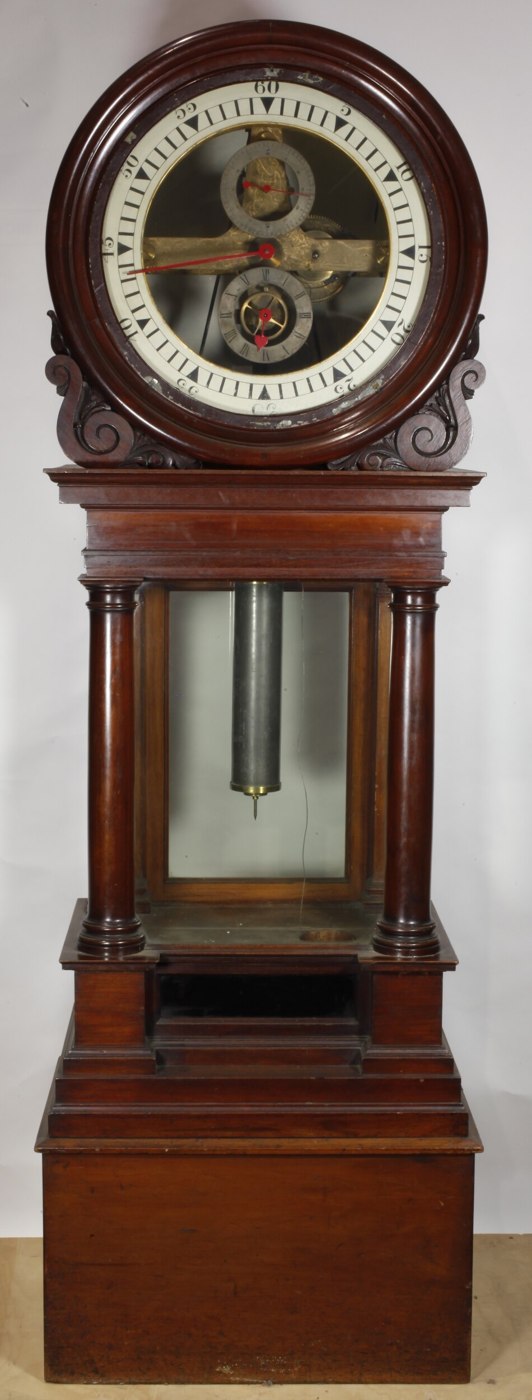
This longcase regulator clock dates to the late 19th century, with an attributed date of circa 1890 in Australia. The clock features a central mechanism housed in a cylindrical case, which is fronted by glass to expose the internal movement and dial. This cylindrical component rests upon a trunk constructed from four wooden columns, featuring glass panels on the front, back, and sides to reveal the pendulum. The circular dial assembly includes a wooden frame decorated with carved scrollwork. The dial configuration utilizes enamel chapter rings, presenting Arabic numerals for the minute track and Roman numerals for the hours. The entire structure measures 227 cm in height, 50 cm in width, and 76 cm in length.

Full-length view of the longcase regulator clock showing the cylindrical dial housing, glazed trunk, and internal pendulum.
Full-length view of the longcase regulator clock showing the cylindrical dial housing, glazed trunk, and internal pendulum. — Museums Victoria. Rights pending — permission not yet requested. Original source

Catalogue identity

Source
collections.museumsvictoria.com.au
Category
Clock · Longcase regulator clock
Maker / attribution
Not established
Reference
Not recorded
Catalogue / lot identifier
ST 19123
Source-reported date
circa 1890
Source-reported place
Australia

Source-reported attribution and specifications are not independent authentication. A listing does not establish present ownership, current display, availability or permission to reproduce.

Object description

Case Construction and Design

The clock is housed in a distinct structural arrangement centered around a cylindrical case. This section is fitted with glass at one end, which provides an unobstructed view of the internal mechanism and the dial face.

The support system for this cylindrical housing consists of a trunk featuring four wooden columns. The sides, front, and back of this trunk are glazed, allowing for visibility of the pendulum assembly within the clock body. The dial is held by a circular wooden frame, which is embellished with carved scroll motifs at its base.

Evidence for this section
  • “Mechanism of clock mounted in cylindrical case with glass at one end to reveal dial and mechanism.”
  • “Cylindrical case supported by trunk consisting of four wooden columns with glass front, back and sides.”
  • “Dial has round wooden frame with carved scrolls supporting it.”

Dial and Timekeeping Display

The display is composed of enamel chapter rings that distinguish between different units of time. Minutes are marked using Arabic numerals on the outer ring, while hours are indicated via Roman numerals on a smaller, secondary ring located within the main assembly.

The dial is positioned within a circular wooden frame, allowing the underlying mechanical components to remain visible to the viewer through the glass front. The arrangement of the numerals and the integration of the escapement and timekeeping elements within the central housing define the regulator function of the piece.

Evidence for this section
  • “Enamel chapter rings for minutes (arabic) and hours (roman).”
  • “Dial has round wooden frame with carved scrolls supporting it.”

Origins and Acquisition

The clock is attributed to Australian manufacture during the late 19th century, specifically dating to circa 1890.

The object entered the institutional collection through a loan followed by a bequest from Mr. John Askew, recorded on 6 December 1929.

Evidence for this section
  • “Association: type: Place & Date Made, date: circa 1890, country: Australia”
  • “Possible that the escapement was imported from England and that the other parts were made in Australia.”
  • “Acquisition: Loan & Subsequent Bequest from Mr John Askew, 06 Dec 1929”

Open research questions

  • What is the origin of the escapement mechanism?
  • Are there any maker's marks located on the internal movement or dial plate?

Source evidence

Recorded claims and source quotations for Regulator Clock
FieldSource-reported valueSource quotation
Registration numberST 19123“ST 19123”
Dimensions76 cm (Length), 50 cm (Width), 227 cm (Height)“76 cm (Length), 50 cm (Width), 227 cm (Height)”
Datecirca 1890“circa 1890”
CountryAustralia“country: Australia”
Dial detailsEnamel chapter rings for minutes (arabic) and hours (roman)“Enamel chapter rings for minutes (arabic) and hours (roman).”
Construction theoryPossible importation of escapement“Possible that the escapement was imported from England and that the other parts were made in Australia.”

Visible details

  • Enamel chapter rings showing Arabic and Roman numerals
  • Four wooden columns forming the trunk section
  • Central cylindrical housing for the mechanism
  • Pendulum visible within the glazed trunk

Research qualifications

  • Possible non-Australian origin for the escapement mechanism
  • Unverified original construction or assembly date beyond the circa 1890 attribution

Photograph identity and source facts were screened before import; rights clearance remains pending.

Consulted source

Regulator Clock - Australia, Late 19th Century

Reviewed 2026-10-26 · Record 05f1d80154

Terms in this record

Glossary explanations for terms named in this object’s record.