
Skip to content
The Encyclopedia of Horology

Clock · Library clock

Molyneux English Five-Glass Library Clock

Partially verified

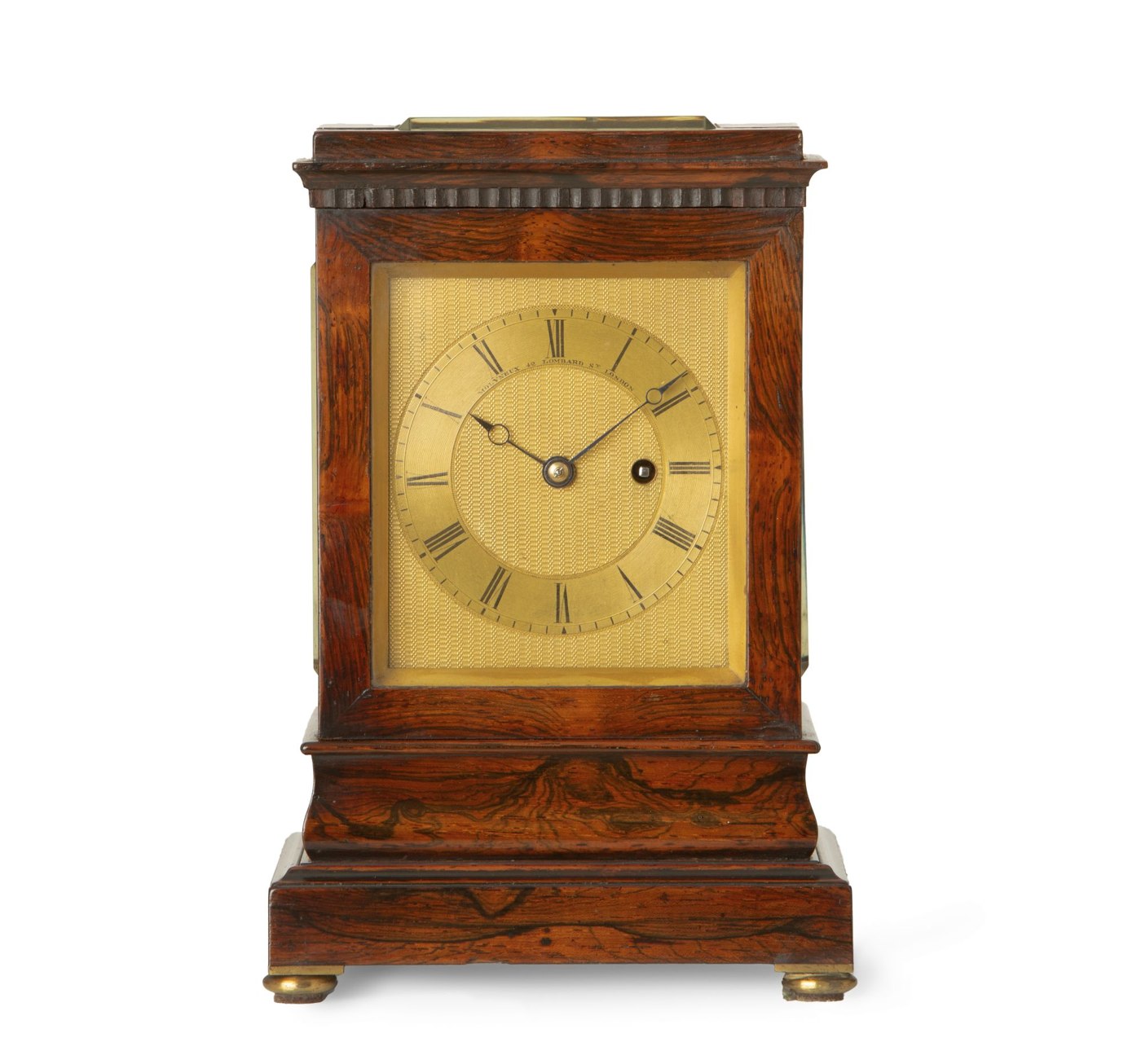
This rosewood library clock, described as an 'English Five Glass' timepiece, is attributed to the maker Robert Molyneux of 42 Lombard Street, London, and dates to circa 1835. The clock features a single-chain fusee movement equipped with Harrison's maintaining power and a jewelled, oversized English lever platform escapement with a monometallic balance. The timepiece is housed in a rosewood case, characterized by a rippled corniche, a large bevelled glass observation window positioned on the top, and glazed side panels, all resting on a moulded base with adjustable brass feet. The 3 ¾-inch brass dial is engine-turned and displays Roman numerals, accompanied by blued steel moon hands and a brass sight ring. The back plate bears the signature of Molyneux. The object was formerly held in a private collection in the United Kingdom and is noted as having been photographed prior to restoration.

Front view of the rosewood library clock showing the engine-turned dial and Roman numerals.
Front view of the rosewood library clock showing the engine-turned dial and Roman numerals. — Dorset Antique Clocks. Rights pending — permission not yet requested. Original source

Catalogue identity

Source
www.dorsetantiqueclocks.co.uk
Category
Clock · Library clock
Maker / attribution
Robert Molyneux
Reference
Not recorded
Catalogue / lot identifier
Source URL identifies the listing
Source-reported date
circa 1835
Source-reported place
London, England

Source-reported attribution and specifications are not independent authentication. A listing does not establish present ownership, current display, availability or permission to reproduce.

Object description

Movement and Escapement

The clock is powered by a high-quality single-chain fusee movement. This mechanism incorporates Harrison's maintaining power, a feature designed to keep the clock running during the winding process. The regulation is managed by a jewelled, oversized English lever platform escapement, which operates in conjunction with a monometallic balance wheel.

The movement is signed on the back plate, reading 'Molyneux 42 Lombard Street London'. This indicates the involvement of Robert Molyneux, a maker who was apprenticed to Thomas Earnshaw and who had a professional history of specializing in the production of escapements for other horological firms.

Evidence for this section
  • “high-quality single-chain fusee movement with Harrisons maintaining power”
  • “jewelled oversized English lever platform escapement and monometallic balance”
  • “back plate also engraved ‘Molyneux 42 Lombard Street London’”

Case and Dial

The rosewood case is constructed in the 'English five glass' style, featuring glazed side panels and a large bevelled glass window on the top, which allows a view of the platform escapement. The structure is accented by a stepped top and a rippled corniche, supported by a large moulded base equipped with adjustable brass feet.

The 3 ¾-inch brass dial is finished with engine turning and displays engraved Roman numerals. It is signed 'Molyneux 42 Lombard St London' and fitted with original finely cut blued steel moon hands. The dial is framed by a brass sight ring, completing the presentation of the timepiece.

Evidence for this section
  • “small rosewood case has a large bevelled glass escapement observation window to the top, framed by a stepped top and rippled corniche over glazed sides”
  • “3 ¾” brass engine turned dial featuring engraved Roman numerals and signed ‘Molyneux 42 Lombard St London’”
  • “original finely cut blued steel moon hands and brass sight ring”

Provenance and Documentation

The object originated from a private collection in the United Kingdom. The provided documentation notes that the available photographs were taken prior to the clock undergoing a restoration process in the workshop of the retailer.

Robert Molyneux, the maker, is noted as having been active in the early 19th century. Records indicate his professional engagement with the Board of Longitude in 1805 regarding chronometers submitted by Thomas Earnshaw and John Arnold, which serves as a biographical detail regarding the maker's reputation during his working life.

Evidence for this section
  • “Provenance: Private collection – U.K.”
  • “Pictures taken pre-restoration”
  • “In 1805, Molyneux was asked to comment on chronometers submitted to the Board of Longitude”

Open research questions

  • What is the specific connection between the workshop of Robert Molyneux and the 'five glass' library clock design?
  • Are there extant records of Molyneux's serial numbering for carriage or library clocks during the 1830s to further narrow the date?

Source evidence

Recorded claims and source quotations for Molyneux English Five-Glass Library Clock
FieldSource-reported valueSource quotation
MakerRobert Molyneux“Molyneux 42 Lombard Street London”
Movement typeSingle-chain fusee“single-chain fusee movement”
EscapementEnglish lever platform escapement“jewelled oversized English lever platform escapement”
Dial size3 3/4 inch“3 ¾” brass engine turned dial”
DatingCirca 1835“CIRCA. 1835”
Case materialRosewood“The small rosewood case”
ProvenancePrivate collection, UK“Provenance: Private collection – U.K.”

Visible details

  • Large bevelled glass escapement observation window on top
  • Engine-turned brass dial with engraved Roman numerals
  • Rippled corniche detail under the top moulding
  • Adjustable brass feet on a moulded base

Research qualifications

  • Exact manufacturing date is an approximation (circa 1835)
  • Attribution to Molyneux is based on signature on dial and back plate

Photograph identity and source facts were screened before import; rights clearance remains pending.

Consulted source

A SMALL ROSEWOOD TIMEPIECE ‘ENGLISH FIVE GLASS’ LIBRARY CLOCK

Reviewed 2026-11-02 · Record b4cb0b7671

Terms in this record

Glossary explanations for terms named in this object’s record.