
Skip to content
The Encyclopedia of Horology

Clock · Mantel clock

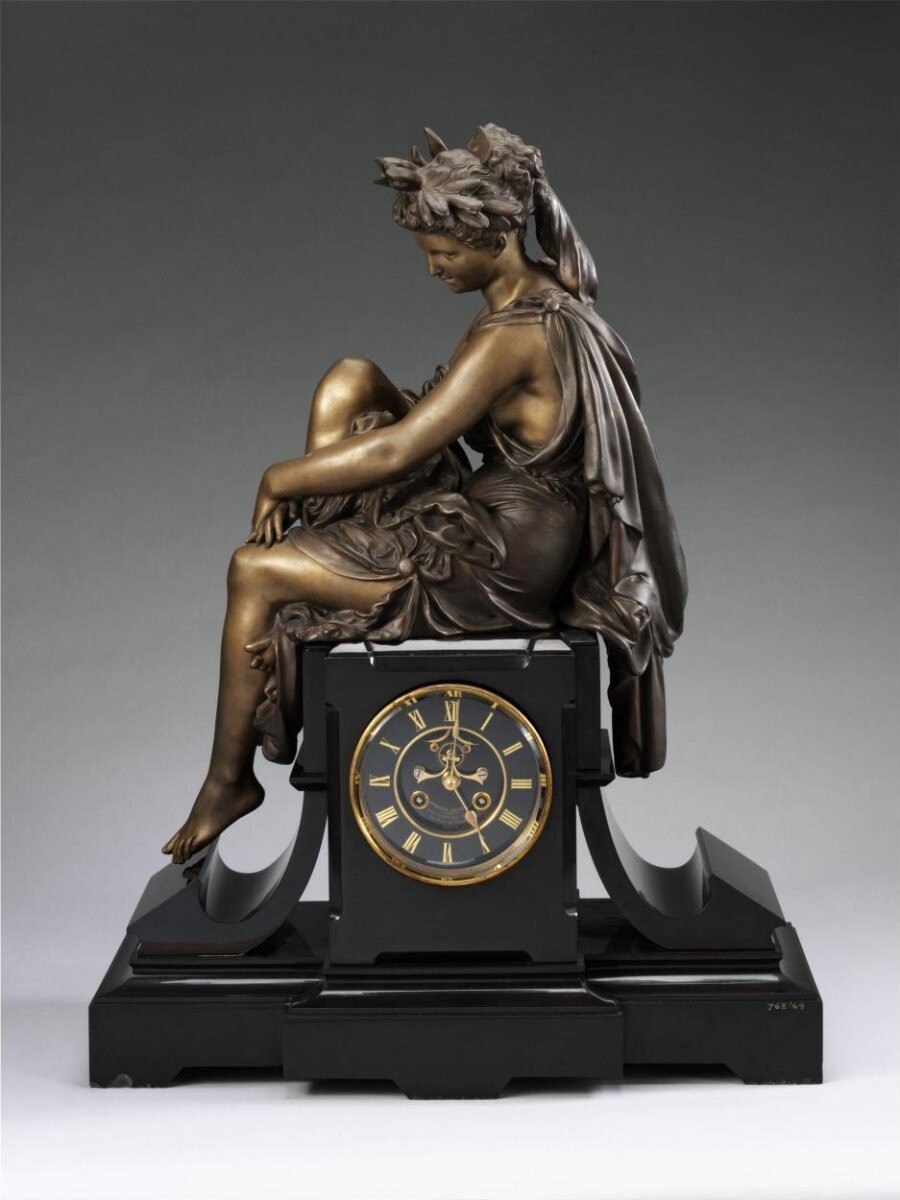
Mantel clock with Contemplation figure

Partially verified

This mantel clock, dating to the 1860s, features a seated female figure representing 'Contemplation' crafted in imitation bronze, mounted atop a black marble case. The piece was designed by Albert Carrier-Belleuse and features a clock movement produced by the firm Boy, Ranvier & Cie, based at 116 Rue de Turenne, Paris. The clock was purchased by the Victoria and Albert Museum at the 1867 Paris International Exhibition. The dial measures 12 cm in diameter and displays a black enamel chapter ring with applied gilt-metal Roman numerals. The movement includes a Brocot-type regulator, though the pendulum is missing. The striking train utilizes an external locking plate and count-wheel mechanism, with a bell mounted to the exterior of the backplate.

Full view of the mantel clock showing the Contemplation figure and the dial layout.
Full view of the mantel clock showing the Contemplation figure and the dial layout. — Victoria and Albert Museum, London. Rights pending — permission not yet requested. Original source

Catalogue identity

Source
collections.vam.ac.uk
Category
Clock · Mantel clock
Maker / attribution
Albert Carrier-Belleuse (designer); Boy, Ranvier & Cie (clockmakers)
Reference
Not recorded
Catalogue / lot identifier
763:1, 2-1869
Source-reported date
1860s
Source-reported place
France

Source-reported attribution and specifications are not independent authentication. A listing does not establish present ownership, current display, availability or permission to reproduce.

Object description

Design and Construction

The clock is composed of a seated female figure cast in imitation bronze, which represents 'Contemplation'. This figure sits upon a base constructed of black marble. The design is attributed to Albert Carrier-Belleuse, a prominent figure who worked in various materials and briefly in England before the production of this piece.

The use of 'imitation bronze' for the sculptural element rather than traditional solid bronze indicates a focus on commercial accessibility and production efficiency during the mid-19th century industrial period.

Evidence for this section
  • “Clock comprising female figure of 'Contemplation' in imitation bronze seated on a clock mounted in black marble.”
  • “Bought at the Paris International Exhibition, 1867, for £18-0s-0d from Messrs Boy as an example of cheapness of manufacture.”

Movement and Dial

The dial is 12 cm in diameter, featuring a 2.2 cm wide black enamel chapter ring with applied gilt-metal Roman numerals. The recessed center of the dial shows the signature of the makers, Boy, Ranvier & Cie. A visible Brocot escapement is positioned in the upper area of the recessed dial, characterized by a cock with curved gilt arms and jewelled pallets.

The movement includes two going barrels and a regulator of the Brocot type, although the pendulum is no longer present. The striking train is controlled by an external locking plate and count-wheel, which allows for a single stroke at the half-hours. A bell is mounted to the exterior of the backplate to signal the hours and half-hours.

Evidence for this section
  • “DIAL: 12 cm diameter with recessed centre”
  • “In the upper part of the recessed area a visible Brocot escapement”
  • “Regulator of Brocot type but pendulum missing.”
  • “Locking-plate, striking train, with outside count-wheel”

Signatures and Acquisition

The dial bears a detailed inscription identifying the makers and the context of the clock's presentation: 'EXPOSITION UNIVERSELLE BOY, RANVIER & CIE, 116 Rue de Turenne PARIS FT A PARIS 1867'. This mark identifies the clock as part of the items associated with the Paris Universal Exhibition of 1867.

This purchase was recorded in the Art Inventory of the time, noting the firm of Messrs Boy as the sellers and emphasizing the clock's function as a representative example of manufactured goods available at the exhibition.

Evidence for this section
  • “EXPOSITION UNIVERSELLE BOY, RANVIER & CIE, 116 Rue de Turenne PARIS FT A PARIS 1867”
  • “Bought at the Paris International Exhibition, 1867, for £18-0s-0d from Messrs Boy”

Open research questions

  • What specific material constitutes 'imitation bronze' used in this casting?
  • Can the missing pendulum be reconstructed based on records of Brocot-type clocks by Boy, Ranvier & Cie from 1867?

Source evidence

Recorded claims and source quotations for Mantel clock with Contemplation figure
FieldSource-reported valueSource quotation
MakerBoy, Ranvier & Cie“BOY, RANVIER & CIE, 116 Rue de Turenne PARIS”
DesignerAlbert Carrier-Belleuse“designed by Carrier-Belleuse”
Accession Number763:1, 2-1869“763:1, 2-1869”
Place of ManufactureParis, France“FT A PARIS”
ProvenancePurchased at Paris International Exhibition 1867“Bought at the Paris International Exhibition, 1867, for £18-0s-0d from Messrs Boy”

Visible details

  • Seated female figure in imitation bronze
  • Applied gilt Roman numerals on black enamel ring
  • Visible Brocot escapement on the dial
  • Bell mounted to the rear of the movement

Research qualifications

  • Pendulum is missing
  • Imitation bronze composition is reported, rather than solid bronze

Photograph identity and source facts were screened before import; rights clearance remains pending.

Terms in this record

Glossary explanations for terms named in this object’s record.