
Skip to content
The Encyclopedia of Horology

Clock · Lyre clock

Louis XVI Lyre Clock

Partially verified

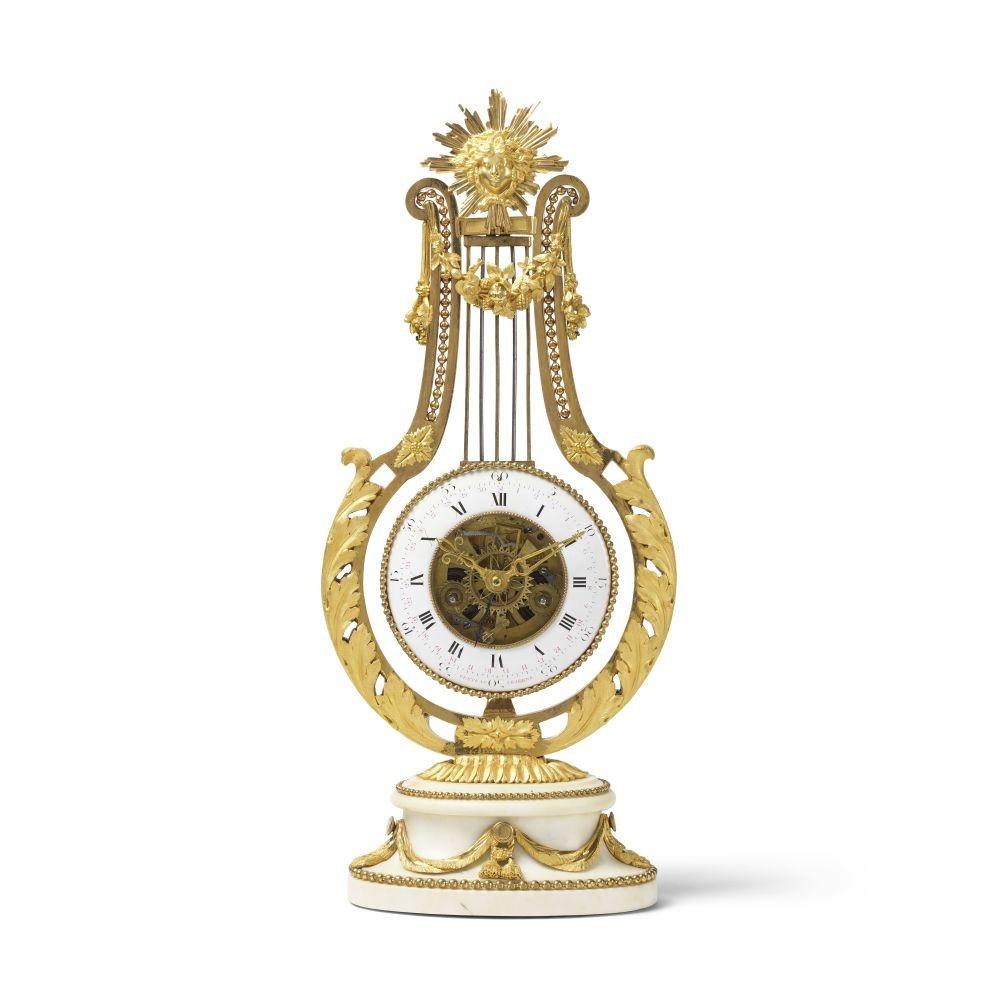
This late 18th-century lyre clock features a white marble and ormolu case, characterized by a radiating motif at the top of the lyre structure flanked by acanthus foliage. The clock rests upon an oval, stepped white marble base decorated with ormolu mounts and draped motifs. The central white enamel dial displays Roman numerals and Arabic five-minute markers, featuring a skeletonized center that reveals a decorated calendar wheel. The movement is a twin-train mechanism with an anchor escapement that strikes the hours and half-hours on a polished bell via an external count wheel located on the backplate. The clock is suspended by a silk thread. The maker is identified as Festeau LeJeune, with the signature appearing at the base of the dial. The dimensions are approximately 49cm high, 21cm wide, and 12.5cm deep. The auction house notes the gilding has been refreshed.

Front view of the Louis XVI lyre clock featuring a white enamel dial and skeletonized center.
Front view of the Louis XVI lyre clock featuring a white enamel dial and skeletonized center. — Bonhams (via Invaluable). Rights pending — permission not yet requested. Original source

Catalogue identity

Source
www.invaluable.com
Category
Clock · Lyre clock
Maker / attribution
Pesteau Lejeune
Reference
Not recorded
Catalogue / lot identifier
122
Source-reported date
Late 18th century
Source-reported place
France

Source-reported attribution and specifications are not independent authentication. A listing does not establish present ownership, current display, availability or permission to reproduce.

Object description

Case and Dial Design

The clock is designed in the shape of a lyre, constructed from white marble and ormolu. The upper portion is surmounted by a radiating motif, while the sides are decorated with acanthus leaf foliage. The main body stands on an oval, stepped base crafted from white marble, which is further embellished with ormolu-mounted drapes.

The dial is white enamel, incorporating both Roman numerals and Arabic numerals for five-minute increments. The center is skeletonized, allowing visibility into a decorated calendar wheel. The timepiece uses gilt brass hands, accompanied by a blued steel hand specifically for the calendar function.

Evidence for this section
  • “The case surmounted by a radiating motif atop the lyre and flanked by acanthus upswept foliage, set on an ormolu-mounted oval stepped white marble base with drapings”
  • “the white enamel dial with Roman numerals, Arabic five minute markers and calendar, skeletonised centre revealing decorated calendar wheel, with finely finished gilt brass hands and a blued steel calendar hand”

Movement and Mechanism

The clock is powered by a twin-train movement equipped with an anchor escapement. It is designed to strike the hours and half-hours. The striking mechanism operates via an external count wheel, which is mounted directly to the backplate of the movement.

The assembly includes a polished bell and utilizes a silk thread suspension for the pendulum. According to the auction records, the clock was functioning at the time of inspection, though a full overhaul has been recommended for continued reliable use.

Evidence for this section
  • “the twin train movement with anchor escapement striking the hours and half hours via an external count wheel mounted to the backplate on a polished bell with silk suspension pendulum”
  • “currently ticking and striking.”

Provenance and Condition

The auction records include a documented history indicating that the clock was previously with Jordi Vergés in Barcelona as of March 13, 2003.

Regarding the current condition, the auction description reports that the case, dial, hands, and movement are in fair condition. The house notes that the gilding on the ormolu elements has been refreshed. The clock is confirmed to be ticking and striking at the time of reporting.

Evidence for this section
  • “Provenance Jordi Vergés, Barcelona, 13 March 2003.”
  • “the gilding refreshed”

Open research questions

  • What is the correct spelling of the maker's name, given the discrepancy between 'Festeau' and 'Pesteau' in the source text?
  • Are there any identifiable inventory marks that corroborate the 2003 provenance record?

Source evidence

Recorded claims and source quotations for Louis XVI Lyre Clock
FieldSource-reported valueSource quotation
MakerFesteau LeJeune“Festeau LeJeune”
Clock TypeLyre clock“Pendule lyre Louis XVI”
DateLate 18th century“A late 18th century Louis XVI ormolu and white marble lyre clock”
Dimensions49cm high, 21cm wide, 12.5cm deep“49cm high, 21cm wide, 12.5cm deep”
EscapementAnchor“twin train movement with anchor escapement”
SuspensionSilk thread“silk suspension pendulum”
SignatureBase of the dial“signed at the base of the dial Pesteau Lejeune”

Visible details

  • Radiating mask/motif atop the lyre
  • Skeletonized movement viewable through the dial
  • Silk thread suspension
  • External count wheel visible on the backplate assembly

Research qualifications

  • The source provides conflicting name spellings: 'Festeau LeJeune' and 'Pesteau Lejeune'.
  • The auction description reports the gilding is 'refreshed', but the full extent of restoration is not verified.

Photograph identity and source facts were screened before import; rights clearance remains pending.

Terms in this record

Glossary explanations for terms named in this object’s record.

Other lyre clock records