
Skip to content
The Encyclopedia of Horology

Clock · Lyre clock

Sèvres porcelain lyre clock

Partially verified

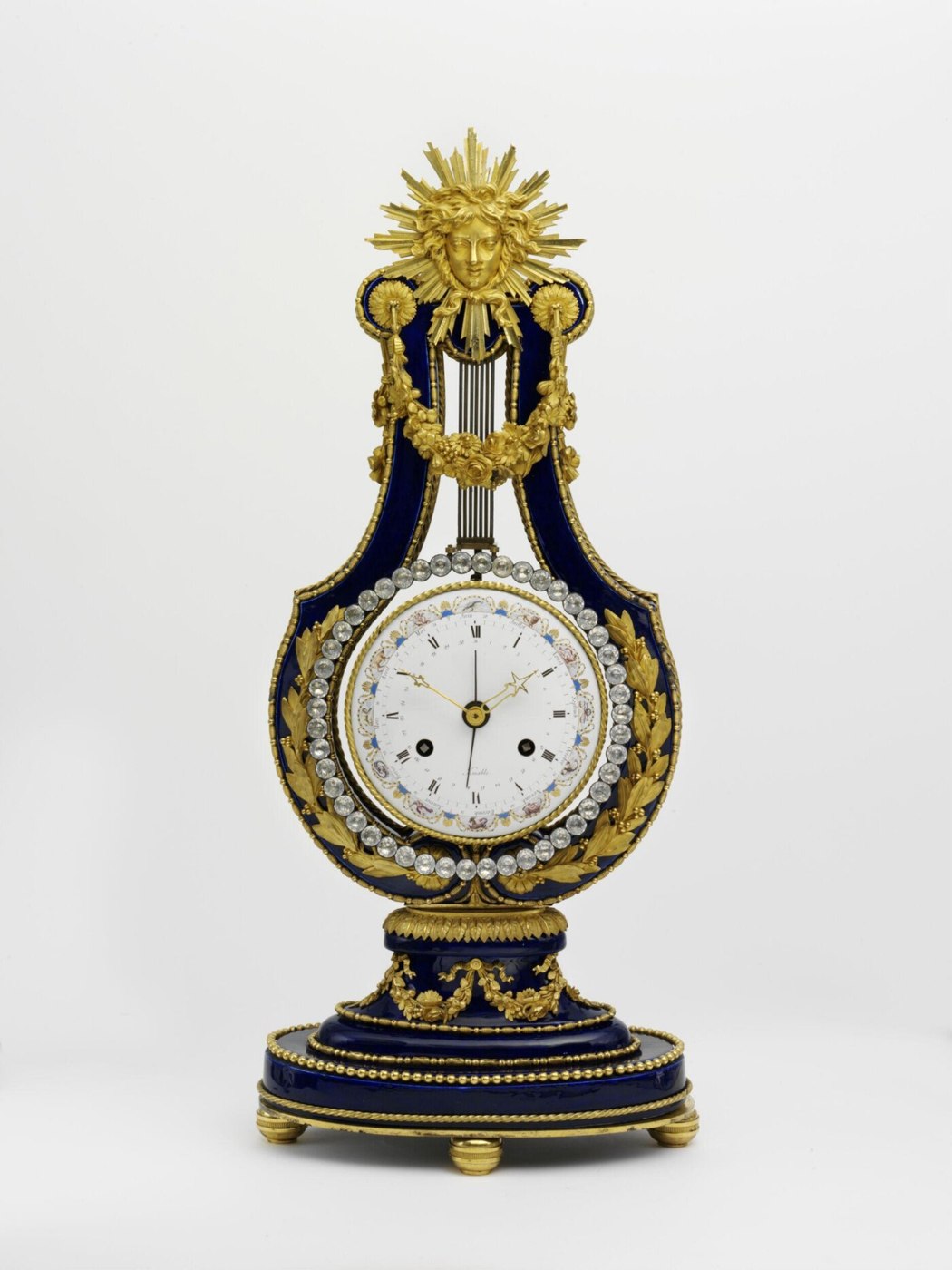
This lyre-shaped clock consists of a porcelain frame produced by the Sèvres porcelain factory in France between approximately 1795 and 1797. The case features a 'beau bleu' (deep blue) ground color and is decorated with chased ormolu mounts. The dial, signed 'Kinable' by the clockmaker Dieudonné Kinable, is painted in enamels with signs of the Zodiac by the enameller Cotteau. The clock display includes Roman numerals for hours, an inner ring for the day of the month, and names of months in French. The pendulum is constructed as a ring of paste diamonds suspended from a mock compensation pendulum composed of brass and steel rods. The circular movement utilizes going barrels and an Amant-type pin-wheel escapement.

Front view of the lyre clock, showing the enamel dial with Zodiac signs and the paste diamond ring pendulum.
Front view of the lyre clock, showing the enamel dial with Zodiac signs and the paste diamond ring pendulum. — Victoria and Albert Museum, London. Rights pending — permission not yet requested. Original source

Catalogue identity

Source
collections.vam.ac.uk
Category
Clock · Lyre clock
Maker / attribution
Sèvres porcelain factory
Reference
Not recorded
Catalogue / lot identifier
1004-1882
Source-reported date
ca. 1795-1797
Source-reported place
France

Source-reported attribution and specifications are not independent authentication. A listing does not establish present ownership, current display, availability or permission to reproduce.

Object description

Case and Dial Construction

The case body is executed in Sèvres porcelain with a distinctive deep blue ground color, known as 'beau bleu', which was developed at the manufactory in 1763. This ceramic frame is embellished with chased ormolu mounts and decorative garlands.

The dial markings provide a multi-functional display, including Roman hour numerals, an inner ring for the thirty-one days of the month, and the names of the months in French. The hour and minute hands are constructed from pierced brass, while the calendar-indicating hands are formed from steel, with one notable as partially broken.

Evidence for this section
  • “Clock with a porcelain frame case, lyre-shaped and blue ( beau bleu , developed at Sèvres in 1763) ground with chased ormolu mounts”
  • “the dial is signed 'Kinable' above VI”
  • “The hour and minute hands are pierced brass, the hands for the day of the month and annual calender steel; the latter hand has partly broken off.”

Movement and Escapement

The internal mechanism is housed on circular plates measuring 12.7cm in diameter. The clock utilizes going barrels for both the time and strike trains. The escapement is of the Amant-type pin-wheel variety. A striking train is included, featuring a locking-plate and an outside count-wheel, designed to provide a single stroke at the half-hour.

The pendulum assembly is visually prominent, featuring a ring of 47 paste diamonds set in copper cups suspended before the porcelain frame. This assembly is connected to a mock compensation pendulum made of four steel and three brass rods. The structure rests on knife-edges and includes a stirrup mechanism for vertical adjustment, with an upward crutch engaging the mock compensation rods via pins.

Evidence for this section
  • “The circular movement plates are 12.7cm diameter. Both trains have going barrels, with an Amant-type pin-wheel escapement.”
  • “The pendulum has a double bob, and at the front the ring of 47 paste diamonds each set in a thin copper cup”
  • “The locking-plate striking train, with an outside count-wheel”

Provenance and Historical Context

The clock entered the South Kensington Museum collection as part of the John Jones bequest in 1882. The clock is one of sixteen timepieces included in his gift.

Although an 1806 date appears on the springs, this is interpreted as a potential indicator of later repair or the final sale of older factory stock.

Evidence for this section
  • “This clock was among a large collection of furniture, porcelain, metalwork, paintings and books owned by the tailor and businessman John Jones”
  • “The clock maker Dieudonné Kinable was active from the late 18th century until after 1816.”
  • “While the date 1806 scratched on the springs of the museum's clock might suggest that its lyre case was one of the seven bought by Kinable in 1806”

Open research questions

  • To what extent does the 1806 date on the spring indicate a specific historical maintenance intervention?
  • Are there archival records definitively linking this specific porcelain case to a Sèvres kiln batch from 1795-1797?
  • What is the current state of the damaged annual calendar hand in relation to the original mechanism?

Source evidence

Recorded claims and source quotations for Sèvres porcelain lyre clock
FieldSource-reported valueSource quotation
MakerSèvres porcelain factory“Sèvres porcelain factory (maker)”
Dateca. 1795-1797“ca. 1795-1797”
Accession number1004-1882“1004-1882”
SignatureKinable“'Kinable'”
EscapementAmant-type pin-wheel“Amant-type pin-wheel escapement”
Height616 mm“Height: 616 mm”
ProvenanceJohn Jones bequest“Bequeathed by John Jones”

Visible details

  • Lyre-shaped case with deep blue porcelain ground and ormolu mounts
  • Dial features Zodiac signs and a central paste diamond ring pendulum
  • Pierced brass hands for hours/minutes, steel hands for calendar functions
  • Stands on a circular porcelain base with ormolu decorative swags

Research qualifications

  • The steel hand for the annual calendar is described as partly broken
  • The 1806 date on the springs may indicate later servicing rather than the original production year of the case
  • Factory records suggest the case might have been sold as old stock in 1806

Photograph identity and source facts were screened before import; rights clearance remains pending.

Consulted source

Clock

Reviewed 2026-10-26 · Record fa6fc5cc20

Terms in this record

Glossary explanations for terms named in this object’s record.

Other lyre clock records