
Skip to content
The Encyclopedia of Horology

Pocket watch · Chronograph pocket watch

Louis Rosselet Hunting-Cased Chronograph

Partially verified

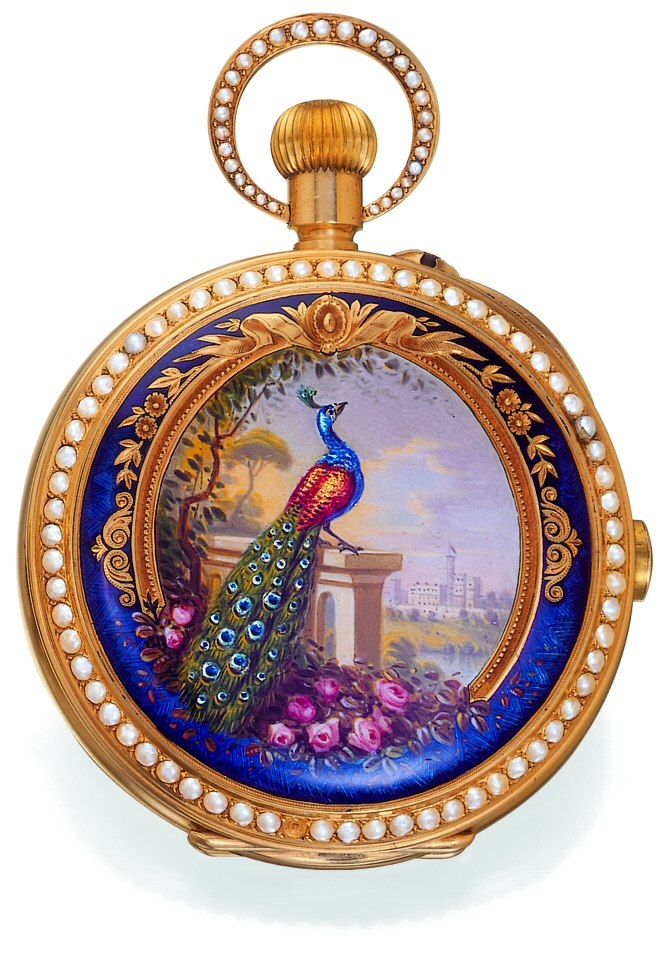
This Swiss-made 18K gold hunting-cased keyless chronograph watch, attributed to enameller Louis Rosselet of Geneva, dates to approximately 1880. Designed for the Indian market, the watch features a white enamel dial with Roman numerals, a 30-minute register at 3 o'clock, and a subsidiary seconds dial at 9 o'clock. The gold spade hands indicate the time, while an outer track is divided into fifths for chronograph measurements. The case is decorated with painted enamel scenes featuring Windsor Castle, including a peacock by a lake on the back and a portrait of Queen Victoria on the front. Both the bezels and the bow are set with pearls. The movement is a 42 mm frosted gilt 3/4-plate design in the English style, housing 15 jewels, a lateral counterpoised lever escapement, and a cut-bimetallic compensation balance equipped with a Breguet balance spring.

Exterior view of the hunting-cased chronograph, showing the painted enamel peacock scene on the cover, pearl-set bezel, and pearl-set bow.
Exterior view of the hunting-cased chronograph, showing the painted enamel peacock scene on the cover, pearl-set bezel, and pearl-set bow. — Antiquorum. Rights pending — permission not yet requested. Original source

Catalogue identity

Source
catalog.antiquorum.swiss
Category
Pocket watch · Chronograph pocket watch
Maker / attribution
Louis Rosselet
Reference
Not recorded
Catalogue / lot identifier
403
Source-reported date
circa 1880
Source-reported place
Switzerland

Source-reported attribution and specifications are not independent authentication. A listing does not establish present ownership, current display, availability or permission to reproduce.

Object description

Enamelled Case and Exterior

The watch is housed in a five-body 18K gold hunting case. The exterior surfaces are finished with detailed painted enamel scenes set against a blue background. The case back features a depiction of a peacock positioned by a lake, with the silhouette of Windsor Castle visible in the distance. The front cover displays a portrait of Queen Victoria, also accompanied by a view of Windsor Castle in the background.

The decorative scheme is complemented by the application of pearls, which are set into the bezels and the bow of the watch.

Evidence for this section
  • “Five-body, the back painted on enamel with a peacock by a lake with Windsor castle in the background”
  • “the front with a very finely painted on enamel portrait of the young Queen Victoria, Windsor castle in the background”
  • “pearl-set bezels and bow, gold hinged cuvette.”

Dial and Chronograph Configuration

The watch features a white enamel dial configured for a chronograph function. The primary timekeeping is indicated by radial Roman numerals and gold spade hands. Minute divisions are marked around the outer edge, while a specialized chronograph track, divided into fifths, surrounds the perimeter to facilitate precise measurement of elapsed time.

Functionality is provided by two auxiliary dials: a 30-minute register positioned at 3 o'clock and a subsidiary seconds dial located at 9 o'clock. This layout allows the user to track seconds and larger intervals through the keyless winding and operation system integrated into the case structure.

Evidence for this section
  • “White enamel, with radial Roman numerals, outer minute divisions, outermost chronograph track divided into fifths”
  • “minute register at 3, subsidiary sunk seconds at 9. Gold spade hands.”

Movement and Escapement

The internal mechanism is a 42 mm movement constructed as a frosted gilt 3/4-plate, which follows an English stylistic tradition. The movement utilizes 15 jewels to reduce friction in the gear train. Precision is maintained through a lateral counterpoised lever escapement paired with a cut-bimetallic compensation balance, which is designed to regulate the effects of temperature changes on timekeeping performance.

The balance wheel is coupled with a Breguet balance spring to facilitate consistent oscillations.

Evidence for this section
  • “frosted gilt 3/4-plate in English style, 15 jewels, lateral counterpoised lever escapement”
  • “cut-bimetallic compensation balance with Breguet balance spring.”

Open research questions

  • What specific evidence links this watch to the Indian market?
  • Are there internal hallmarks on the cuvette identifying the case maker?

Source evidence

Recorded claims and source quotations for Louis Rosselet Hunting-Cased Chronograph
FieldSource-reported valueSource quotation
MakerLouis Rosselet“Enamel attributed to Louis Rosselet”
Datecirca 1880“circa 1880”
Case Material18K Gold“Very fine 18K gold and painted on enamel, pearl-set, hunting-cased keyless chronograph watch”
MarketIndian market“made for the Indian market”
Movement Type3/4-plate in English style“frosted gilt 3/4-plate in English style, 15 jewels”
Dial DetailsWhite enamel“White enamel, with radial Roman numerals”
Diameter52 mm“Diam. 52 mm.”

Visible details

  • The case back displays a painted enamel peacock and a landscape scene.
  • The exterior of the watch case, including the bezels and bow, is adorned with inset pearls.
  • The dial includes a 30-minute register and a subsidiary seconds dial.
  • The watch features a crown-wound keyless mechanism.

Research qualifications

  • The enamel work is attributed to Louis Rosselet rather than definitively signed.
  • The connection to the Indian market is provided by the auction house without further documentation.

Photograph identity and source facts were screened before import; rights clearance remains pending.

Terms in this record

Glossary explanations for terms named in this object’s record.