
Skip to content
The Encyclopedia of Horology

Clock · Longcase clock

Longcase clock

Partially verified

This eight-day longcase clock is constructed from an oak carcass veneered in walnut, featuring elaborate scrolling marquetry designs created in rosewood, sycamore, pear, and walnut. The clock features a brass break-arch dial signed by William Halstead, London, which displays Roman hour numerals and Arabic minute markers, along with a subsidiary seconds ring and a calendar aperture. The hood is topped with a stepped, domed cresting adorned with three brass ball-and-shaft finials. The movement is an eight-day, weight-driven, three-train mechanism featuring a recoil anchor escapement, hour striking on a bell, and quarter chiming on six bells controlled by a countwheel. The object is currently maintained in the Victoria and Albert Museum collection.

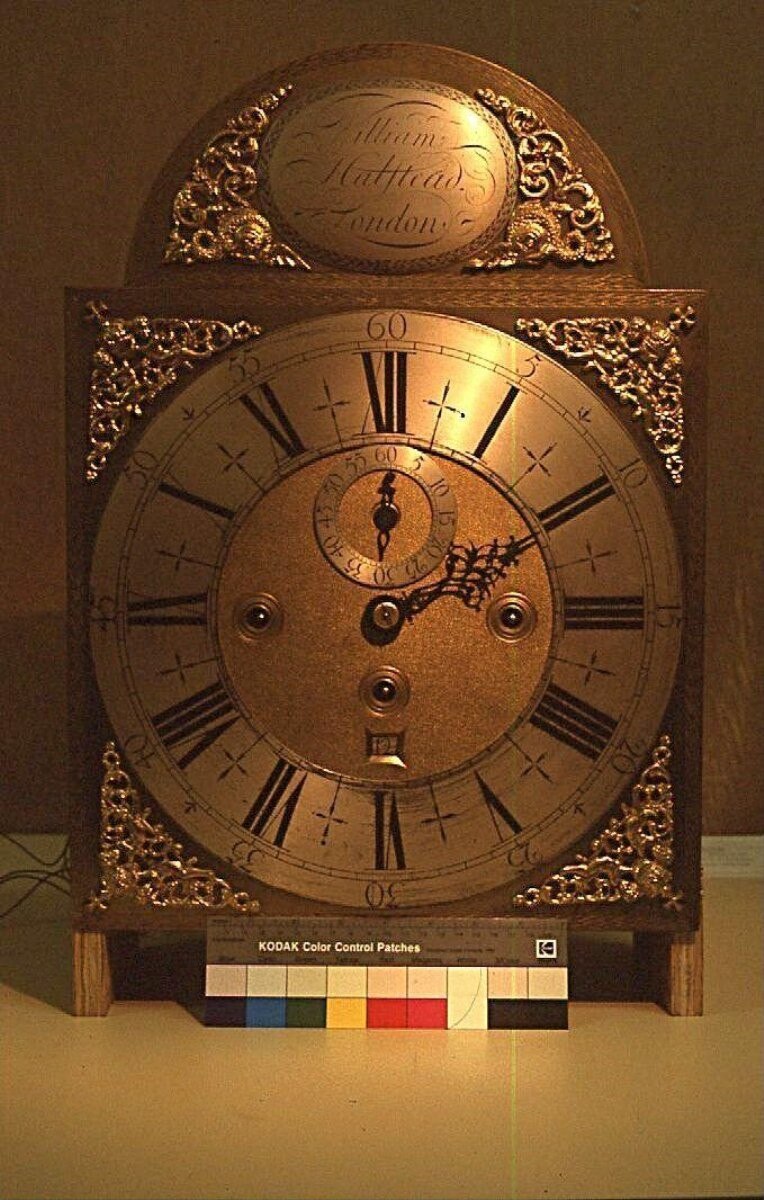
Front view of the clock dial, showing the break-arch design and signature plate.
Front view of the clock dial, showing the break-arch design and signature plate. — Victoria and Albert Museum. Rights pending — permission not yet requested. Original source

Catalogue identity

Source
collections.vam.ac.uk
Category
Clock · Longcase clock
Maker / attribution
William Halstead
Reference
W.24:1 to 8-1938
Catalogue / lot identifier
W.24:1 to 8-1938
Source-reported date
ca.1720
Source-reported place
United Kingdom

Source-reported attribution and specifications are not independent authentication. A listing does not establish present ownership, current display, availability or permission to reproduce.

Object description

Case and Exterior Decoration

The tall clock case consists of an oak carcass finished with walnut veneer. The exterior is extensively decorated with symmetric, scrolling marquetry incorporating diverse woods including rosewood, sycamore, and pear. The design features various motifs, such as addorsed birds, and is framed by narrower bands of marquetry.

The hood is capped with a stepped, domed cresting supported by three brass ball-and-shaft finials. The door of the hood is flanked by Corinthian pillars with brass capitals and bases, and features openwork fret spandrels. The base door includes an integrated circular brass-framed observation disc.

Evidence for this section
  • “An eight-day longcase clock in an oak case veneered in walnut, with scrolling marquetry designs in rosewood, sycamore, pear and walnut”
  • “The case is decorated all over with scrolling marquetry, including addorsed birds, the whole arranged symmetrically”

Dial and Hands

The clock features a break-arch brass dial, which shows evidence of being a later adaptation of a square dial. A double wheatear engraved border exists at the base of the arch, a detail resulting from the joining of two separate dial components. The arch contains a signed silvered plaque flanked by dolphin spandrels.

The square portion of the dial contains a matted center, a seconds aperture, and a calendar aperture behind a silvered ring. The chapter ring features Roman hour numerals and Arabic five-minute indicators. The current hand set is incomplete, with the minute hand missing and only the tail of the seconds hand remaining.

Evidence for this section
  • “the break arch dial is made from two pieces”
  • “In the arch, a silvered plaque, itself bordered by wheatear engraving and flanked by dolphin spandrels, bears the engraved signature William Halstead London”

Movement and Modifications

The eight-day, weight-driven, three-train movement is constructed with five pillars featuring fins and knops. The going train utilizes a recoil anchor escapement. The striking and chiming systems are controlled by an inside locking plate and an externally mounted countwheel, respectively.

The movement displays several modifications and indicators of past maintenance, including the filing of a pillar to allow space for train changes, plugged holes in the backplate, and vacant holes in the front plate. The pendulum suspension is a replacement, and the pallets have been reshaped as part of historical repair work.

Evidence for this section
  • “One inside pillar has been filed down to allow space for a modification to the train.”
  • “The mechanism has been extensively repaired. The pendulum suspension is new, and the pallets have been reshaped.”

Open research questions

  • At what specific date was the dial converted from a square format to the current break-arch configuration?
  • Can the origin of the additional pieces added to the seatboard chops be confirmed as a later 'marriage' of movement and case?

Source evidence

Recorded claims and source quotations for Longcase clock
FieldSource-reported valueSource quotation
MakerWilliam Halstead“Made by William Halstead, London, about 1720”
MaterialsOak, walnut, rosewood, sycamore, pear“Marquetry of walnut, rosewood, sycamore and pear, oak carcase with a walnut veneer”
Movement8 day, three train“8 day brass and steel weight driven, three train movement.”
Dial ConstructionTwo-piece break arch“the break arch dial is made from two pieces”
ProvenanceMrs A. Anderson“Bequeathed by Mrs A. Anderson as a memorial to her husband and his family”

Visible details

  • The dial arch features a silvered plaque engraved with the maker's name.
  • Twin cherub-and-crown spandrels are positioned at the four corners of the square dial plate.
  • The clock door features marquetry incorporating addorsed birds.

Research qualifications

  • The dial plate may have been converted from a square to a break-arch design at an uncertain date.
  • The movement exhibits various vacant holes and modifications suggesting past repairs or assembly as a marriage.
  • The minute hand is missing and the seconds hand retains only its tail.

Photograph identity and source facts were screened before import; rights clearance remains pending.

Terms in this record

Glossary explanations for terms named in this object’s record.