
Skip to content
The Encyclopedia of Horology

Clock · Wall regulator clock

Lenzkirch regulator wall clock

Partially verified

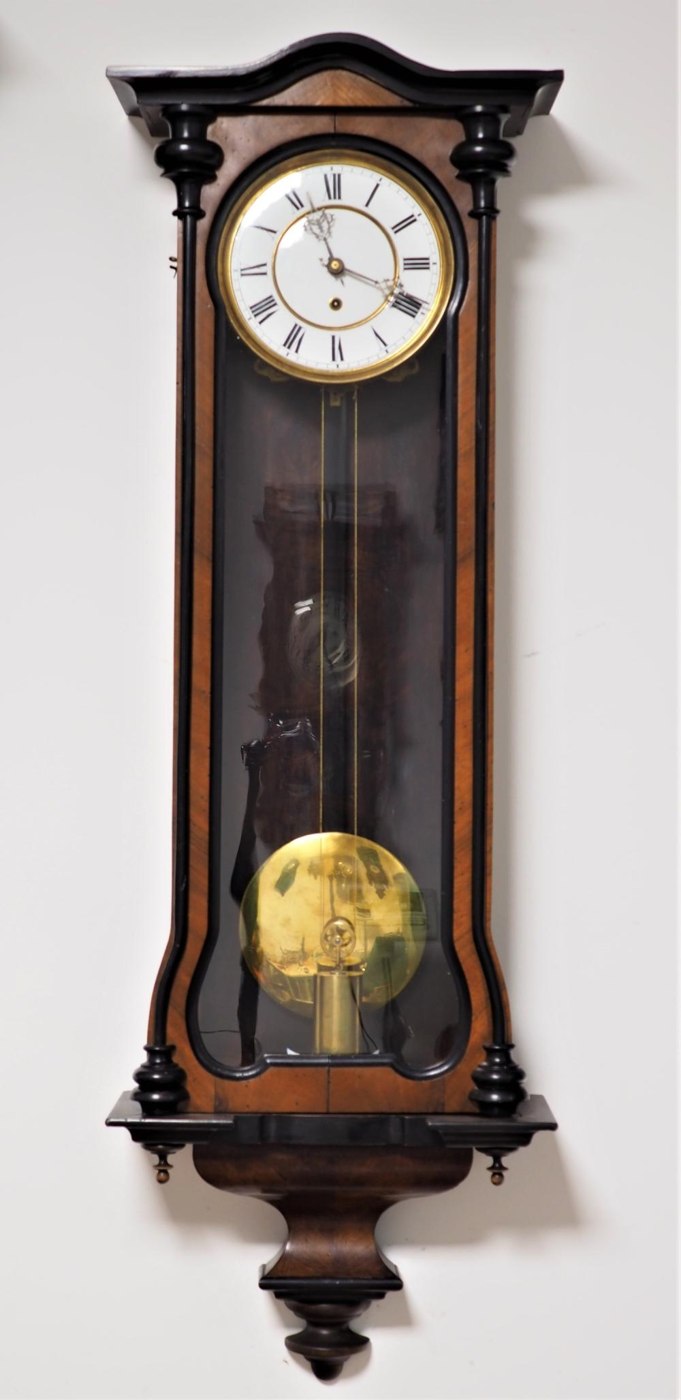
This Lenzkirch regulator is a wall-mounted clock, dated by the source to circa 1880. The long case is constructed from softwood veneered in walnut, featuring partial black-painted surfaces. The front door is curved and fitted with three glass panels, providing visibility of the pendulum and internal components. The case is finished with applied pilasters and turned decorative elements. The clock is powered by an eight-day movement with a weight-driven mechanism and a long pendulum, both housed within the primary case. The movement is signed "Lenzkirch" on the back plate, where the movement number is also located. The overall dimensions are 105 cm in height, 34 cm in width, and 14 cm in depth. The object is presented in a used condition with observed signs of age and wear.

Full view of the wall regulator clock, showcasing the glazed door, walnut veneer case, and internal pendulum.
Full view of the wall regulator clock, showcasing the glazed door, walnut veneer case, and internal pendulum. — Auktionshaus Wersching (via Invaluable). Rights pending — permission not yet requested. Original source

Catalogue identity

Source
www.invaluable.com
Category
Clock · Wall regulator clock
Maker / attribution
Lenzkirch
Reference
Not recorded
Catalogue / lot identifier
553
Source-reported date
circa 1880
Source-reported place
Germany

Source-reported attribution and specifications are not independent authentication. A listing does not establish present ownership, current display, availability or permission to reproduce.

Object description

Case Construction and Design

The wall clock features a long case design constructed primarily from softwood, which has been finished with a walnut veneer. The visual aesthetic includes areas finished in black, providing a contrast to the wood grain. The front-facing door is characterized by its curved work and is glazed with three distinct glass panels, which allow for a view of the internal pendulum and the weight-driven mechanism.

The design incorporates architectural-style details, including applied pilasters along the vertical frame and turned elements at the terminal points. The upper section of the case is finished with a curved, profiled finial that caps the hood of the clock. These elements collectively support the proportions and mounting structure of the regulator case.

Evidence for this section
  • “Case made of softwood and veneered with walnut.”
  • “Partly blackened, in the upper part curved profiled finial, triple glazed.”
  • “Long case in the front with door, this curved worked, with applied pilasters and turned finishes.”

Movement and Timekeeping

The clock is operated by an eight-day movement manufactured by the Lenzkirch firm. It utilizes a long pendulum to govern the rhythm of the timekeeping mechanism.

The movement is mounted within the case, and identifying marks are found on the back plate. These marks consist of the manufacturer's name, "Lenzkirch," and a specific movement number, which serves as a record of the assembly or production series for this particular unit.

Evidence for this section
  • “Built-in 8 day movement by "Lenzkirch" with weight drive and long pendulum.”
  • “Movement on back plate hallmarked "Lenzkirch" and movement number.”

Condition and Attribution

The auction house describes the clock as being in a good used condition. The physical state of the object exhibits signs associated with its age and use, although no specific damage or restoration is itemized in the description. The timekeeping mechanism is reported to be in a good working condition.

The attribution of the clock to the Lenzkirch workshop is based on the hallmarks present on the back plate of the movement. The dating to around 1880 is provided by the auction house in their catalogue entry for the lot.

Evidence for this section
  • “Clock in good used condition with signs of age and wear, good working condition.”
  • “Lenzkirch regulator, around 1880”

Open research questions

  • What is the specific movement number and what date does it map to in Lenzkirch production registers?
  • Was the black-painted finish original to the case or added as part of a later decorative update?

Source evidence

Recorded claims and source quotations for Lenzkirch regulator wall clock
FieldSource-reported valueSource quotation
MakerLenzkirch“Built-in 8 day movement by "Lenzkirch”
Datecirca 1880“Lenzkirch regulator, around 1880”
MaterialsSoftwood, walnut veneer“Case made of softwood and veneered with walnut.”
Movement type8-day weight-driven“Built-in 8 day movement by "Lenzkirch" with weight drive”
Case dimensions105 cm x 34 cm x 14 cm“H. 105 cm, w. 34 cm, d. 14 cm.”
MarkingsSigned on back plate“Movement on back plate hallmarked "Lenzkirch" and movement number.”

Visible details

  • The dial displays Roman numerals and is surrounded by a metallic bezel.
  • The pendulum consists of a brass disc suspended by a thin rod visible through the glass front.
  • A single cylindrical weight is suspended inside the case lower section.

Research qualifications

  • The exact year of manufacture is not specified beyond 'around 1880'.
  • The internal movement condition is described only as 'good working condition' without internal mechanical evaluation.

Photograph identity and source facts were screened before import; rights clearance remains pending.

Consulted source

Lenzkirch regulator, around 1880

Reviewed 2026-10-26 · Record 6b8ecd2623

Terms in this record

Glossary explanations for terms named in this object’s record.