
Skip to content
The Encyclopedia of Horology

Clock · Lantern clock

Lantern clock by Geuroux

Partially verified

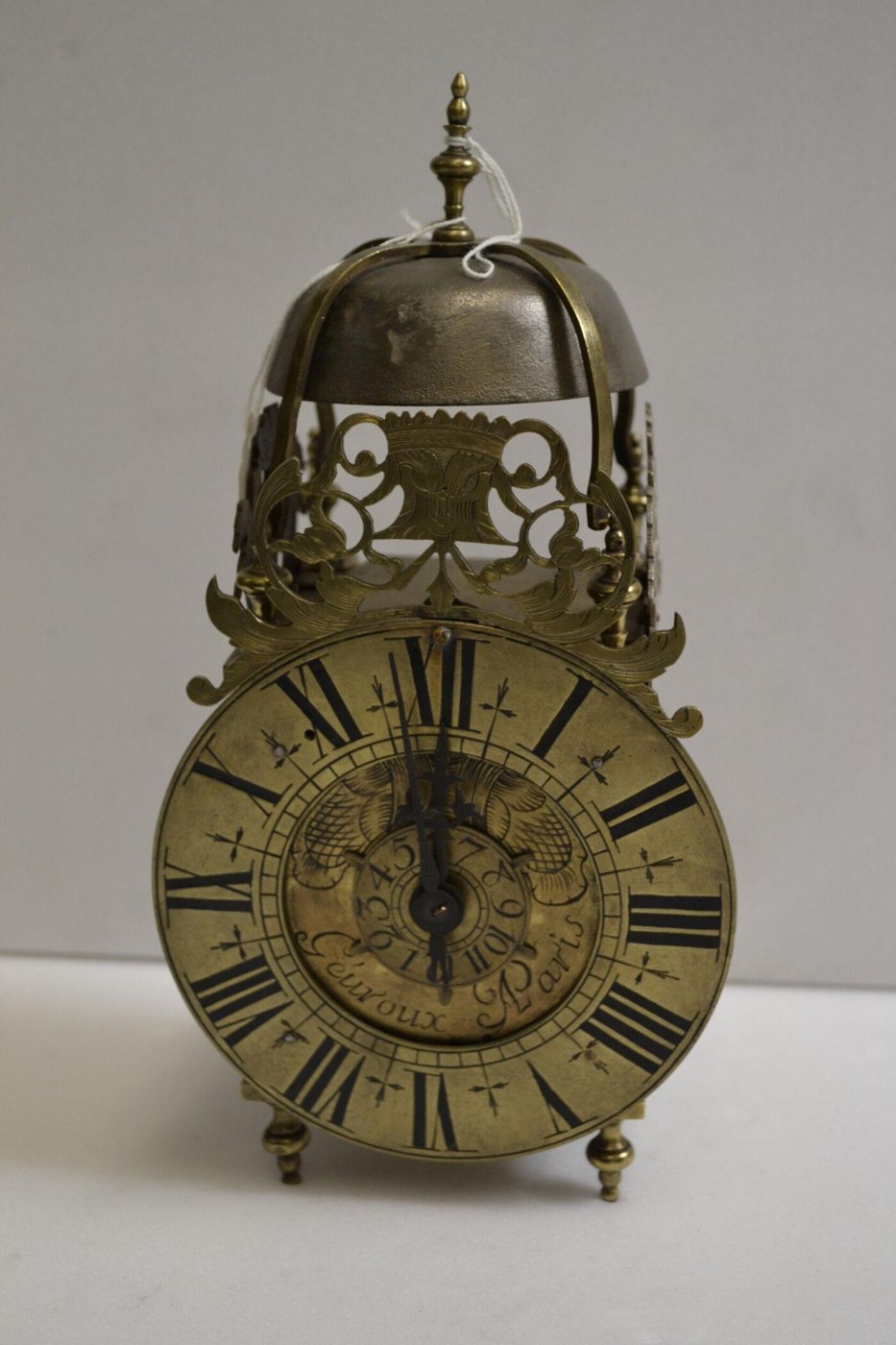
and dates to the mid-17th century in Paris. The wall-mounted, weight-driven chamber clock features a metal construction composed of brass and iron. The design includes square top and bottom plates decorated with pierced foliate strapwork incorporating tulip flower and leaf motifs. The clock is surmounted by a large bell for time-striking, supported by four brackets. The dial displays a chapter ring with Roman numerals, featuring both hour and minute hands. A central smaller dial is provided to adjust the alarm mechanism. This item was acquired by the V&A museum as part of a bequest from Estella Canziani, a friend of the benefactor Dr. Hildburgh.

Front view of the brass lantern clock showing the dial, bell, and foliate strapwork.
Front view of the brass lantern clock showing the dial, bell, and foliate strapwork. — Victoria and Albert Museum. Rights pending — permission not yet requested. Original source

Catalogue identity

Source
collections.vam.ac.uk
Category
Clock · Lantern clock
Maker / attribution
Geuroux
Reference
Not recorded
Catalogue / lot identifier
M.48-1995
Source-reported date
mid 17th century
Source-reported place
France

Source-reported attribution and specifications are not independent authentication. A listing does not establish present ownership, current display, availability or permission to reproduce.

Object description

Case and Dial Design

The lantern clock is constructed primarily from brass and iron. It is designed for wall mounting, intended to hang from a hook or rest on a high bracket. The structure is defined by its square top and bottom plates, which are embellished with pierced foliate strapwork featuring recurring tulip flower and leaf designs. This brass lantern clock is attributed to the maker Geuroux The donation included a broader group of thirteen objects, encompassing various pieces of silver and jewellery.

The clock is surmounted by a large bell that serves as the striking mechanism. Four brackets support this bell, each topped by a turned baluster finial.

Evidence for this section
  • “Brass lantern clock, French, mid 17th century”
  • “square bottom and top plates in the form of pierced foliate strapwork featuring tulip flowers and leaves”
  • “turned baluster finials are matched by finials either side of the top plate and surmounting the four brackets which hold the bell in place”

Dial and Timekeeping

The dial face features a primary chapter ring inscribed with large Roman numerals for tracking the time. It is equipped with two hands, allowing for the indication of both hours and minutes.

An integrated alarm function is present, operated via a smaller dial located in the center of the main dial plate. This component can be adjusted to set the required alarm time.

Evidence for this section
  • “The dial has a prominent chapter ring with large Roman numerals; a single hand to register the hours and another to register the minutes”
  • “The small dial in the middle of the main dial can be turned to set the alarm”

Provenance and History

This clock entered the museum collection as part of a bequest from Estella Canziani.

Canziani was known as an artist and was a friend of Dr. Hildburgh, who served as a primary benefactor for the Victoria and Albert Museum.

Evidence for this section
  • “The clock was one of two clocks bequeathed by Estella Canziani; amongst thirteen objects including jewellery and silver”
  • “Canziani was an artist friend of Dr Hildburgh, a leading benefactor of the V&a”

Open research questions

  • What is the specific horological history of the maker Geuroux in 17th-century Paris?
  • Are there missing components from the weight-driven mechanism visible in the current museum display?

Source evidence

Recorded claims and source quotations for Lantern clock by Geuroux
FieldSource-reported valueSource quotation
MakerGeuroux“Geuroux (maker)”
Accession numberM.48-1995“M.48-1995”
MaterialsBrass and iron“Brass and iron”
DateMid 17th century“mid 17th century”
InscriptionsGeuroux AParis“Geuroux AParis”

Visible details

  • Pierced foliate strapwork on top plate
  • Engraved 'Geuroux AParis' signature on dial
  • Turned baluster finials
  • Central alarm setting dial

Research qualifications

  • Exact date range beyond 'mid 17th century' is not specified
  • Extent of original components vs potential repairs not documented

Photograph identity and source facts were screened before import; rights clearance remains pending.

Consulted source

Lantern clock

Reviewed 2026-10-26 · Record 2d0355847b

Terms in this record

Glossary explanations for terms named in this object’s record.