
Skip to content
The Encyclopedia of Horology

Clock · Lantern clock

Lantern Clock by Edward Webbe

Partially verified

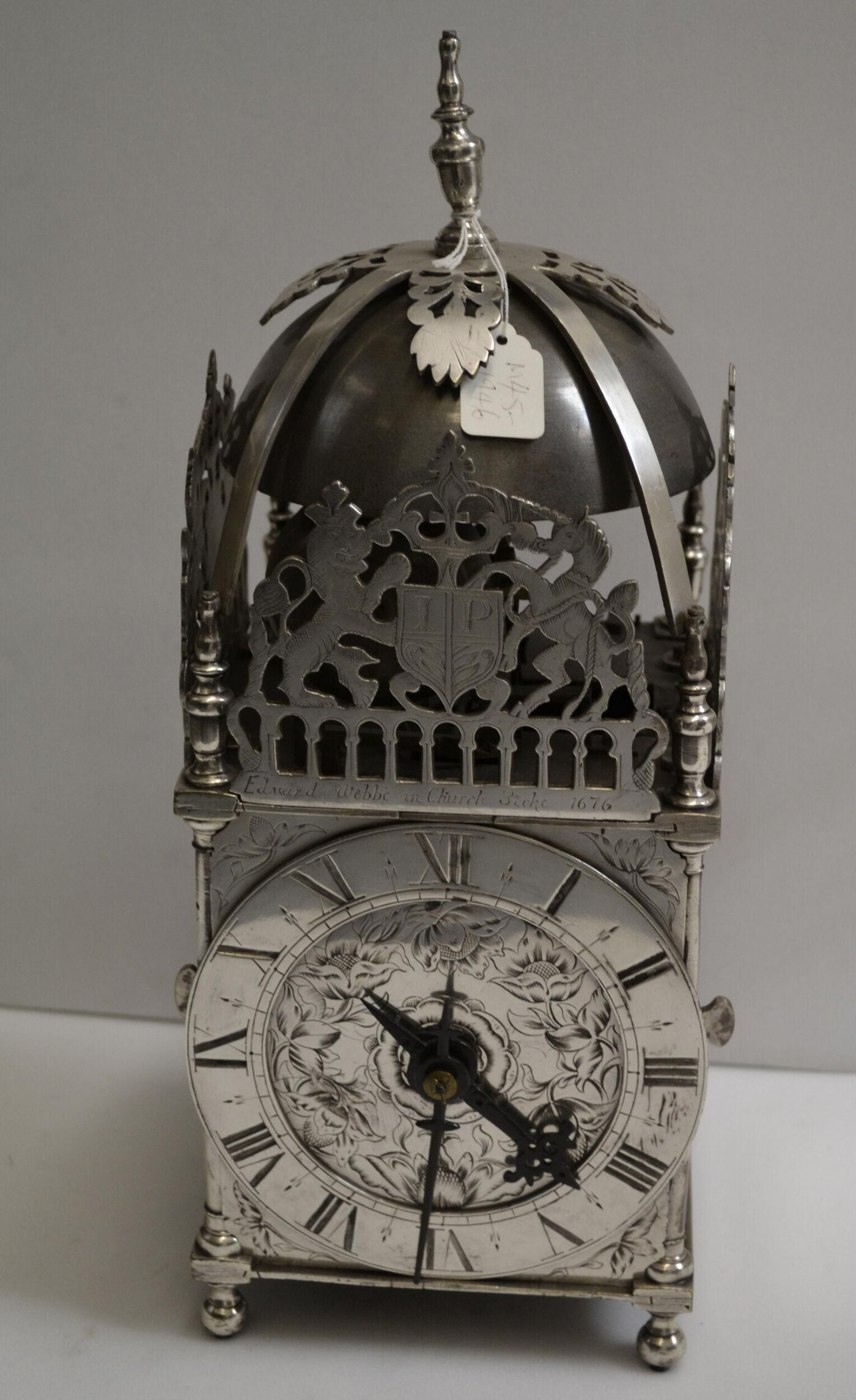
This silver lantern clock is signed and dated 1676 by the maker Edward Webbe of Church Stoke, Somerset, where he was active between 1660 and 1693. Constructed from silver with an integrated brass movement, the clock stands 40 cm high. The silver dial features an applied chapter ring with Roman numerals and fleur-de-lis half-hour markers, engraved with floral motifs and strawberry leaves. It is surmounted by an openwork key-pattern cresting featuring royal supporters flanking a crowned shield engraved with the initials I P. The clock incorporates a quarter-chiming train on six bells and a locking-plate striking train located at the rear of the movement. The timepiece originally functioned with an hour hand only; a minute hand was subsequently added. The movement utilizes a verge escapement and a bob pendulum.

Front view of the silver lantern clock by Edward Webbe, 1676.
Front view of the silver lantern clock by Edward Webbe, 1676. — Victoria and Albert Museum. Rights pending — permission not yet requested. Original source

Catalogue identity

Source
collections.vam.ac.uk
Category
Clock · Lantern clock
Maker / attribution
Edward Webbe
Reference
Not recorded
Catalogue / lot identifier
M.45:1, 2-1946
Source-reported date
1676
Source-reported place
Church Stoke, Somerset

Source-reported attribution and specifications are not independent authentication. A listing does not establish present ownership, current display, availability or permission to reproduce.

Object description

Case and Dial

The clock is housed in a silver case supported by four ball feet. The front of the case features a silver dial-plate measuring 15.6 by 13.6 cm, engraved with floral and strawberry leaf decorations. An applied silver chapter ring, 15.3 cm in diameter, provides the timekeeping display with Roman numerals, quarter-hour increments, and fleur-de-lis half-hour markers.

Above the dial, an openwork cresting exhibits a key-pattern design, displaying royal supporters flanking a crowned shield inscribed with the initials I P. Additional unengraved crestings are positioned on either side of the case. The bell assembly is supported by four vases, with a fifth vase acting as a terminal finial at the apex. The cresting is signed by the maker.

Evidence for this section
  • “The case rests on four ball feet, and the dial is engraved with flowers and with strawberry leaves.”
  • “Above is an openwork key-pattern surmounted by the royal supporters flanking a crowned shield engraved with I P.”
  • “The cresting above the dial is signed “Edward Webbe in Church Stoke 1676”.”

Movement and Chime

The brass movement is configured with a going train and a quarter-chiming train, the latter operating on six bells. The count-wheel for the quarter-chiming function is integrated into the chime-barrel itself. At the rear of the movement, a locking-plate striking train is released via a pin on the quarters count-wheel.

The escapement is of the verge type, featuring a 15-tooth escape wheel. The pendulum, 19.8 cm in length, is threaded at its base, though the bob is currently absent. The motion-work employs a 12:48 reduction for the hour hand and a 48:16 speed-up for the minute hand.

Evidence for this section
  • “verge escapement with 15T escape wheel”
  • “At centre, quarter-chiming train on 6 bells”
  • “Locking-plate striking train at rear of movement (released by a pin from the quarters count-wheel) with outside count-wheel.”

Provenance and Historical Details

This clock was crafted by Edward Webbe, a clockmaker who operated in Church Stoke, Somerset, during the late 17th century, specifically between the years 1660 and 1693. The object is dated 1676, roughly two decades prior to Webbe’s death in 1694.

The clock later entered the collection of the Victoria and Albert Museum as a bequest from the Reverend E G Winstanley.

Evidence for this section
  • “made in Church Stoke, Somerset, where Webb worked between 1660 and 1693.”
  • “Bequeathed by the Reverend E G Winstanley”
  • “Lantern clocks were used as domestic time keepers, wall hung, usually in the hall where the sound of the bell could be heard throughout the house.”

Open research questions

  • What is the significance of the initials 'I P' engraved on the shield?
  • Does the current movement configuration reflect its original state, or were major modifications made during the transition from a single-hand to a two-hand display?

Source evidence

Recorded claims and source quotations for Lantern Clock by Edward Webbe
FieldSource-reported valueSource quotation
MakerWebb, Edward“Edward Webbe in Church Stoke 1676”
MaterialsSilver and brass“Silver, engraved with brass movement”
Accession numberM.45:1, 2-1946“M.45:1, 2-1946”
Dimensions40 cm H x 16.8 cm W x 20.4 cm D“Height: 40 cm; Width: 16.8 cm; Depth: 20.4cm”
EscapementVerge“verge escapement with 15T escape wheel”

Visible details

  • The dial plate is heavily engraved with floral and foliate patterns.
  • The cresting above the dial incorporates royal supporters.
  • The clock is fitted with a side-hinged access door.
  • The bell assembly is surmounted by a central vase finial.

Research qualifications

  • The minute hand is reported as an addition.
  • The hour hand is suspected to be a renewal.
  • The pendulum bob is stated to be missing.

Photograph identity and source facts were screened before import; rights clearance remains pending.

Consulted source

Lantern clock

Reviewed 2026-10-26 · Record 7ee633dc26

Terms in this record

Glossary explanations for terms named in this object’s record.