
Skip to content
The Encyclopedia of Horology

Clock · Table clock

Joseph Knibb timepiece table clock

Partially verified

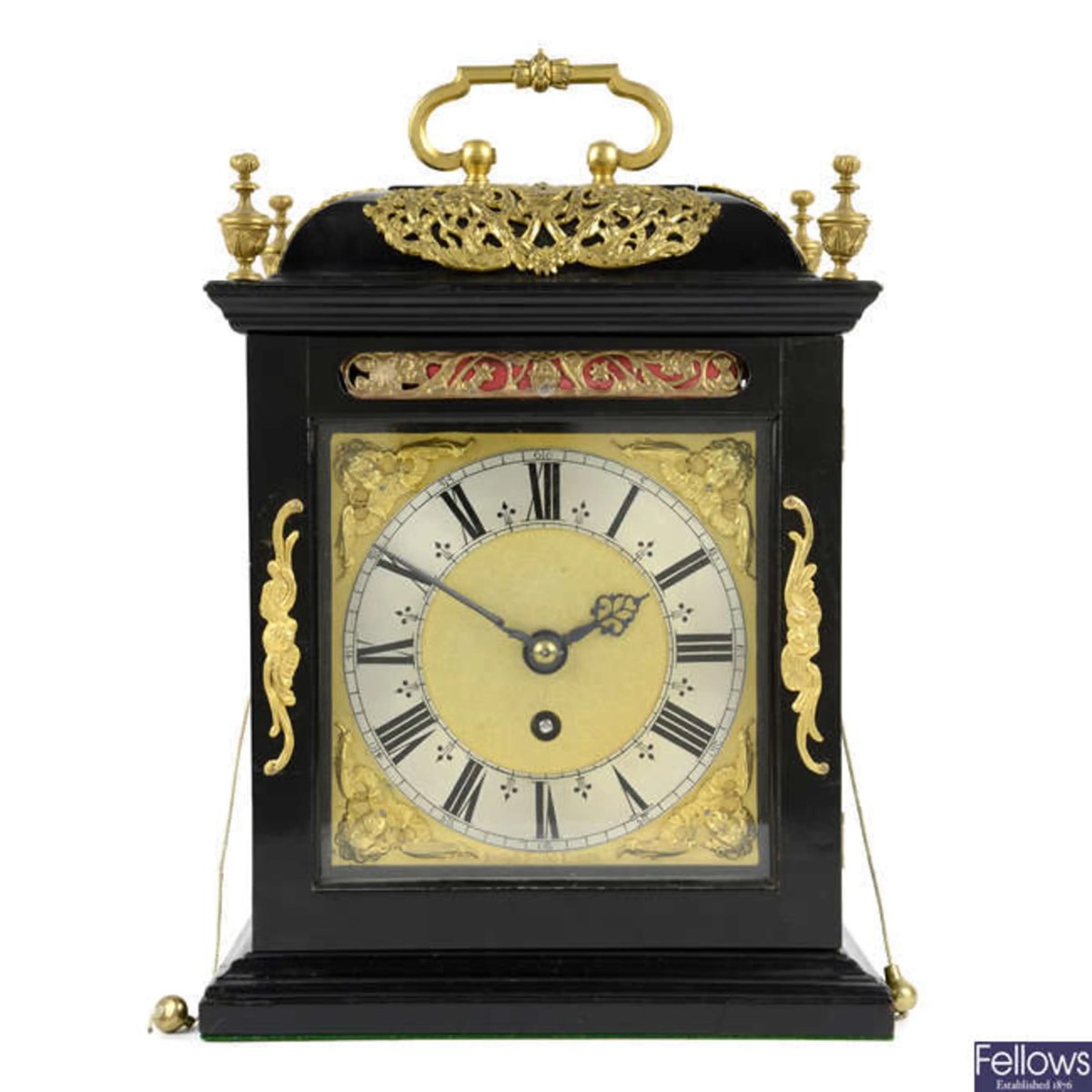
This late 17th-century William III ebony-veneered timepiece table clock is attributed by the auction source to Joseph Knibb, dating to circa 1690. The rectangular case features baluster-turned finials, a pierced fret panel backed in red fabric, and a brass carrying handle. The dial is fitted with winged cherub-head spandrels and a silvered chapter ring. According to cataloguing, the movement incorporates a verge escapement, a latched dial and movement, and pull quarter repeat mechanism on a bell. The total height measures 32 cm with the handle upright.

Front view of an ebony-veneered timepiece table clock attributed to Joseph Knibb
Front view of an ebony-veneered timepiece table clock attributed to Joseph Knibb — Fellows. Rights pending — permission not yet requested. Original source

Catalogue identity

Source
www.fellows.co.uk
Category
Clock · Table clock
Maker / attribution
Joseph Knibb
Reference
Not recorded
Catalogue / lot identifier
1
Source-reported date
circa 1690
Country
England

Source-reported attribution and specifications are not independent authentication. A listing does not establish present ownership, current display, availability or permission to reproduce.

Object description

Case and Exterior Construction

The timepiece is housed in an ebony-veneered rectangular case measuring 28 cm by 22 cm by 15 cm. It is surmounted by brass baluster finials and features a hinged carrying handle. A pierced fret panel is positioned in the lintel above the glazed door.

Condition reports note that the left mount escutcheon has been pinned down, the right escutcheon is installed upside down, and both are likely replacements. The side frets are described as unusual and of poor quality. The pull repeat cords are noted as replaced.

Evidence for this section
  • “A late 17th century, William III ebony veneered timepiece table clock”
  • “Case - 28cm x 22cm x 15cm”
  • “The left mount escutcheon has been pinned down and the right is upside down, both are likely replacements.”
  • “The frets at the side are unusual and poor quality”
  • “The cords have been replaced.”

Dial and Mechanism

The clock features a square dial plate adorned with cherub escutcheons and a silvered chapter ring with Roman numerals. The movement is fitted with a verge escapement and utilizes a latched dial and movement system.

The clock includes a pull quarter repeat mechanism which has been substantially replaced. The striking assembly utilizes a bell, which is noted as a replacement for the original style of bell.

Evidence for this section
  • “verge escapement with latched dial and movement”
  • “Quarter repeating work has been substantially replaced.”
  • “The bell has been replaced (there should be a 'pork-pie' bell)”

Condition and Attribution Notes

The cataloguer notes the wooden base is a replacement and that existing holes in the base do not align with the movement, suggesting the case and movement may be a marriage. The underdial has been restored.

Correspondence from the late 1960s and early 1970s identifies a historical requirement for various components, including ornaments for the case, a minute hand, backcock, and pendulum holdfast, noting six vacant holes in the front plate.

Evidence for this section
  • “The wooden piece the clock sits upon is a replacement and the very base has old holes which do not configure with the base, this would suggest the case and movement are a marriage”
  • “Underdial has been restored”
  • “I need ornaments for the case, a minute hand, backcock, pendulum holdfast, as there are six vacant holes in the front plate”

Open research questions

  • What is the current mechanical state of the movement regarding the six vacant holes mentioned in historical correspondence?
  • Do the internal movement plates show evidence of modifications consistent with the 'marriage' description provided in the condition report?
  • To what extent does the gearing reflect original Knibb specifications despite the identified replacements?

Source evidence

Recorded claims and source quotations for Joseph Knibb timepiece table clock
FieldSource-reported valueSource quotation
Maker attributionJoseph Knibb“pull quarter repeat by Joseph Knibb, circa 1690”
Period and VeneerWilliam III ebony veneered“A late 17th century, William III ebony veneered timepiece table clock”
EscapementVerge escapement with latched dial and movement“verge escapement with latched dial and movement”
Height32 cm (including handle upright)“height 32cm (including handle upright)”
Condition notesQuarter repeating work substantially replaced“Quarter repeating work has been substantially replaced.”
Total Height32 cm“height 32cm (including handle upright)”
Escapement StatusRestored“The verge escapement has been restored.”

Visible details

  • Ebony-veneered rectangular case surmounted by brass baluster finials and a hinged carrying handle.
  • Square dial plate with winged cherub head spandrels and a silvered chapter ring marked with Roman hour numerals.
  • Pierced gilt fret backed by red cloth positioned in the lintel above the glazed door.
  • Pull repeat cords fitted with turned brass weights hanging down both flanks of the case.

Research qualifications

  • Source condition report notes extensive alterations, including a replaced bell, substantially replaced quarter repeating work, restored verge escapement, replaced wooden base, and mismatched case-movement mounting holes suggesting a possible marriage.
  • Front escutcheon mounts differ in colour from the dial and are considered probable replacements by the auctioneer.
  • Interior movement plates and rear view are not depicted in this image.

Photograph identity and source facts were screened before import; rights clearance remains pending.

Consulted source

Lot 1 | Joseph Knibb timepiece table clock, circa 1690

Reviewed 2026-10-22 · Record d32f5dcd6e

Terms in this record

Glossary explanations for terms named in this object’s record.