
Skip to content
The Encyclopedia of Horology

Pocket watch · Fermée-type pendant watch

Jolly Fermée-Type Pendant Watch

Partially verified

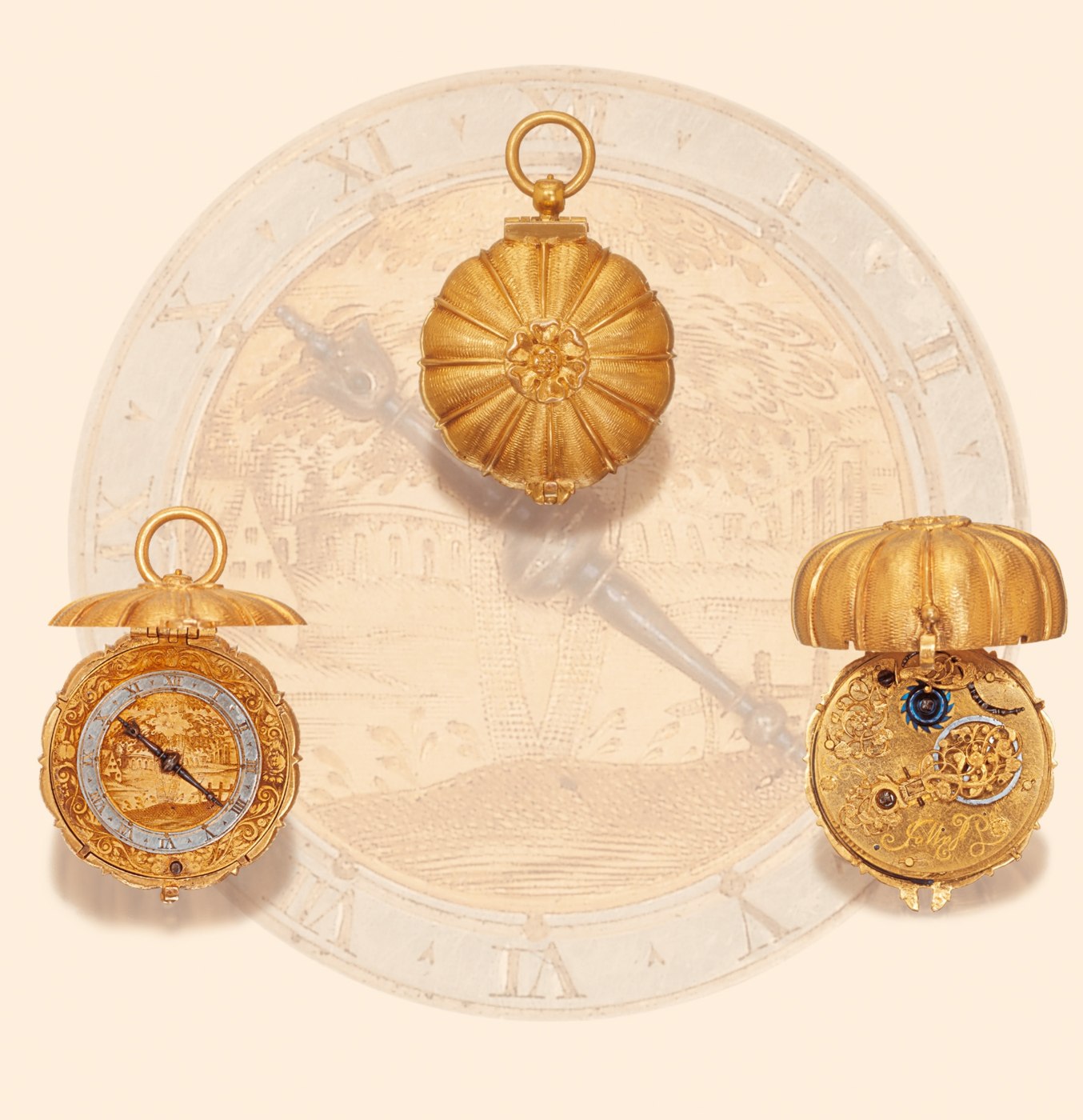
This pendant watch by Jolly, Paris, dates to circa 1640. It is a gilt brass savonette piece of the 'fermée-type', characterized by its curved-in edge and an eight-lobed case design featuring a barley corn pattern and central rosette. Measuring 35 mm in diameter, the watch is driven by a 30 mm hinged, full-plate gilt brass movement featuring turned baluster pillars and a fusee with gut line. It utilizes a verge escapement with a circular iron foliot, lacking a balance spring. The silver ring dial displays champlevé radial Roman numerals and half-hour markers, surrounding a gilt brass plate engraved with a city scene and stylized foliage. The single hand is fashioned from blued steel in a 'tulip' shape. The movement is signed on the back plate, and the watch retains a round pendant with a loose ring.

The Jolly pendant watch shown with its engraved case exterior, dial detail, and internal movement.
The Jolly pendant watch shown with its engraved case exterior, dial detail, and internal movement. — Antiquorum. Rights pending — permission not yet requested. Original source

Catalogue identity

Source
catalog.antiquorum.swiss
Category
Pocket watch · Fermée-type pendant watch
Maker / attribution
Jolly
Reference
Not recorded
Catalogue / lot identifier
404
Source-reported date
circa 1640
Source-reported place
France

Source-reported attribution and specifications are not independent authentication. A listing does not establish present ownership, current display, availability or permission to reproduce.

Object description

Case and Dial Construction

The watch is housed in a two-body gilt brass case of the 'fermée-type', distinguished by its curved-in edge. The exterior is divided into eight lobes, each decorated with a detailed barley corn engraving, centered on both the front cover and the back by a decorative rosette. The case design is rounded and includes a traditional pendant with a loose ring for suspension.

The dial consists of a silver ring featuring champlevé radial Roman numerals and corresponding half-hour markers. This ring is mounted onto a central gilt brass plate that is engraved with a detailed city scene surrounded by stylized foliage.

Evidence for this section
  • “Two-body, ?fermée type? with curved?in edge, formed of eight lobes engraved with what was later to be called the Barley corn pattern, centered by a rosette”
  • “Silver ring, champlevé radial Roman numerals, half-hour markers fixed to gilt brass engraved plate with a city scene in the center, stylized foliage on the border”

Movement and Escapement

The watch is powered by a 30 mm hinged, full-plate gilt brass movement. Its construction includes turned baluster pillars and is powered by a fusee and gut line mechanism. This movement is notably a pre-balance-spring design, utilizing a verge escapement paired with a circular iron foliot.

Additional movement components include an irregular pinned cock and a pierced, engraved gilt brass click assembly, which manages the ratchet-wheel mainspring set-up. The back plate of the movement carries the signature of the maker, Jolly, identifying the origin of the piece. The movement is reported in good condition, though the auction house recommends an overhaul for ongoing functionality.

Evidence for this section
  • “30 mm, hinged, gilt brass full plate, turned baluster pillars, fusee and gut, short train, verge escapement, circular iron foliot, irregular pinned cock”
  • “Signed on the back plate.”

Provenance and Documentation

This object has a recorded history of auction participation, having previously been offered by Antiquorum Geneva on April 24, 2004, where it was sold as lot 512. The watch is catalogued as a piece from the mid-17th century, specifically attributed to the maker Jolly in Paris around 1640.

Regarding its condition, the auction house grades the watch as AAA Excellent, with the case condition noted as 3-39 (Good/Rubbed) and the movement and dial both rated as 3 (Good). The documentation notes that the case decoration provides a glimpse into early engraving techniques, despite the absence of the mechanical 'engine-turning' process that would be developed later.

Evidence for this section
  • “Jolly, Paris circa 1640.”
  • “This lot was previously sold by Antiquorum Geneva, April 24, 2004, lot 512.”
  • “The case is meticoulsly engraved with a very small zigzag pattern, forming an appealing and elegant design.”

Open research questions

  • What specific archival evidence links the Jolly workshop to this exact period and style?
  • How does the 'fermée' construction compare to other prevalent 17th-century watch case designs in terms of structural integrity?

Source evidence

Recorded claims and source quotations for Jolly Fermée-Type Pendant Watch
FieldSource-reported valueSource quotation
MakerJolly“Jolly, Paris circa 1640.”
Case TypeTwo-body Fermée-type“Two-body, ?fermée type? with curved?in edge, formed of eight lobes”
Movement Diameter30 mm“30 mm, hinged, gilt brass full plate”
EscapementVerge with iron foliot“verge escapement, circular iron foliot, irregular pinned cock”
Hand MaterialBlued steel“Blued steel ?tulip? hand.”
Dial CompositionSilver ring with gilt brass plate“Silver ring, champlevé radial Roman numerals, half-hour markers fixed to gilt brass engraved plate”
Case DecorationBarley corn pattern“formed of eight lobes engraved with what was later to be called the Barley corn pattern”
ProvenanceAntiquorum Geneva, 2004“This lot was previously sold by Antiquorum Geneva, April 24, 2004, lot 512.”

Visible details

  • Case exterior features an eight-lobed design with barley corn engraving and central rosette
  • Dial plate engraved with a central city scene and floral border
  • Movement employs a circular iron foliot instead of a balance wheel
  • Single blued steel tulip-shaped hand indicates time

Research qualifications

  • The exact significance of the 'fermée-type' construction remains descriptive rather than definitively established in this record
  • Historical attribution to Jolly and the circa 1640 dating are as provided by the auction house

Photograph identity and source facts were screened before import; rights clearance remains pending.

Terms in this record

Glossary explanations for terms named in this object’s record.