
Skip to content
The Encyclopedia of Horology

Pocket watch · Key-wound open-face pocket watch

John Walker silver key-wound pocket watch

Partially verified

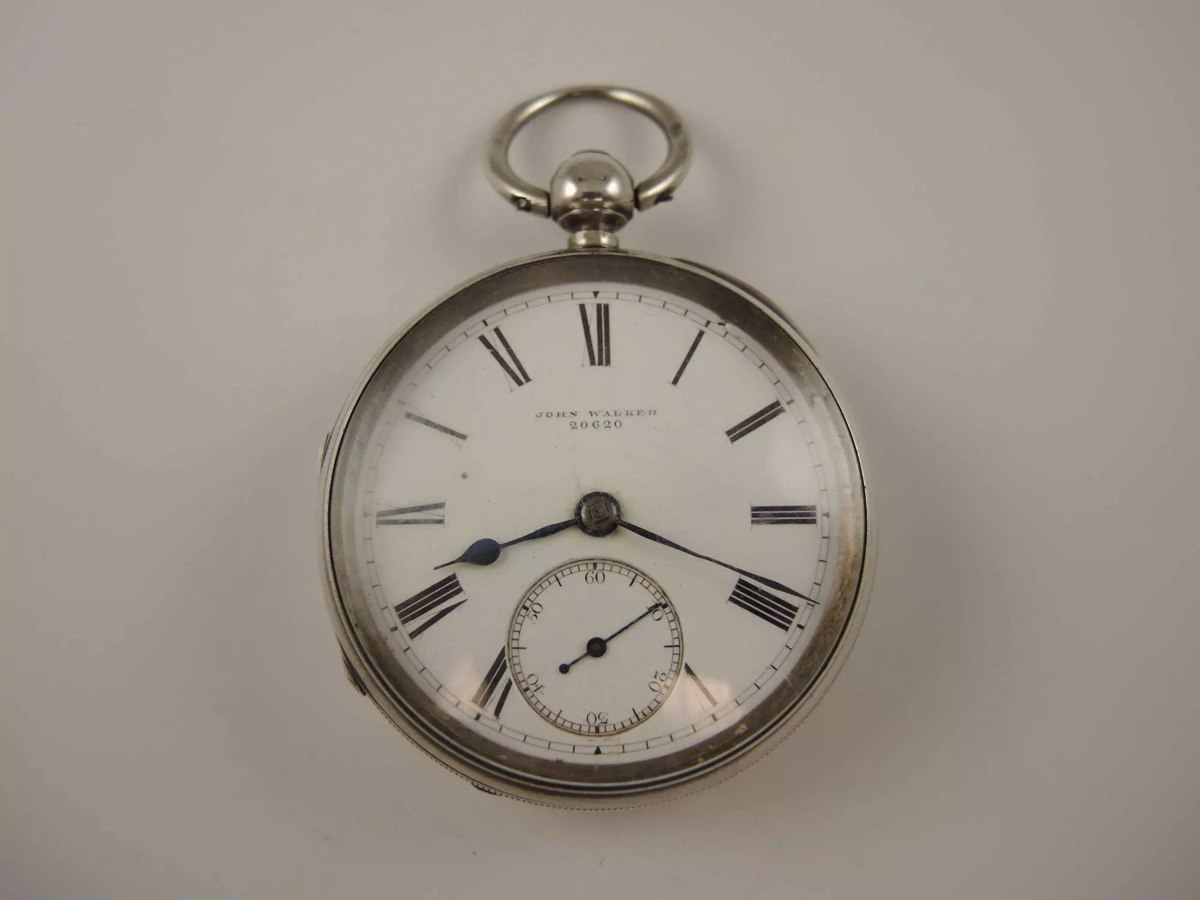
This open-face pocket watch features a white enamel dial signed 'John Walker, 20620' with black Roman numerals, blued steel hands, and a subsidiary seconds dial at 6 o'clock. The dealer reports a gilt full-plate going barrel movement with a lever escapement and a gilt dust cap, signed 'J Walker, 77. Cornhill and 230 Regent St, London' and numbered 20620. Housed in a silver case with coin-edged sides, engine turning, and Birmingham hallmarks reported for 1913, the watch is key wound and key set.

Dial view of the John Walker silver key-wound pocket watch
Dial view of the John Walker silver key-wound pocket watch — Atlam Watches / Antiques Boutique. Rights pending — permission not yet requested. Original source

Catalogue identity

Source
www.antiquesboutique.com
Category
Pocket watch · Key-wound open-face pocket watch
Maker / attribution
John Walker
Reference
Not recorded
Catalogue / lot identifier
WE65 (AB-147435)
Source-reported date
c. 1887 / case 1913
Country
United Kingdom
Source-reported serial
20620

Source-reported attribution and specifications are not independent authentication. A listing does not establish present ownership, current display, availability or permission to reproduce.

Object description

Dial and Visual Presentation

The pocket watch displays a white enamel dial with black Roman numerals and an outer railway minute track. It is signed 'JOHN WALKER / 20620' below the 12 o'clock position and is fitted with blued steel spade hands and a subsidiary seconds register at 6 o'clock.

The case features coin-edge reeding along its band, with a circular bow affixed to a rounded pendant at 12 o'clock. The seller reports that the dial has 'a hairlines from the centre to the 11' and is covered by a 'plastic glass which has some marks.'

Evidence for this section
  • “White enamel dial signed 'JOHN WALKER / 20620' below 12 o'clock.”
  • “Black Roman numeral hour markers with an outer railway minute track.”
  • “Blued steel spade hands and subsidiary seconds dial positioned at 6 o'clock.”
  • “Coin-edge reeding visible along the edge of the silver case band.”
  • “Circular bow attached to a rounded pendant at the 12 o'clock position.”
  • “a hairlines from the centre to the 11”
  • “plastic glass which has some marks”

Reported Movement and Casing Construction

According to the dealer description, the watch contains a 'gilt full plate going barrel movement' with a 'lever escapement' and a gilt dust cap. The movement is reported to be signed 'J Walker, 77. Cornhill and 230 Regent St, London' and numbered '# 20620'.

The silver case measures 48mm by 18mm and is constructed with a 'hinged back and bezel', where the assembly 'swings out from the front also.' The piece is key-wound from the back and key-set from the front, with the case back described as featuring engine turning and 'a cross on the crest on the back.'

Evidence for this section
  • “gilt full plate going barrel movement has a lever escapement, is signed “J Walker, 77. Cornhill and 230 Regent St, London” # 20620”
  • “Comes with a gilt dust cap.”
  • “The case has a hinged back and bezel. The watch is wound from the back, set from the front and swings out from the front also.”
  • “decorated with coin edged sides, engine turning and a cross on the crest on the back.”
  • “The watch measures 48mm x 18mm”

Dating and Source Discrepancies

There is an unresolved chronological discrepancy in the listing between the headline date and the reported hallmarks. The listing title dates the watch to 'c1887' and assigns it to the Victorian period (1837 to 1901), yet the silver case is explicitly stated to bear 'hallmarks for Birmingham 1913'.

Because only a front dial photograph is provided, internal details—including the dust cap, movement signature, hallmark stamps, and the seller's condition assessment of the movement as 'very dirty'—remain unverified by visual evidence in the record.

Evidence for this section
  • “English silver key wound pocket watch. john Walker, London c1887”
  • “Period Victorian (1837 to 1901)”
  • “hallmarks for Birmingham 1913”
  • “very dirty”

Open research questions

  • Do the Birmingham 1913 hallmarks indicate that an earlier Victorian movement was recased, or is the listing title's 'c1887' date an unsubstantiated dealer estimate?
  • What maker's mark or sponsor's mark is present inside the case alongside the 1913 Birmingham hallmarks?
  • Do serial records for John Walker confirm when number 20620 was manufactured relative to the dual address at 77 Cornhill and 230 Regent Street?

Source evidence

Recorded claims and source quotations for John Walker silver key-wound pocket watch
FieldSource-reported valueSource quotation
Movement signatureJ Walker, 77. Cornhill and 230 Regent St, London“signed “J Walker, 77. Cornhill and 230 Regent St, London””
Movement number20620“# 20620”
Case hallmarksBirmingham 1913“hallmarks for Birmingham 1913”
Case decorationCoin edged sides, engine turning and a cross on the crest on the back“decorated with coin edged sides, engine turning and a cross on the crest on the back”
Dial signatureJohn Walker, 20620“signed “John Walker, 20620””
Dimensions48mm x 18mm“measures 48mm x 18mm”
Case constructionHinged back and bezel with front swing-out mechanism“The case has a hinged back and bezel. The watch is wound from the back, set from the front and swings out from the front also.”
Reported mechanical statusRunning, unserviced, sold without warranty“The watch is running however the watch has not been cleaned & serviced and is sold with NO warranty”

Visible details

  • White enamel dial signed 'JOHN WALKER / 20620' below 12 o'clock.
  • Black Roman numeral hour markers with an outer railway minute track.
  • Blued steel spade hands and subsidiary seconds dial positioned at 6 o'clock.
  • Coin-edge reeding visible along the edge of the silver case band.
  • Circular bow attached to a rounded pendant at the 12 o'clock position.

Research qualifications

  • Dealer listing title suggests circa 1887, whereas case hallmarks are stated to date to Birmingham 1913.
  • Movement, dust cap, and case interior are not visible in the supplied photograph.
  • Source reports a hairline crack running from dial center toward 11 o'clock and marks on the plastic glass.

Photograph identity and source facts were screened before import; rights clearance remains pending.

Terms in this record

Glossary explanations for terms named in this object’s record.

Other key-wound open-face pocket watch records