
Skip to content
The Encyclopedia of Horology

Clock · Longcase clock

John Thompson Automata Longcase Clock

Partially verified

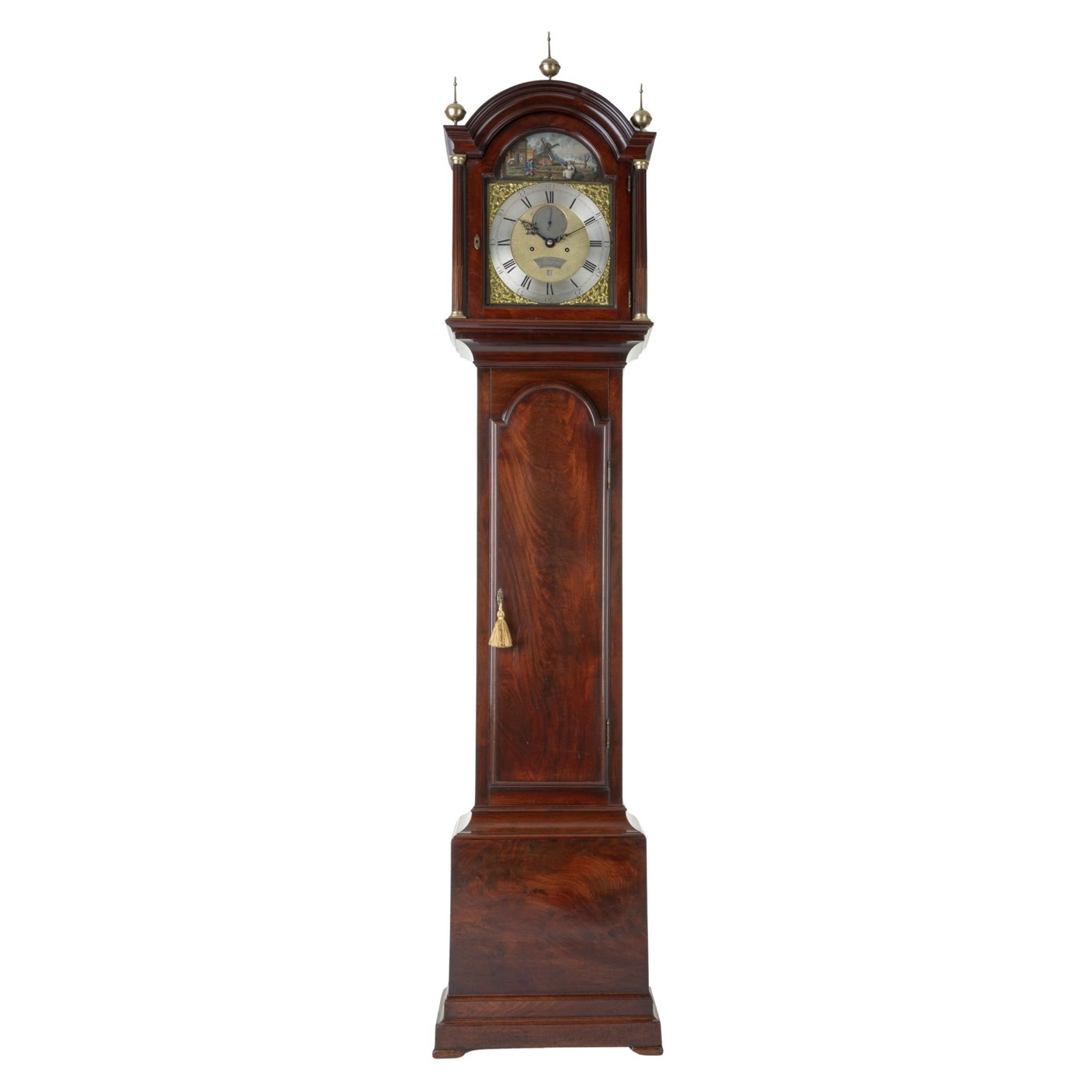
This eight-day longcase clock is attributed to the London-based maker John Thompson, dating to approximately 1780. The mahogany case is finished with flame veneers, featuring stop-fluted columns and brass finials. The clock houses a mechanical movement with rack striking on a bell. The dial incorporates a silvered chapter ring with both Roman and Arabic numerals, a subsidiary seconds dial, and a signed nameplate. The arched dial space contains automata elements including a rocking couple on a see-saw, a windmill in motion, and a miller emerging from a house. Standing 237 cm tall, the clock is constructed with knopped pillars. The item is described as an automata longcase clock, combining timekeeping with animated decorative features intended for display in a domestic interior. The object originates from a UK private collection.

Full-length view of the John Thompson longcase clock showing the mahogany case, arched dial with automata, and brass finials.
Full-length view of the John Thompson longcase clock showing the mahogany case, arched dial with automata, and brass finials. — Dorset Antique Clocks. Rights pending — permission not yet requested. Original source

Catalogue identity

Source
www.dorsetantiqueclocks.co.uk
Category
Clock · Longcase clock
Maker / attribution
John Thompson
Reference
Not recorded
Catalogue / lot identifier
Source URL identifies the listing
Source-reported date
circa 1780
Source-reported place
UK

Source-reported attribution and specifications are not independent authentication. A listing does not establish present ownership, current display, availability or permission to reproduce.

Object description

Case and Dial

The clock is housed in a case constructed from flame-veneered mahogany, elevated on a plinth base. The hood section is surmounted by brass ball finials and features stop-fluted columns flanking the dial.

The dial is designed with a silvered chapter ring featuring both Roman and Arabic numerals. A subsidiary seconds dial is present, alongside a central nameplate. The arch of the dial contains the primary decorative focus, consisting of an animated scene depicting a rocking couple on a see-saw, a windmill, and a miller emerging from a house.

Evidence for this section
  • “The use of flame-veneered mahogany and brass accents, such as the stop-fluted columns and finials”
  • “The silvered Roman and Arabic chapter ring, along with the subsidiary seconds dial and nameplate”
  • “The intricate automata elements—the rocking couple on a see-saw, the windmill in motion, and the miller emerging from his house”

Movement and Functionality

The clock is powered by an eight-day movement. It utilizes rack striking to sound the hour on a bell. The construction of the internal movement includes the use of knopped pillars.

These animated features operate in conjunction with the movement to create visual interest.

Evidence for this section
  • “The eight-day movement with rack striking on a bell”
  • “The knopped pillars are characteristic of fine clockmaking from the period”
  • “These animated features were crafted to entertain and astonish viewers, combining artistry with mechanical ingenuity.”

Provenance and Documentation

The clock is attributed to the London-based clockmaker John Thompson and is dated to approximately 1780. The object is recorded as having been held in a private collection within the United Kingdom prior to this listing.

The seller identifies the clock as a representative example of 18th-century horology, noting its historical function as a centrepiece in a wealthy household.

Evidence for this section
  • “London-based clockmaker John Thompson created a masterpiece with this mahogany automaton longcase clock.”
  • “CIRCA. 1780”
  • “Provenance: Private collection, UK”

Open research questions

  • What specific mechanical linkage connects the primary timekeeping movement to the automata elements in the arch?
  • Are there recorded examples of other longcase clocks signed by John Thompson that feature this specific suite of automata?

Source evidence

Recorded claims and source quotations for John Thompson Automata Longcase Clock
FieldSource-reported valueSource quotation
MakerJohn Thompson“London-based clockmaker John Thompson created a masterpiece with this mahogany automaton longcase clock.”
Datingcirca 1780“CIRCA. 1780”
Height237 cm“Height: 93 ½” or 237 cm”
Movement typeEight-day“The eight-day movement with rack striking on a bell”
Case materialFlame-veneered mahogany“The use of flame-veneered mahogany and brass accents”
ProvenancePrivate collection, UK“Provenance: Private collection, UK”

Visible details

  • Silvered chapter ring with Roman and Arabic numerals
  • Animated scene with a windmill and figures in the dial arch
  • Stop-fluted columns on the hood
  • Flame-veneered mahogany case finish

Research qualifications

  • The exact mechanisms of the automata are not internally documented in the source
  • The attribution to John Thompson is stated as a fact by the seller without referencing specific archival identification

Photograph identity and source facts were screened before import; rights clearance remains pending.

Consulted source

A RARE MAHOGANY AUTOMATA LONGCASE CLOCK – JOHN THOMPSON – LONDON

Reviewed 2026-11-02 · Record b82ec2bd18

Terms in this record

Glossary explanations for terms named in this object’s record.