
Skip to content
The Encyclopedia of Horology

Clock · Carriage clock

John Moore & Sons Giant Carriage Clock

Partially verified

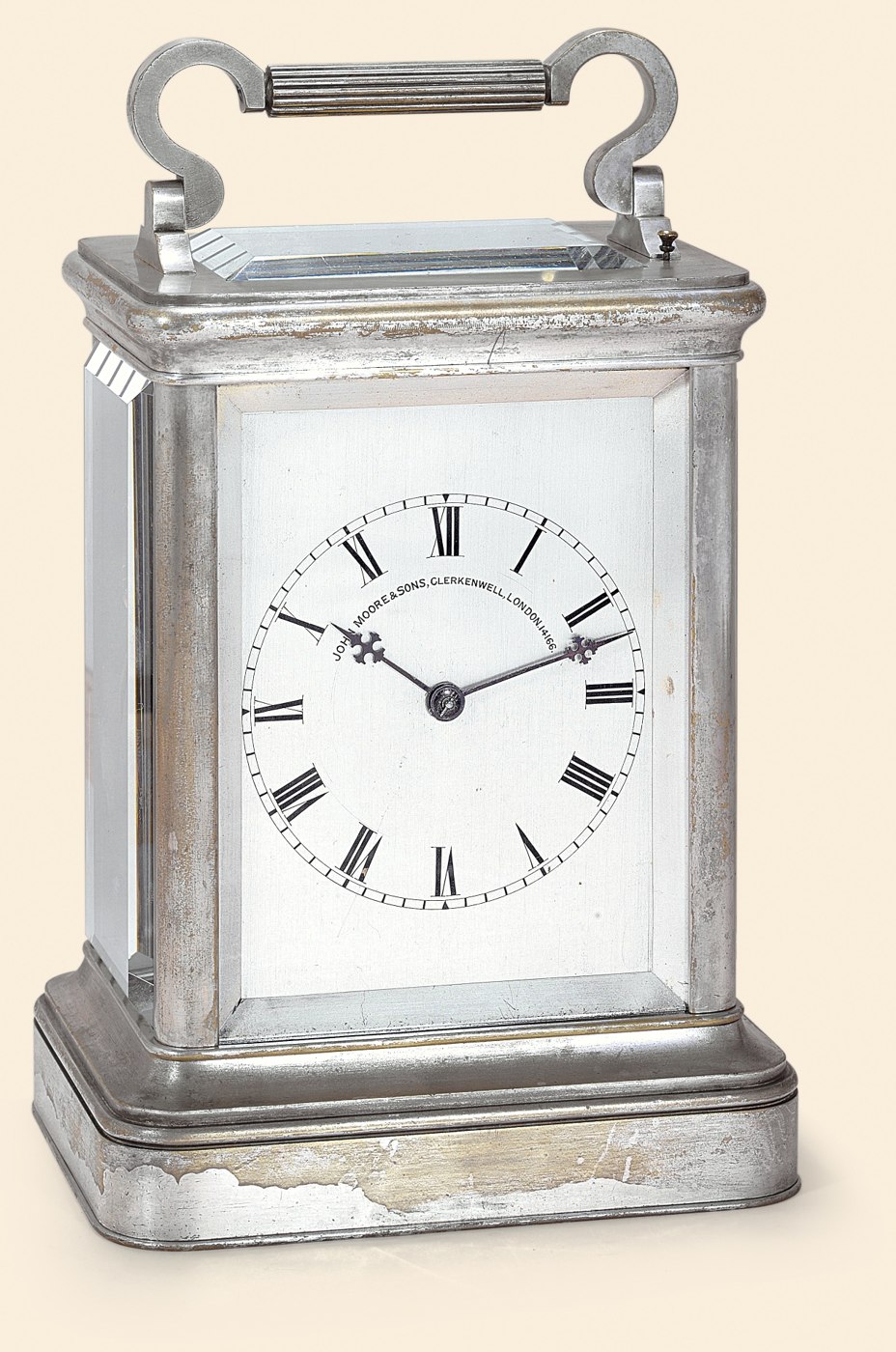
This "giant" carriage clock was produced by John Moore & Sons of Clerkenwell, London, circa 1850. The timepiece is housed in a silvered brass case featuring a molded, stepped base and top, with glazing on three sides and the top. A massive fluted handle is mounted on the top for transport. The brushed silvered dial displays radial Roman numerals and an outer minute track, with blued steel "Quatrefoil" hands. Internally, the clock features a rectangular brass movement with twin fusee-and-chain trains. It includes Harrison’s maintaining power on the going side and a platform escapement with a lateral lever. The clock strikes the hours and half-hours on a coiled gong, with a repeating function activated by a button on the top. The piece is signed and numbered on both the dial and the movement.

Front view of the John Moore & Sons giant carriage clock, showing the silvered dial, Roman numerals, and fluted handle.
Front view of the John Moore & Sons giant carriage clock, showing the silvered dial, Roman numerals, and fluted handle. — Antiquorum. Rights pending — permission not yet requested. Original source

Catalogue identity

Source
catalog.antiquorum.swiss
Category
Clock · Carriage clock
Maker / attribution
John Moore & Sons
Reference
Not recorded
Catalogue / lot identifier
214
Source-reported date
circa 1850
Source-reported place
United Kingdom
Source-reported serial
14166

Source-reported attribution and specifications are not independent authentication. A listing does not establish present ownership, current display, availability or permission to reproduce.

Object description

Case and Dial Design

The clock is constructed with a "giant" silvered brass case that measures 20 cm in height. The architecture incorporates a molded and stepped base and top, providing a formal aesthetic. Glazing is provided on three sides and the top panel to allow visibility into the movement housing. A massive fluted hinged handle is attached to the top, facilitating the movement of the substantial timekeeper.

The dial consists of a brushed silvered plate featuring radial Roman numerals and an outer minute track. Time is indicated by blued steel hands in the distinctive "Quatrefoil" pattern.

The dial is signed and numbered, ensuring clear identification of the piece as a product of the Moore workshop.

Evidence for this section
  • “Glazed on three sides and on top, molded and stepped top and base, massive fluted hinged handle”
  • “Brushed silvered with radial Roman numerals, outer minute track. Blued steel ?Quatrefoil? hands.”
  • “Dial and movement signed and numbered.”

Movement and Complications

The interior houses a rectangular brass movement characterized by a double-train configuration. Each train is powered by a fusee and chain mechanism. The going side is equipped with Harrison’s maintaining power, ensuring consistent force delivery during winding. The clock utilizes a platform-mounted lateral lever escapement, accompanied by a frosted gilt three-arm monometallic balance and a blued steel flat balance spring.

The clock performs dual functions of striking and repeating. It strikes the hours and half-hours on a coiled gong. A repeating mechanism is included, which is manually triggered by a button located on the top of the clock case. Adjustment of the clock's rate is facilitated by an index regulator, and the movement is further protected by a brass back plate featuring shuttered holes for winding and setting the hands.

Evidence for this section
  • “Rectangular brass, both trains with fusees and chains, Harrison?s maintaining power on the going side”
  • “platform with lateral lever escapement, frosted gilt three-arm monometallic balance”
  • “striking the hours and half-hours on a coiled gong and repeating activated by depressing a button on the top.”

Condition and Attribution

The auction description reports the clock's condition as generally good, though specific issues are noted. The case condition is classified as "Good" but with mention of oxidation described as "Rusted". The dial is also documented as "Good" but with surface scratches present.

The timepiece is attributed to the firm of John Moore & Sons, who operated out of Clerkenwell, London.

Evidence for this section
  • “Grading System Grade: AA Very good Case: 3-16 Good Rusted Movement: 3* Good Overhaul recommended, at buyer's expense Dial: 3-9-01 Good Scratched”
  • “carried on as John Moore & sons from 1824 onwards. They were most famous for making turret clocks.”

Open research questions

  • What is the specific history of the 'giant' carriage clock format within the John Moore & Sons production record?
  • Can the rust noted in the report be attributed to long-term storage conditions or specific environmental exposure?

Source evidence

Recorded claims and source quotations for John Moore & Sons Giant Carriage Clock
FieldSource-reported valueSource quotation
MakerJohn Moore & Sons“John Moore & Sons, Clerkenwell, London”
Serial Number14166“No. 14166”
Dimensions20 x 15.3 x 12.2 cm“Height 20 cm, width 15.3 cm, depth 12.2 cm., excluding handle.”
EscapementLateral lever“platform with lateral lever escapement”
FunctionsTime, strike, repeat“striking and repeating the hours and half-hours”
PowerTwin fusee“both trains with fusees and chains, Harrison?s maintaining power on the going side”
Case MaterialSilvered brass“silvered brass 8 day-going double-train carriage clock”

Visible details

  • Case includes a large, hinged fluted handle
  • Silvered finish on the case shows signs of wear
  • Dial features traditional Roman numeral hour markers
  • Movement includes an integrated platform escapement

Research qualifications

  • Condition report suggests the movement is rusted and requires an overhaul
  • The silvered surface is noted by the auction house as scratched or worn

Photograph identity and source facts were screened before import; rights clearance remains pending.

Terms in this record

Glossary explanations for terms named in this object’s record.