
Skip to content
The Encyclopedia of Horology

Clock · Longcase clock

James Snelling Longcase Clock

Partially verified

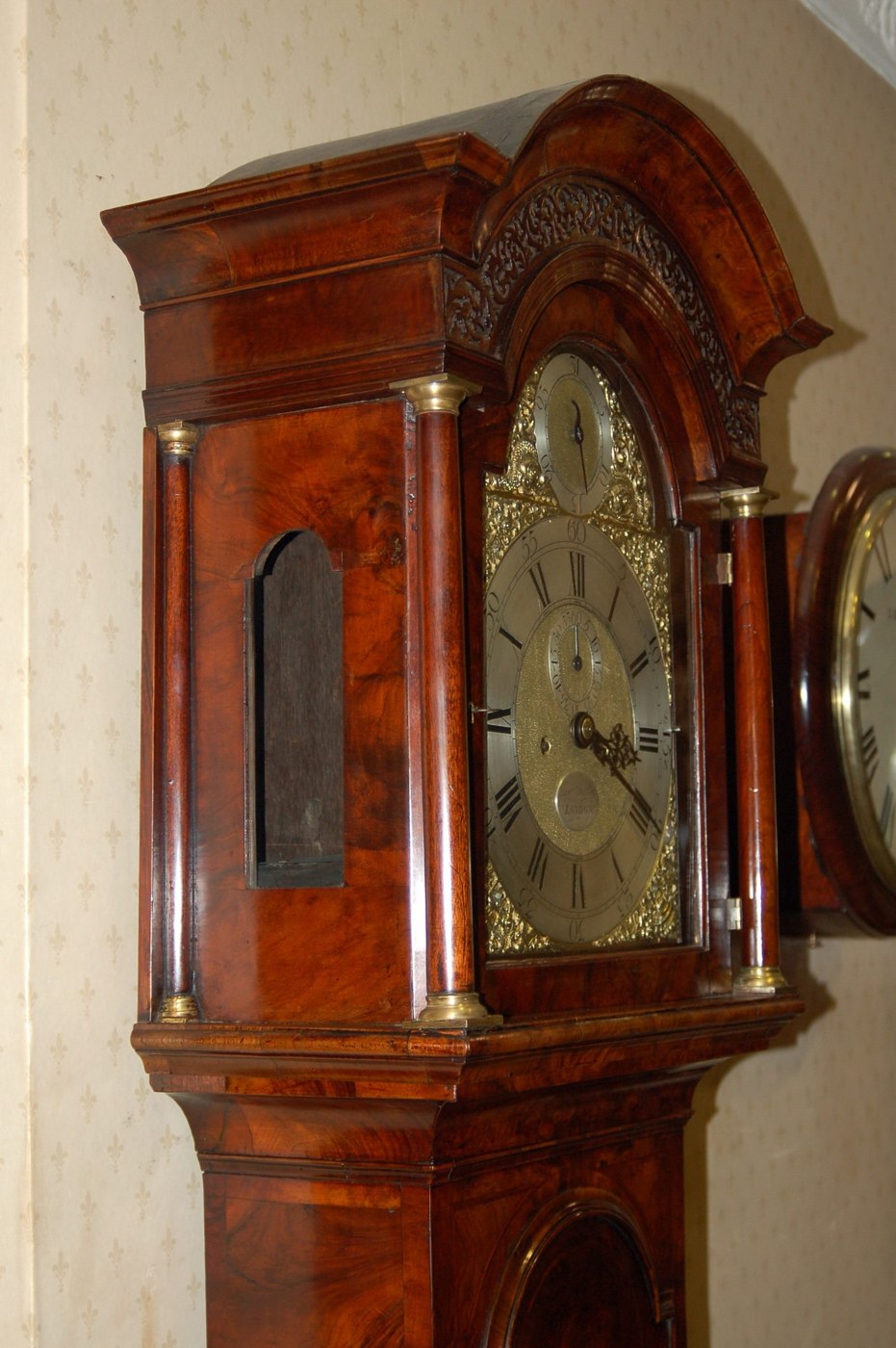
This antique longcase clock is attributed to the London clockmaker James Snelling, dating to circa 1735. The clock features an eight-day movement with five pillars, striking the hours on a single bell. The arched brass dial includes a chapter ring, spandrels, a matted center, a subsidiary seconds dial, a calendar in the arch, and a strike/silent mechanism at the three o'clock position. The clock is housed in a walnut-veneered case, characterized by book-matched veneers on the trunk and base, along with molding to the trunk door and two plinths. James Snelling served as Master of the Clockmaker’s Company in 1736 and operated from premises in Poultry, London.

A side-profile view of the arched brass dial and hood of the James Snelling longcase clock.
A side-profile view of the arched brass dial and hood of the James Snelling longcase clock. — Pendulum of Mayfair. Rights pending — permission not yet requested. Original source

Catalogue identity

Source
www.pendulumofmayfair.co.uk
Category
Clock · Longcase clock
Maker / attribution
James Snelling
Reference
G-JS1
Catalogue / lot identifier
Source URL identifies the listing
Source-reported date
circa 1735
Source-reported place
England

Source-reported attribution and specifications are not independent authentication. A listing does not establish present ownership, current display, availability or permission to reproduce.

Object description

Dial and Movement

The clock is powered by an eight-day duration movement featuring five pillars, designed to strike the hours on a single bell. The assembly is fronted by an arched brass dial that incorporates technical features including a subsidiary seconds dial and a matted center.

Operational utility is provided by a calendar function located in the arch of the dial and a strike/silent mechanism positioned at the three o'clock location. These functions are integrated into the brass dial plate, reflecting the specific design configuration attributed to James Snelling.

Evidence for this section
  • “arched ‘8 day’ brass dial”
  • “The exceptional quality 5 pillar movement striking the hours on a single bell.”
  • “rare calendar to the arch and strike silent to the three o clock position.”

Case Construction

The housing is constructed with walnut veneers, displaying a pattern of book-matched veneers across the trunk and base. The case structure follows standard London design characteristics, incorporating specific moldings to the trunk door and base plinths.

The aesthetic presentation relies on the application of the walnut veneer, which covers the exterior surfaces. The physical proportions of the longcase include a base consisting of two plinths, supporting the central trunk and the hooded dial section.

Evidence for this section
  • “The case of the finest choice walnut veneers.”
  • “Moulding to the trunk door and two plinths.”
  • “Lovely ‘book matched’ veneers to the trunk and the base”

Attribution and History

The clock is associated with the London maker James Snelling, who was based in Poultry. Historical records provided indicate that Snelling held the position of Master of the Clockmaker’s Company in 1736, and he is identified as having produced other clocks currently held in museum collections.

The dating of the object is established as circa 1735. The provenance is provided by the seller, Pendulum of Mayfair, which includes the attribution of the work to Snelling based on the signature and style of the dial.

Evidence for this section
  • “James Snelling was an eminent clockmaker who was Master of the Clockmaker’s Company in 1736.”
  • “He was based in Poultry in London.”
  • “His clocks are located in various museums around the world.”

Open research questions

  • Is the movement signed on the backplate or solely on the dial?
  • Has the walnut veneer been subjected to modern restoration or refinishing?

Source evidence

Recorded claims and source quotations for James Snelling Longcase Clock
FieldSource-reported valueSource quotation
MakerJames Snelling“eminent clockmaker James Snelling of London”
Datecirca 1735“London C1735”
Movement type8-day duration“arched '8 day' brass dial”
StrikingStrikes on a single bell“striking the hours on a single bell”
FeaturesCalendar and strike/silent“rare calendar to the arch and strike silent to the three o clock position”
Case materialWalnut veneer“The case of the finest choice walnut veneers.”
Movement construction5 pillars“The exceptional quality 5 pillar movement”
Maker's historyMaster of the Clockmaker’s Company in 1736“Master of the Clockmaker’s Company in 1736”

Visible details

  • Arched brass dial with decorative spandrels
  • Visible strike/silent lever at the three o'clock position
  • Walnut case with book-matched veneer sections
  • Two-tiered plinth construction at the base

Research qualifications

  • Attribution to James Snelling relies solely on the provided auction description
  • Condition details are minimal and provided only by the seller

Photograph identity and source facts were screened before import; rights clearance remains pending.

Consulted source

Antique grandfather clock by James Snelling – London C1735

Reviewed 2026-11-02 · Record 3e3a5d7dce

Terms in this record

Glossary explanations for terms named in this object’s record.