
Skip to content
The Encyclopedia of Horology

Clock · Table clock

Jaeger-LeCoultre Mappemonde World-Time Table Clock

Partially verified

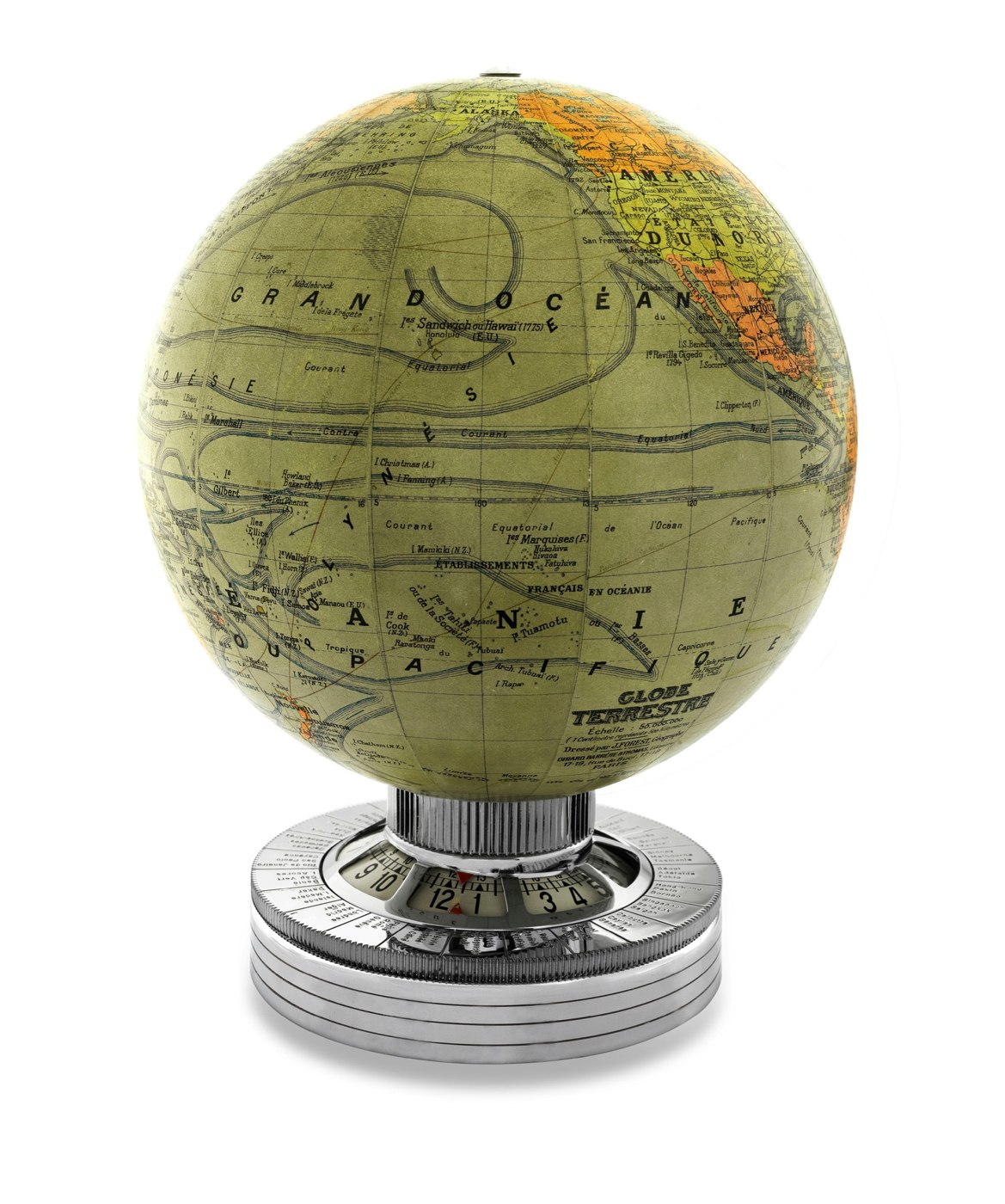
This Jaeger-LeCoultre Mappemonde World-Time table clock, produced circa 1935, features a spherical terrestrial globe illuminated by an integrated electrical system. The globe is constructed of glass covered with paper gores, executed by the firm J. Forest of Paris at a scale of 1:50,000,000. It rests upon a fluted, chromed cylindrical base that incorporates an annular time display. The clock is powered by a Caliber 201 movement with an 8-day power reserve, utilizing a straight-line lever escapement, a monometallic balance, and an index regulator. A rotating chromed disc, toothed at its circumference and engraved with 70 global city names, facilitates the world-time function. The time is indicated by red triangular pointers against an annular white and gray track featuring Arabic numerals and a 24-hour display.

Jaeger-LeCoultre Mappemonde World-Time table clock with illuminated globe and integrated 24-hour world-time indicator.
Jaeger-LeCoultre Mappemonde World-Time table clock with illuminated globe and integrated 24-hour world-time indicator. — Antiquorum. Rights pending — permission not yet requested. Original source

Catalogue identity

Source
catalog.antiquorum.swiss
Category
Clock · Table clock
Maker / attribution
Jaeger-LeCoultre
Reference
Not recorded
Catalogue / lot identifier
203
Source-reported date
circa 1935
Source-reported place
France

Source-reported attribution and specifications are not independent authentication. A listing does not establish present ownership, current display, availability or permission to reproduce.

Object description

Construction and Design

The object is a terrestrial globe table clock mounted on a fluted, cylindrical chrome base. The globe itself is formed of glass and finished with paper gores printed by J. Forest of Paris at a 1:50,000,000 scale. The structure includes an integrated electrical connection allowing the globe to function as an illuminated lamp. , and the project is attributed by the auction house to designer Paul Dupré-Lafon.

The base assembly incorporates a rotating chrome disc with a toothed perimeter. This component is engraved with the names of 70 major world cities, serving as the world-time reference system. The overall dimensions of the piece are 32 cm in height by 24 cm in width, presenting a substantial table-top profile that combines a functional timepiece with a decorative cartographic instrument.

Evidence for this section
  • “Glass globe overlaid with paper gores to a scale of 1: 50,000,000”
  • “fl uted columnar chrome base with apertures for the dial”
  • “rotating chromed disc with toothed edge and engraved with the names of 70 world cities”
  • “probably designed by Paul Dupré-Lafon”

Dial and Timekeeping

The clock displays time via an annular dial situated within the base, marked with a color-coded white and gray design to distinguish day and night hours. It incorporates bold Arabic numerals and a corresponding 24-hour track to facilitate international time reading alongside the city disc. Two red triangular pointers indicate the current time, providing a clear visual contrast against the dial surface.

The timekeeping is driven by a rhodium-plated Caliber 201 movement, which provides an 8-day going duration. The regulation of the movement is managed by an index regulator, while the escapement utilizes a standard straight-line lever configuration paired with a monometallic balance and a self-compensating flat balance spring.

Evidence for this section
  • “Annular white and gray for the day and night hours, bold Arabic numerals, minute track above with 24-hour numerals”
  • “Red triangular pointers for the hours and minutes”
  • “8-day going Art Deco table clock”
  • “rhodium-plated, straight-line lever escapement, monometallic balance, self-compensating fl at balance spring, index regulator”

Condition and Attribution

The auction house provides a condition assessment based on a grading system where 'AAA' signifies an excellent state. The case and dial are described as being in good condition with original hands. However, the internal movement is reported to require an overhaul to ensure optimal function. The provenance information confirms the involvement of the specialist cartography firm J. Forest in the production of the globe gores.

The attribution of the clock's design to Paul Dupré-Lafon is noted as a probability rather than a confirmed fact within the documentation. The object is cataloged as a rare iteration of the Mappemonde World-Time series, reflecting the specific manufacturing era of circa 1935.

Evidence for this section
  • “Grading System Grade: AAA Excellent”
  • “Overhaul recommended, at buyer's expense”
  • “probably designed by Paul Dupré-Lafon”

Open research questions

  • What specific evidence exists to link the design of the base to Paul Dupré-Lafon?
  • Were there variations in the city lists used on the 70-city rotating disc among different production runs of this model?

Source evidence

Recorded claims and source quotations for Jaeger-LeCoultre Mappemonde World-Time Table Clock
FieldSource-reported valueSource quotation
MakerJaeger-LeCoultre“Jaeger-LeCoultre”
CartographerJ. Forest“the globe gores by J. Forest, 17-19, Rue de Buci, Paris.”
MovementCaliber 201“M. Cal. 201”
Globe Scale1:50,000,000“scale of 1: 50,000,000”
Datecirca 1935“Made circa 1935.”
Dimensions32 x 24 cm“Dim. 32 x 24 cm.”
EscapementStraight-line lever“straight-line lever escapement”

Visible details

  • Globe base features a rotating toothed disc with 70 engraved city names
  • Time is read via an annular dial with white and gray segments
  • The clock movement has an 8-day going duration

Research qualifications

  • The source attributes the design to Paul Dupré-Lafon only as a probability
  • The condition report notes the movement requires an overhaul

Photograph identity and source facts were screened before import; rights clearance remains pending.

Terms in this record

Glossary explanations for terms named in this object’s record.