
Skip to content
The Encyclopedia of Horology

Clock · Carriage clock

Jacot Etched Gilt Brass Carriage Clock

Partially verified

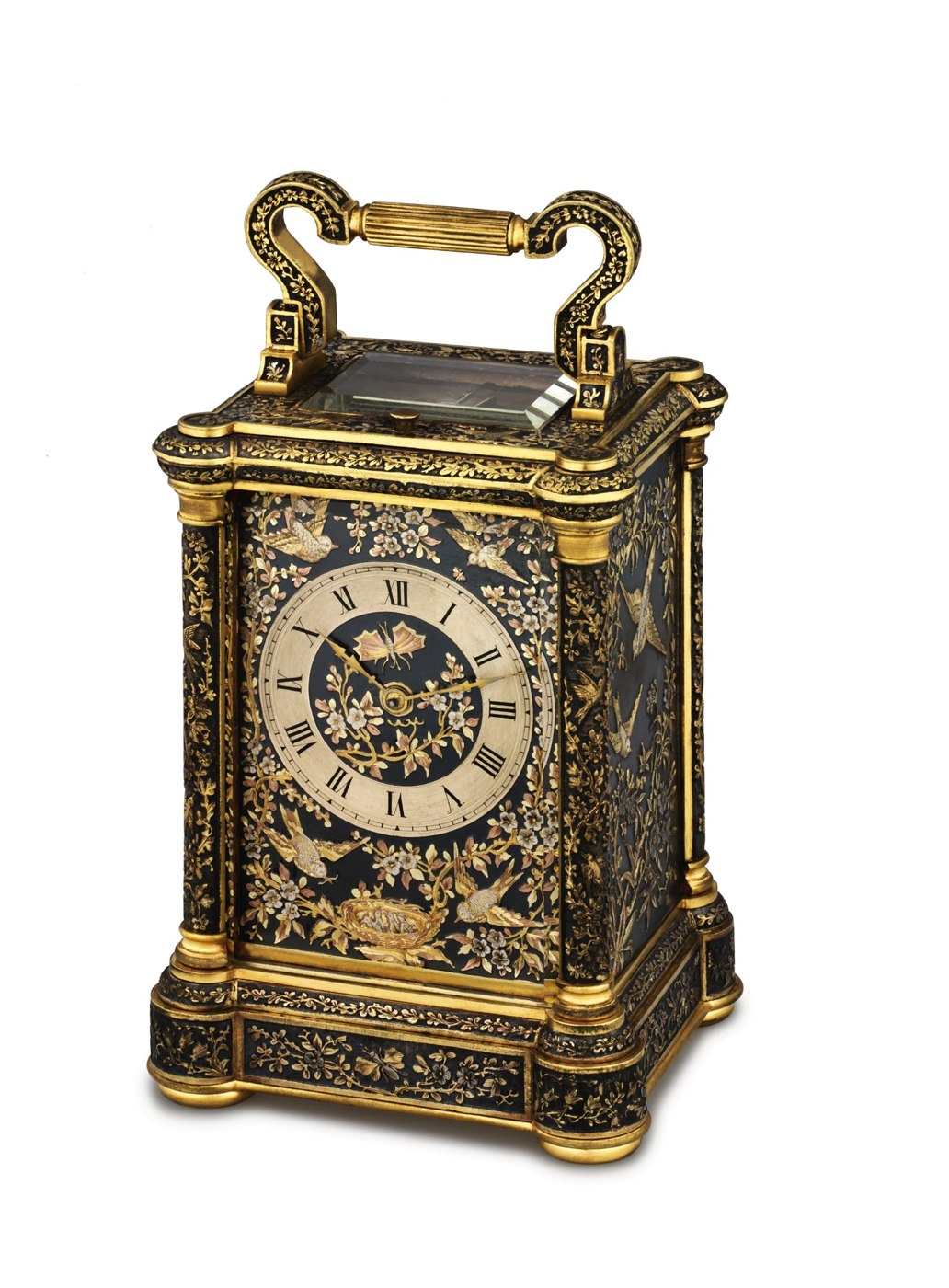
This large carriage clock is attributed to the maker Jacot and dates to approximately 1880. It features an eight-day going train with hour and half-hour striking and repeating functions. The case is constructed from multi-piece gilt brass with a pillar design, further embellished with acid-etched decoration depicting birds, flowers, and foliage against a grey ground. The front, back, and top sections are glazed, with the side panels matching the overall etched theme. The dial consists of a brushed silvered chapter ring with Roman numerals and an outer minute track, with the central mask area echoing the bird and floral motifs of the case, including a nest of chicks. The movement is powered by rectangular brass plates and utilizes going barrels for both the going and striking trains, regulated by a lateral lever escapement mounted on a silvered platform with a bimetallic compensation balance.

A front view of the etched gilt brass carriage clock, displaying the dial with Roman numerals and the ornate bird and foliage motifs on the case.
A front view of the etched gilt brass carriage clock, displaying the dial with Roman numerals and the ornate bird and foliage motifs on the case. — Antiquorum. Rights pending — permission not yet requested. Original source

Catalogue identity

Source
catalog.antiquorum.swiss
Category
Clock · Carriage clock
Maker / attribution
Jacot
Reference
Not recorded
Catalogue / lot identifier
59
Source-reported date
circa 1880
Source-reported place
France

Source-reported attribution and specifications are not independent authentication. A listing does not establish present ownership, current display, availability or permission to reproduce.

Object description

Case and Dial Construction

The clock is housed in a large, multi-piece gilt-brass case. The design incorporates pillars and acid-etched surfaces featuring a detailed motif of birds, flowers, and foliage. The ground of the etching is finished in grey, providing a contrast to the partially silvered elements. The case is glazed on the front, back, and top, and sits on a stepped base.

The dial features a brushed silvered chapter ring with black Roman numerals and a minute track. The central mask and surrounding dial areas are decorated to match the exterior of the case, specifically depicting birds and a nest of chicks nestled within flowering foliage. The clock is fitted with gilt scotties hands.

Evidence for this section
  • “Multi-piece, "pillars", gilt-brass, acid-etched with a partially silvered design of birds, fl owers and foliage on a grey ground”
  • “Brushed silvered chapter ring with radial black Roman numerals”
  • “mask and center decorated to match the case with birds and a nest of chicks amongst fl owering foliage”

Movement and Escapement

The timekeeping and striking mechanisms are housed within rectangular brass plates. The clock is powered by going barrels that serve both the going and striking trains. It is capable of hour and half-hour striking as well as a repeating function, operating via a coiled gong.

The escapement is a lateral lever type, which is mounted upon a silvered platform. Regulation is managed by a cut bimetallic compensation balance paired with a blued steel flat balance spring and an index regulator.

Evidence for this section
  • “Rectangular brass plates, going barrels for the going and striking trains”
  • “lateral lever escapement on a silvered platform, cut bimetallic compensation balance”

Condition and Attribution

The auction description attributes the clock to the maker Jacot and suggests a production date of circa 1880.

Specific condition notes indicate that the movement requires an overhaul, which the catalog notes as being the responsibility of the purchaser. The dial is described as being in 'Very good' condition, and the hands are identified as original.

Evidence for this section
  • “Attributed to Jacot, French. Made circa 1880.”
  • “Case: 3 Good”
  • “Movement: 3* Good Overhaul recommended, at buyer's expense”
  • “HANDS Original”

Open research questions

  • What is the specific historical documentation or style signature linking this object to a maker named Jacot?
  • Does the serial number exist on the movement plates to further verify the identity of the maker?

Source evidence

Recorded claims and source quotations for Jacot Etched Gilt Brass Carriage Clock
FieldSource-reported valueSource quotation
MakerJacot“Attributed to Jacot”
OriginFrench“French”
Datecirca 1880“Made circa 1880.”
Dimensions14.2 x 10.2 x 9.1 cm“Dim. 14.2 x 10.2 x 9.1 cm. excluding handle.”
Movement8-day going, striking and repeating“8-day going, hour and half-hour striking and repeating carriage clock.”
EscapementLateral lever“lateral lever escapement on a silvered platform”
CaseAcid-etched gilt brass“gilt-brass, acid-etched with a partially silvered design”

Visible details

  • Acid-etched gilt brass case featuring a grey ground with foliage and birds.
  • Brushed silvered chapter ring with radial Roman numerals.
  • Movement includes a coiled gong for strike and repeat functions.
  • Hinged handle mounted on top.

Research qualifications

  • The maker attribution is based solely on the auction description.
  • Condition reports note that an overhaul is recommended.

Photograph identity and source facts were screened before import; rights clearance remains pending.