
Skip to content
The Encyclopedia of Horology

Clock · Coach clock

Jacob Hase Hour-Striking Coach Clock

Partially verified

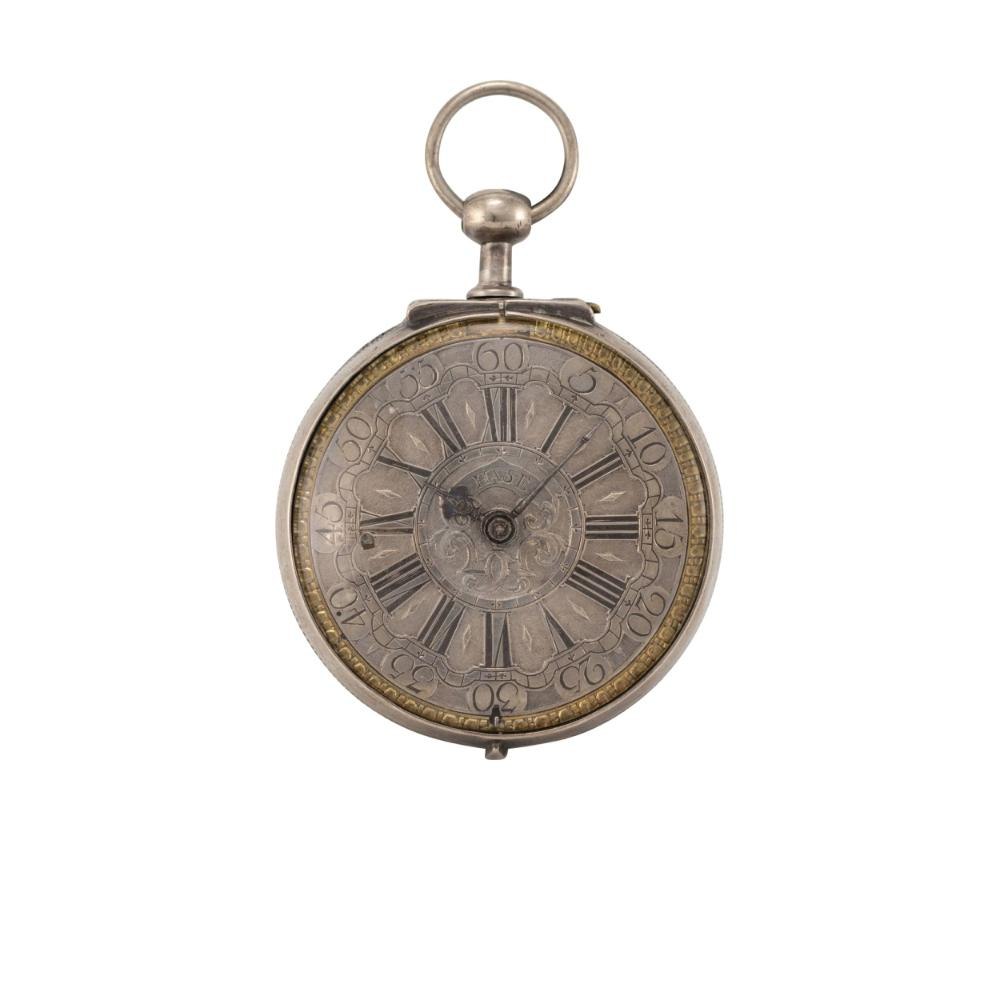
This coach clock, measuring 61 mm in diameter and weighing 227 g, is dated circa 1725 with origins reported in Germany. The auction house attributes the piece presumably to Augsburg Baroque watchmaker Johann Jakob Haase, noting it was previously held in the Fraenkel Collection under inventory number 49. The piece features a silver case with an open-worked rim engraved with hunting dogs and acanthus tendrils, housing a rear bell. Its silver champlevé dial displays Roman hour markers, an outer five-minute track with Arabic numerals, and a central engraved cartouche signed 'HASE'. According to the catalogue, it is driven by a chain-and-fusee full plate movement with a florally engraved barrel, locking plate hour strike mechanism, single hammer, and a three-arm brass balance.

Front view of the silver champlevé dial and coach clock case
Front view of the silver champlevé dial and coach clock case — Auktionen Dr. Crott. Rights pending — permission not yet requested. Original source

Catalogue identity

Source
www.invaluable.com
Category
Clock · Coach clock
Maker / attribution
Presumably Johann Jakob Haase (Augsburg)
Reference
Not recorded
Catalogue / lot identifier
248
Source-reported date
circa 1725
Country
Germany

Source-reported attribution and specifications are not independent authentication. A listing does not establish present ownership, current display, availability or permission to reproduce.

Object description

Object Identity and Attribution

This silver coach clock is categorized as an hour-striking timepiece of German origin, dating to approximately 1725. The auction documentation attributes the work to Johann Jakob Haase, an Augsburg-based clockmaker, though the source qualifies this maker identification as a presumption rather than an absolute verification.

The object has a recorded history associated with the Fraenkel Collection, where it was catalogued as inventory number 49.

Evidence for this section
  • “Presumably the maker of this watch was Johann Jakob Haase in Augsburg”
  • “This watch was previously part of the Fraenkel Collection (inventory no. 49).”
  • “circa 1725”

Case and Dial Construction

The clock is housed in a circular silver case characterized by an open-worked rim. This exterior is decorated with engraved acanthus tendrils and hunting dogs. The design incorporates an overhead hinge, a neck, and a large, round suspension ring. A rear bell is mounted to the case, serving as the audio component for the strike mechanism.

The silver champlevé dial features radial Roman numerals for the hours and an outer chapter ring displaying Arabic numerals in five-minute increments. The center of the dial contains an engraved disc featuring foliate scrollwork and an oval cartouche signed 'HASE', with the time indicated by two dark or blued metal hands.

Evidence for this section
  • “Circular silver case fitted with an overhead hinge, neck, and large round suspension ring.”
  • “Silver champlevé dial featuring radial Roman hour numerals and an outer Arabic five-minute chapter ring (5 to 60).”
  • “open-worked rim decorated with engraved hunting dogs and acanthus tendrils, rear bell.”

Mechanism Specifications

The clock operates via a full-plate movement utilizing a chain-and-fusee system. The power source includes a florally engraved barrel. Timing is regulated by a three-arm brass balance.

The striking mechanism is a locking-plate system configured to actuate a single hammer. The source notes that the movement has undergone minor restorations and remains functional.

Evidence for this section
  • “Movm.: Full plate movement, chain/fusee, florally engraved barrel, locking plate for strike mechanism, 1 hammer, three-arm brass balance.”
  • “Movm.: very good, small restaurations, capable of running.”

Open research questions

  • Does the 'HASE' signature on the dial possess hallmarks or stamps typical of Johann Jakob Haase's verified workshop output?
  • What is the full scope of the 'small restorations' reported by the seller regarding the movement's integrity?
  • Is there existing archival evidence that links inventory number 49 of the Fraenkel Collection specifically to the 1725 production period?

Source evidence

Recorded claims and source quotations for Jacob Hase Hour-Striking Coach Clock
FieldSource-reported valueSource quotation
Dimensions61 mm“Dimensions 61 mm”
Weight227 g“Weight 227 g”
DialSilver champlevé“Dial: Silver champlevé.”
Movement constructionFull plate movement, chain/fusee“Movm.: Full plate movement, chain/fusee”
Striking mechanismLocking plate strike mechanism, 1 hammer“locking plate for strike mechanism, 1 hammer”
ProvenanceFormer Fraenkel Collection (inventory no. 49)“This watch was previously part of the Fraenkel Collection (inventory no. 49).”
Diameter61 mm“Dimensions 61 mm”

Visible details

  • Circular silver case fitted with an overhead hinge, neck, and large round suspension ring.
  • Silver champlevé dial featuring radial Roman hour numerals and an outer Arabic five-minute chapter ring (5 to 60).
  • Central engraved disc bearing foliate scrollwork and an oval cartouche signed 'HASE'.
  • Two blued or dark metal hands centered on the dial arbor.

Research qualifications

  • Maker attribution to Johann Jakob Haase is catalogued by the source as presumed rather than verified.
  • Movement details, striking bell, and engraved rim ornamentation described in the text are obscured or not visible in the front-facing photograph.

Photograph identity and source facts were screened before import; rights clearance remains pending.

Consulted source

At Auction: Jacob Hase - Coach Clock

Reviewed 2026-10-25 · Record d1acf81b63

Terms in this record

Glossary explanations for terms named in this object’s record.