
Skip to content
The Encyclopedia of Horology

Clock · Coach clock

Georg Hörman Half Quarter Repeating Coach Clock

Partially verified

Attributed to Georg Hörmann of Eichstätt and dated by the source to circa 1710, this German coach clock measures 104 mm in diameter and weighs 862 g. The auction catalogue reports an 'à toc et à tact' half quarter repeating mechanism driven by a full plate movement with chain and fusee, verge escapement, and two hammers striking a rear bell. The clock is housed in an openworked, firegilt brass inner case, accompanied by a leather-covered outer transport case. The gilt champlevé dial displays Roman hours and Arabic five-minute numerals, signed in central cartouches.

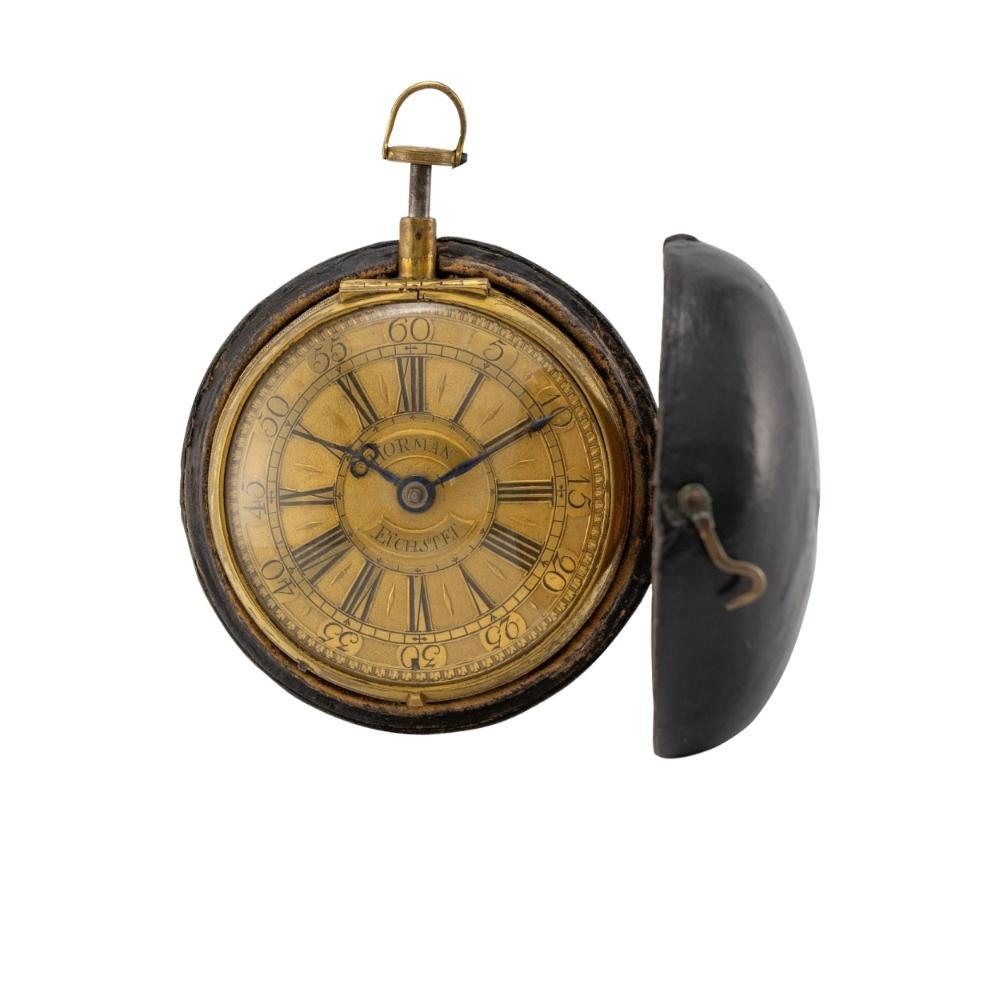
Front view of the Georg Hörman coach clock with gilt champlevé dial in an opened outer leather case
Front view of the Georg Hörman coach clock with gilt champlevé dial in an opened outer leather case — Auktionen Dr. Crott. Rights pending — permission not yet requested. Original source

Catalogue identity

Source
www.invaluable.com
Category
Clock · Coach clock
Maker / attribution
Georg Hörman
Reference
Not recorded
Catalogue / lot identifier
245
Source-reported date
circa 1710
Country
Germany

Source-reported attribution and specifications are not independent authentication. A listing does not establish present ownership, current display, availability or permission to reproduce.

Object description

Attribution and Identification

The object is identified by the source as a German 'à toc et à tact' half quarter repeating coach clock, attributed to the maker Georg Hörmann. The source reports the clock was likely made by Georg (Melchior) Hörmann, who worked in Eichstätt between 1655 and 1710.

The maker's name is rendered inconsistently in the provided documentation: as 'Georg Hörman' in the title, 'HORMAN' on the dial, and 'Georg Hörmann' in the body text. The movement is referenced as being illustrated in 'Die Kutschenuhr' by Lukas Stolberg (1993) and 'Klassik Uhren' (2002).

Evidence for this section
  • “An important Eichstätt "à toc et à tact" half quarter repeating coach clock”
  • “He was most likely Georg (Melchior) Hörmann, who probably worked in Eichstätt between 1655 and 1710.”
  • “The movement of this carriage clock is illustrated and described in "Die Kutschenuhr" by Lukas Stolberg, Munich 1993, p. 242 and in Klassik Uhren 1/2002, Munich 2002, page 16.”

Dial and Visual Features

The clock features a gilt, champlevé dial with radial Roman hours and an outer track with Arabic numerals at five-minute intervals. The dial is signed in central cartouches with 'HORMAN' above the arbor and 'EICHSTET' below.

Visible observations include blued steel hands with an openwork hour hand. The clock features a long cylindrical pendant neck with a stirrup-shaped suspension bow.

Evidence for this section
  • “Dial: Gilt, champlevé.”
  • “Gilt champlevé dial with radial Roman hours and outer track with Arabic numerals at five-minute divisions.”
  • “Central cartouches inscribed 'HORMAN' above the arbor and 'EICHSTET' below.”

Construction and Movement

The clock is housed in a firegilt brass inner case that is artfully openworked and engraved on the sides with Baroque motifs such as acanthus scrolls, volutes, and fanciful birds. It is accompanied by an outer transport case of wood and leather, decorated with an applied silver ornament.

The movement is described as a full plate design with chain and fusee, a verge escapement, a three-arm steel balance, and two hammers striking a rear bell.

Evidence for this section
  • “Inner case - brass, firegilt, artfully openworked and engraved on the sides and decorated with Baroque motifs such as acanthus scrolls, volutes, and fanciful birds, rear bell.”
  • “Accessories Case: Transport case - wood/ leather, silver ornament.”
  • “Movm.: Full plate movement, chain/fusee, 2 hammers, verge escapement, three-arm steel balance.”

Open research questions

  • What is the physical evidence that links the 'HORMAN' signature to the maker Georg (Melchior) Hörmann?
  • Are the specific movement characteristics consistent across the cited literature ('Die Kutschenuhr' and 'Klassik Uhren')?

Source evidence

Recorded claims and source quotations for Georg Hörman Half Quarter Repeating Coach Clock
FieldSource-reported valueSource quotation
ComplicationHalf quarter repeating ('à toc et à tact')“An important Eichstätt "à toc et à tact" half quarter repeating coach clock”
Dimensions104 mm“Dimensions 104 mm”
Weight862 g“Weight 862 g”
DialGilt, champlevé“Dial: Gilt, champlevé.”
MovementFull plate, chain/fusee, verge escapement, 2 hammers“Full plate movement, chain/fusee, 2 hammers, verge escapement, three-arm steel balance.”
OriginGermany (Eichstätt)“Origin Deutschland”

Visible details

  • Gilt champlevé dial with radial Roman hours and outer track with Arabic numerals at five-minute divisions.
  • Central cartouches inscribed 'HORMAN' above the arbor and 'EICHSTET' below.
  • Blued steel hands, with an openwork hour hand.
  • Fitted within an open outer dark leather transport case featuring a metal catch/hook on the hinged cover.
  • Long cylindrical pendant neck with a stirrup-shaped suspension bow at the top.

Research qualifications

  • The internal movement, rear bell, and openworked case sides described in the catalogue are obscured from view in the front photograph.
  • The maker's name is rendered variously as 'Georg Hörman' in the lot title, 'HORMAN' on the dial, and 'Georg Hörmann' in the body text.
  • Dating to circa 1710 and technical movement details rely entirely on source reporting.

Photograph identity and source facts were screened before import; rights clearance remains pending.

Consulted source

At Auction: Georg Hörman - Coach Clock

Reviewed 2026-10-25 · Record 698ae0bf1e

Terms in this record

Glossary explanations for terms named in this object’s record.

Other coach clock records