
Skip to content
The Encyclopedia of Horology

Clock · Atmos clock

J.L. Reutter Patent Atmos Clock

Partially verified

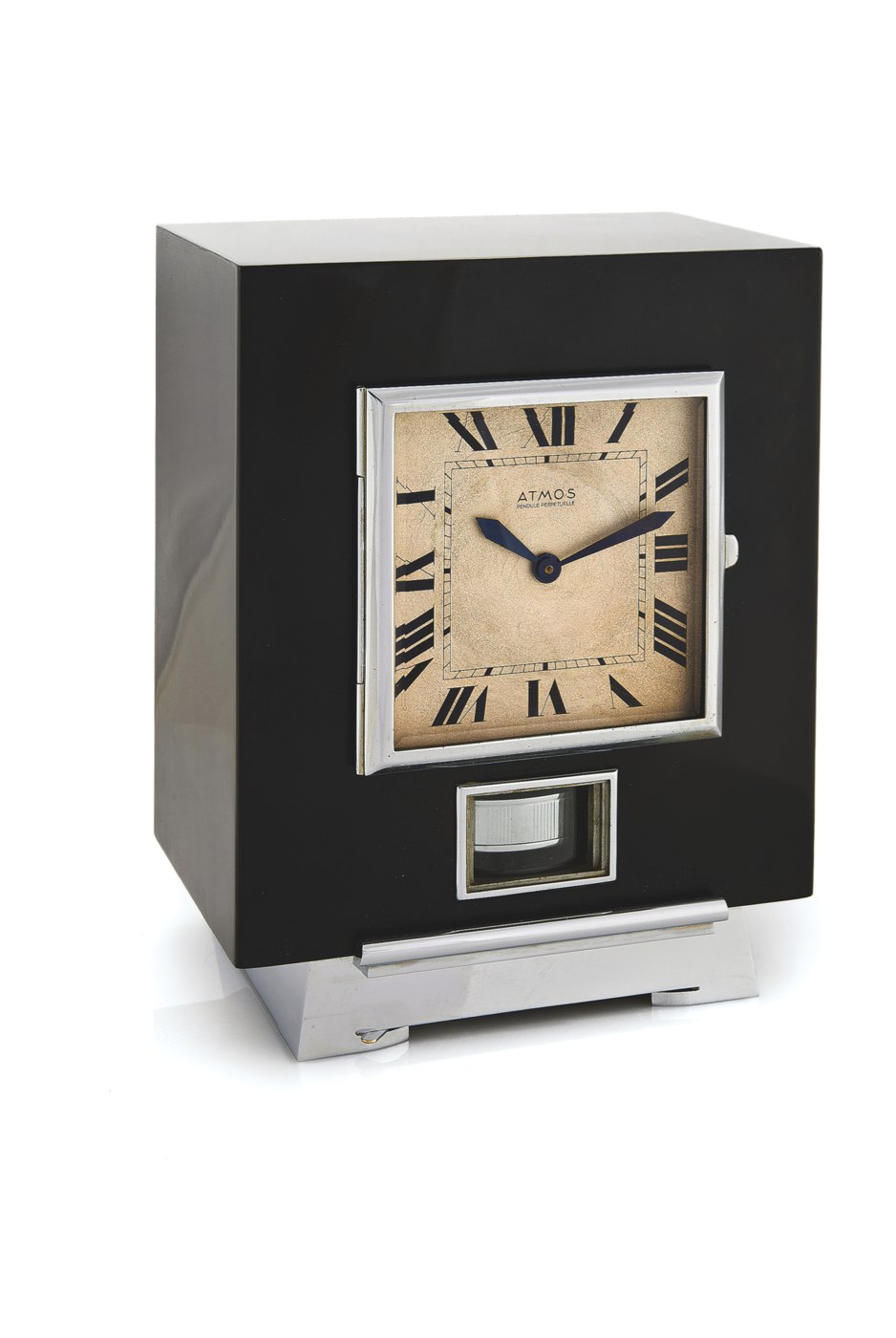
This Atmos Pendule Perpetuelle, numbered 6883, is an early example of a clock design by J. L. Reutter, produced in France circa 1933. The object features a rectangular body constructed of black lacquered steel, supported by a chromed inclined base. Its primary mechanism relies on a mercury-in-glass expansion device responding to barometric pressure fluctuations, which drives a vacuum chamber to wind the going barrel. The time is displayed on a matte silver dial featuring radial Roman numerals and an inner minute track, with blued steel sword hands. A small aperture on the front of the lacquered case reveals the annular torsion pendulum. The movement is finished in chrome and includes a locking lever located in the base. An applied plaque on the case back confirms its origin with an inscription referencing the J. L. Reutter patent. The overall dimensions are 24 cm in height, 19 cm in width, and 12 cm in depth.

Front view of the Atmos clock showing the black lacquered body, silvered dial, and lower pendulum aperture.
Front view of the Atmos clock showing the black lacquered body, silvered dial, and lower pendulum aperture. — Antiquorum. Rights pending — permission not yet requested. Original source

Catalogue identity

Source
catalog.antiquorum.swiss
Category
Clock · Atmos clock
Maker / attribution
J.L. Reutter
Reference
Not recorded
Catalogue / lot identifier
370
Source-reported date
circa 1933
Source-reported place
France
Source-reported serial
6883

Source-reported attribution and specifications are not independent authentication. A listing does not establish present ownership, current display, availability or permission to reproduce.

Object description

Case and Dial Construction

The clock is housed in a rectangular, black lacquered steel case that contrasts with a chromed inclined base. The design includes a specific aperture on the lower portion of the front face, which provides visual access to the annular torsion pendulum. The bezel is also executed in chrome, framing the display.

The dial is finished in a matte silver surface and features painted radial Roman numerals alongside an inner minute track. Time is indicated by blued steel sword-style hands.

Evidence for this section
  • “C. Rectangular, black lacquered body, chromed inclined base, aperture to view the pendulum, chromed bezel.”
  • “D. Matte silver with painted radial Roman numerals, inner minute track. Blued steel sword hands.”

Movement and Mechanism

The movement is chrome-finished and operates on the principle of energy derived from barometric pressure changes. A mercury-in-glass expansion device facilitates the winding of the going barrel, which is maintained by a blued steel spring and ratchet mechanism. This unique power source is housed within a vacuum chamber system.

The timekeeping assembly comprises a lever escapement regulated by an annular torsion pendulum. A locking lever is positioned in the base directly below the pendulum, intended to secure the delicate mechanism during transport or when the clock is not in operation.

Evidence for this section
  • “M. Chrome, vacuum chamber with rotating drum driven by a mercury in glass expansion device winding the going barrel by a blued steel spring and ratchet, lever escapement driven by annular torsion pendulum, locking lever in the base below the pendulum.”

Signatures and Condition

The object carries an applied plaque on the case back, which provides explicit information regarding its technical provenance. The inscription confirms the patent rights and the place of manufacture for this unit.

Regarding its physical condition, the auction description provides a grade for individual components. The case and the movement are both assessed as 'Good'.

Evidence for this section
  • “Applied plaque on the case back inscribed ?Brevets J. L. Reutter S.G.D.G., Made in France.?”
  • “Grading System Grade: AA Very good Case: 3 Good Movement: 3* Good Overhaul recommended, at buyer's expense Dial: 3-10-01 Good”

Open research questions

  • What is the specific nature of the '3-10-01' notation in the dial condition report?
  • Has the mercury-in-glass device been replaced or restored in the clock's history?

Source evidence

Recorded claims and source quotations for J.L. Reutter Patent Atmos Clock
FieldSource-reported valueSource quotation
MakerJ. L. Reutter“J. L. Reutter patent”
Serial Number6883“No. 6883”
Datecirca 1933“Made circa 1933”
Country of originFrance“Made in France.”
Case materialBlack lacquered steel and chrome“black lacquered steel and chrome”
Dimensions24 cm x 19 cm x 12 cm“HEIGHT 24 cm., WIDTH 19 cm., DEPTH 12 cm.”
Movement typePerpetual, barometric pressure winding“?perpetual? clock wound by changes in barometric pressure”
Dial detailsMatte silver, Roman numerals“Matte silver with painted radial Roman numerals”

Visible details

  • Black lacquered rectangular casing
  • Chromed inclined base
  • Matte silver dial with painted radial Roman numerals
  • Annular torsion pendulum visible through lower aperture

Research qualifications

  • The internal state of the mercury-in-glass expansion device is unverified.
  • The long-term functionality of the movement is not guaranteed without professional intervention.

Photograph identity and source facts were screened before import; rights clearance remains pending.

Terms in this record

Glossary explanations for terms named in this object’s record.