
Skip to content
The Encyclopedia of Horology

Clock · Atmos clock

Jaeger-LeCoultre Atmos du Millénaire Atlantis Clock

Partially verified

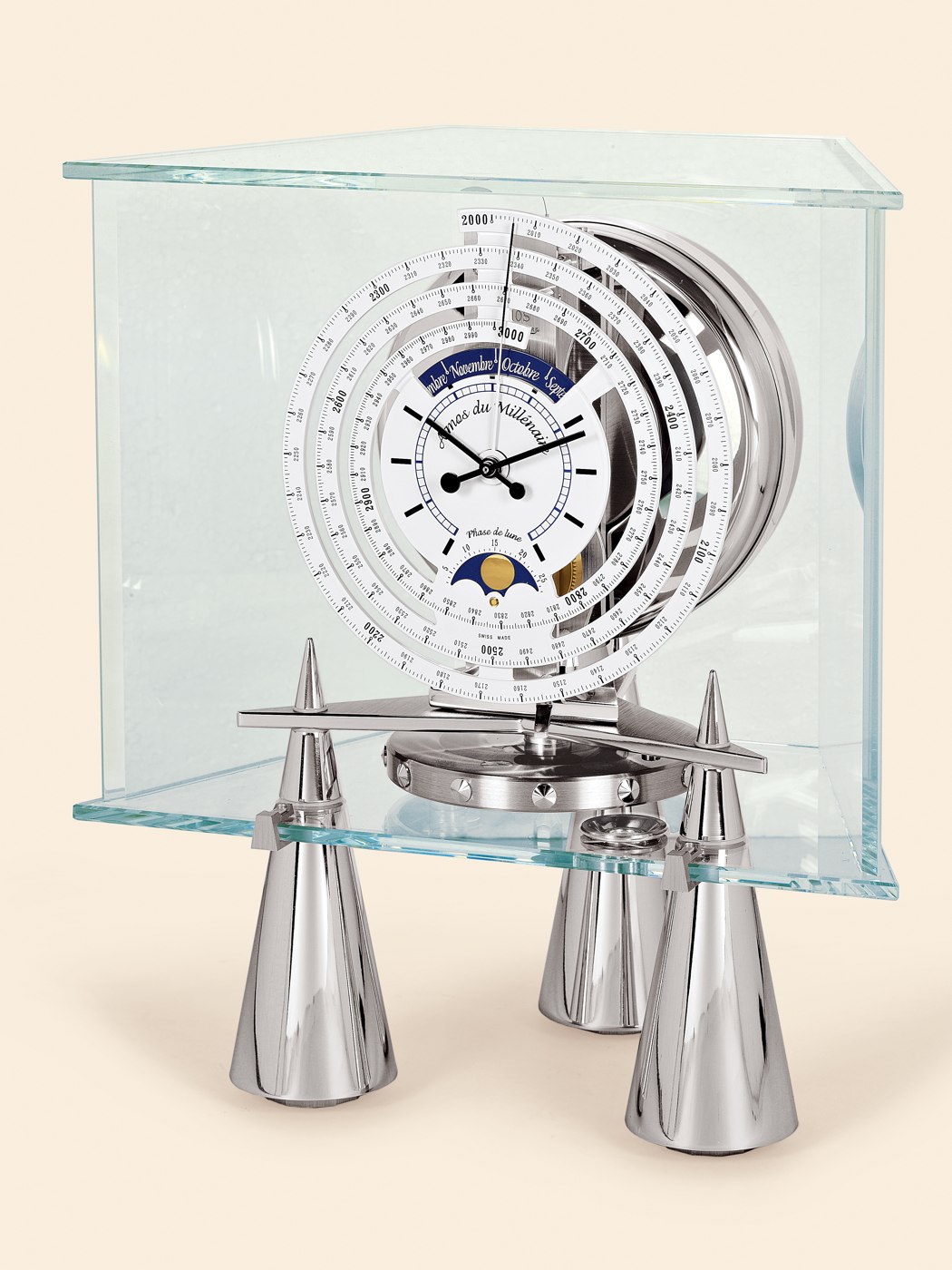
The Atmos du Millénaire 'Atlantis' is a specialized barometric change-driven clock produced by Jaeger Le Coultre from 1999, intended as part of an annual series of 50 units. Constructed from stainless steel and bevelled glass panels, the clock features a wedge-shaped profile supported by three conical feet and includes an integrated spirit level for leveling. The movement operates via a vacuum chamber that winds the mainspring, utilizing temperature and barometric pressure fluctuations to power an annular tension pendulum. The white lacquered dial incorporates a 12-month indicator, moon phases with a lunar calendar, and a distinctive spiral scale calibrated for years extending to 3000. It is designed to function without manual winding for extended periods. The entire assembly measures 27 x 25 x 14 centimeters and is accompanied by a fitted presentation box as described in the accompanying auction details.

Frontal view of the Jaeger-LeCoultre Atmos du Millénaire 'Atlantis' clock showing the dial, lunar calendar, and glass housing.
Frontal view of the Jaeger-LeCoultre Atmos du Millénaire 'Atlantis' clock showing the dial, lunar calendar, and glass housing. — Antiquorum. Rights pending — permission not yet requested. Original source

Catalogue identity

Source
catalog.antiquorum.swiss
Category
Clock · Atmos clock
Maker / attribution
Jaeger Le Coultre
Reference
Atmos du Millénaire 'Atlantis'
Catalogue / lot identifier
150
Source-reported date
From 1999
Source-reported place
Not established

Source-reported attribution and specifications are not independent authentication. A listing does not establish present ownership, current display, availability or permission to reproduce.

Object description

Case and Dial Construction

The case is constructed from glass panels with bevelled edges, arranged in a wedge-shaped configuration. It is elevated by three conical stainless steel feet that provide stability and a distinct visual profile. An integrated spirit level is inset within the structure to ensure proper positioning on a level surface.

The dial is finished in white lacquer and features baton indexes, a central minute ring, and a separate disc for months. The lower portion of the dial displays a moon phase aperture integrated with a lunar calendar. A prominent feature is the outer spiral scale, which tracks individual years up to the year 3000, catering to the millennial theme of the timepiece.

Evidence for this section
  • “C. Wedge-shaped and constructed from bevelled glass panels, raised on three conical stainless steel feet, inset spirit level.”
  • “D. White laquered with painted baton indexes, inner minute ring, blue painted months disc above, the names of the months painted in white, aperture for the moon phases below with lunar calendar, outer spiral scale calibrated for each year until the year 3000.”

Movement and Mechanism

The clock is powered by a mechanical movement that requires no manual winding, instead utilizing a vacuum chamber that responds to fluctuations in temperature and barometric pressure. The movement incorporates a lever escapement, which is regulated by an annular tension pendulum. The mechanism includes a locking lever situated above the pendulum disc for safety during transport or storage, and a regulator positioned at the top of the assembly.

Designed to function for extended periods without external input, the movement leverages even slight environmental changes to maintain its operation. According to the provided information, a temperature variation of a single degree is sufficient to power the clock for approximately two days of operation.

Evidence for this section
  • “M. Stainless steel, vacuum chamber winding the going barrel, lever escapement driven by annular tension pendulum, locking lever above the pendulum disc, regulator at top.”
  • “a fluctuation of only one degree is sufficient for two days? operation.”

Provenance and Condition

The auction description lists this clock as the property of a Chinese Gentleman. Regarding the current condition, the auction documentation provides a grading of 'AA' for the overall object, with individual grades of 2 for the case, movement, and dial.

The clock is provided with a fitted box as part of the lot.

Evidence for this section
  • “Property of a Chinese Gentleman”
  • “Grading System Grade: AA Very good Case: 2 Very good Movement: 2 Very good Dial: 2-01 Very good”
  • “The Atmos clock was invented by Neuchâtel engineer Jean-Léon Reutter (1899-1971).”

Open research questions

  • Does this specific unit bear a serial number on the base or movement that confirms its production year within the 1999 onwards series?
  • Are there any specific regional variations or distinct markings for the units produced for the Chinese market?

Source evidence

Recorded claims and source quotations for Jaeger-LeCoultre Atmos du Millénaire Atlantis Clock
FieldSource-reported valueSource quotation
MakerJaeger Le Coultre“Jaeger Le Coultre”
ModelAtmos du Millénaire 'Atlantis'“Atmos du Millénaire 'Atlantis'”
Dimensions27 x 25 x 14 cm“Dim. 27 x 25 x 14 cm”
MaterialsStainless steel and glass“stainless steel and glass”
Power sourceBarometric change-driven“barometric change-driven clock”
Calendar rangeUp to the year 3000“outer spiral scale calibrated for each year until the year 3000”
Movement detailsVacuum chamber winding and annular tension pendulum“vacuum chamber winding the going barrel, lever escapement driven by annular tension pendulum”

Visible details

  • Wedge-shaped glass case with bevelled edges
  • Three conical stainless steel support feet
  • Spiral calendar scale extending to year 3000
  • Moon phase aperture positioned at lower dial

Research qualifications

  • Total production quantity per year is stated as 'according to' the manufacturer
  • Exact serial number for this specific unit is not provided in the source

Photograph identity and source facts were screened before import; rights clearance remains pending.

Terms in this record

Glossary explanations for terms named in this object’s record.