
Skip to content
The Encyclopedia of Horology

Clock · Atmos clock

Atmos Clock - Jaeger LeCoultre

Partially verified

This Atmos clock, manufactured in 1953 in Geneva, Switzerland, is a self-winding timekeeper designed to operate based on atmospheric temperature fluctuations. The mechanism utilizes a sealed container filled with a mixture of gas and ethyl chloride. Changes in ambient temperature cause the internal mixture to expand and contract, which in turn compresses and releases a spiral spring that winds the mainspring. The manufacturer states that a one-degree temperature change provides enough energy to power the clock for two days. The movement features a torsion pendulum, which is visible at the base of the clock and oscillates at a rate of two oscillations per minute. The overall dimensions of the clock are 22 cm in length, 16 cm in width, and 22.5 cm in height. The movement is inscribed with the serial number 60196 on the top plate.

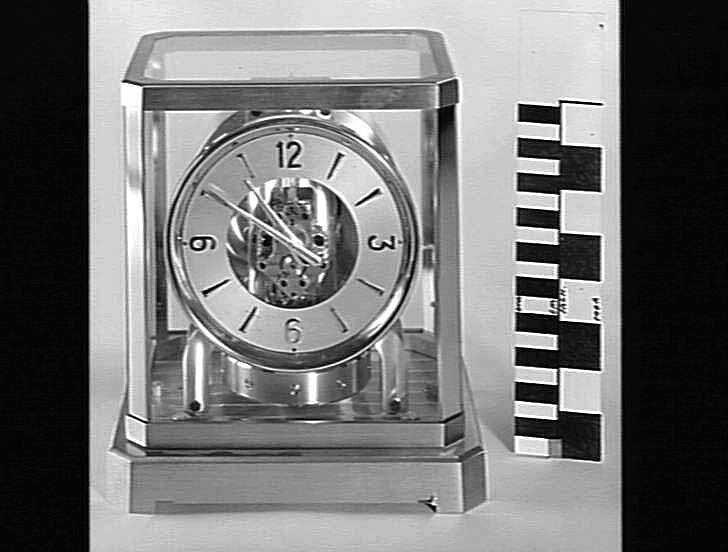
Front view of the Atmos clock showing the dial, pendulum, and transparent housing.
Front view of the Atmos clock showing the dial, pendulum, and transparent housing. — Museums Victoria. Rights pending — permission not yet requested. Original source

Catalogue identity

Source
collections.museumsvictoria.com.au
Category
Clock · Atmos clock
Maker / attribution
Jaeger-Lecoultre
Reference
Not recorded
Catalogue / lot identifier
ST 29854
Source-reported date
1953
Source-reported place
Switzerland
Source-reported serial
60196

Source-reported attribution and specifications are not independent authentication. A listing does not establish present ownership, current display, availability or permission to reproduce.

Object description

Construction and Mechanism

The Atmos clock operates through a physical process triggered by environmental temperature changes. The core of the winding system is a sealed capsule containing a combination of gas and ethyl chloride. As the ambient temperature shifts, the mixture inside the capsule expands or contracts, exerting mechanical force on a spiral spring that effectively winds the clock's mainspring.

The timekeeping is regulated by a torsion pendulum positioned in the lower section of the movement. This pendulum is designed for a low oscillation rate, completing only two oscillations every sixty seconds. This slow-moving action minimizes energy consumption, allowing the clock to maintain function through the energy harvested from temperature variations.

Evidence for this section
  • “A mixture of gas and ethyl chloride in a sealed container expands and contracts with changes in temperature”
  • “A torsion pendulum completes only two oscillations per minute.”

Signatures and Identification

The object is identified as a Jaeger-Lecoultre timepiece. It is assigned the registration number ST 29854 within the museum collection. This specific unit was manufactured in 1953 in Geneva, Switzerland.

Internal identification is provided by a number stamped onto the movement. The top of the movement bears the inscription '60196', which serves as the specific serial number for this clock mechanism.

Evidence for this section
  • “Association: type: Manufacturer, name: Jaeger-Lecoultre, date: 1953, locality: Geneva, country: Switzerland”
  • “Registration number: ST 29854”
  • “Stamped on top of movement: '60196'.”

Dimensions and Physical Form

The clock is housed in a clear rectangular case that protects the movement while allowing visibility of the internal components. The assembly measures 22 cm in length, 16 cm in width, and 22.5 cm in height.

The face of the clock features a circular dial, which displays the time via a standard hand arrangement.

Evidence for this section
  • “Overall Dimensions, dimensions: 22 cm (Length), 16 cm (Width), 22.5 cm (Height)”

Open research questions

  • Does the serial number 60196 correspond to specific production batches from 1953?
  • Are there additional proprietary marks on the bellows capsule?

Source evidence

Recorded claims and source quotations for Atmos Clock - Jaeger LeCoultre
FieldSource-reported valueSource quotation
MakerJaeger-Lecoultre“Manufacturer, name: Jaeger-Lecoultre”
Date1953“date: 1953”
Serial Number60196“Stamped on top of movement: '60196'.”
Manufacturing LocationGeneva, Switzerland“locality: Geneva, country: Switzerland”
Power MechanismTemperature-driven expansion of gas and ethyl chloride“A mixture of gas and ethyl chloride in a sealed container expands and contracts with changes in temperature”
Pendulum PerformanceTwo oscillations per minute“A torsion pendulum completes only two oscillations per minute.”
Registration NumberST 29854“Registration number: ST 29854”

Visible details

  • Circular dial with Arabic numerals at 3, 6, 9, and 12 positions
  • Visible torsion pendulum located at the base of the movement
  • Rectangular glass casing with metallic frame structure
  • Gas-filled bellows capsule visible behind the dial

Research qualifications

  • Verification of internal movement parts beyond the exterior view
  • Confirmation of the original state of the gas-filled bellows

Photograph identity and source facts were screened before import; rights clearance remains pending.

Consulted source

Atmos Clock - Jaeger LeCoultre, 1953

Reviewed 2026-10-26 · Record 38fd7eae87

Terms in this record

Glossary explanations for terms named in this object’s record.