
Skip to content
The Encyclopedia of Horology

Tool · German horizontal dial

Horizontal string-gnomon sundial by Markus Purmann

Partially verified

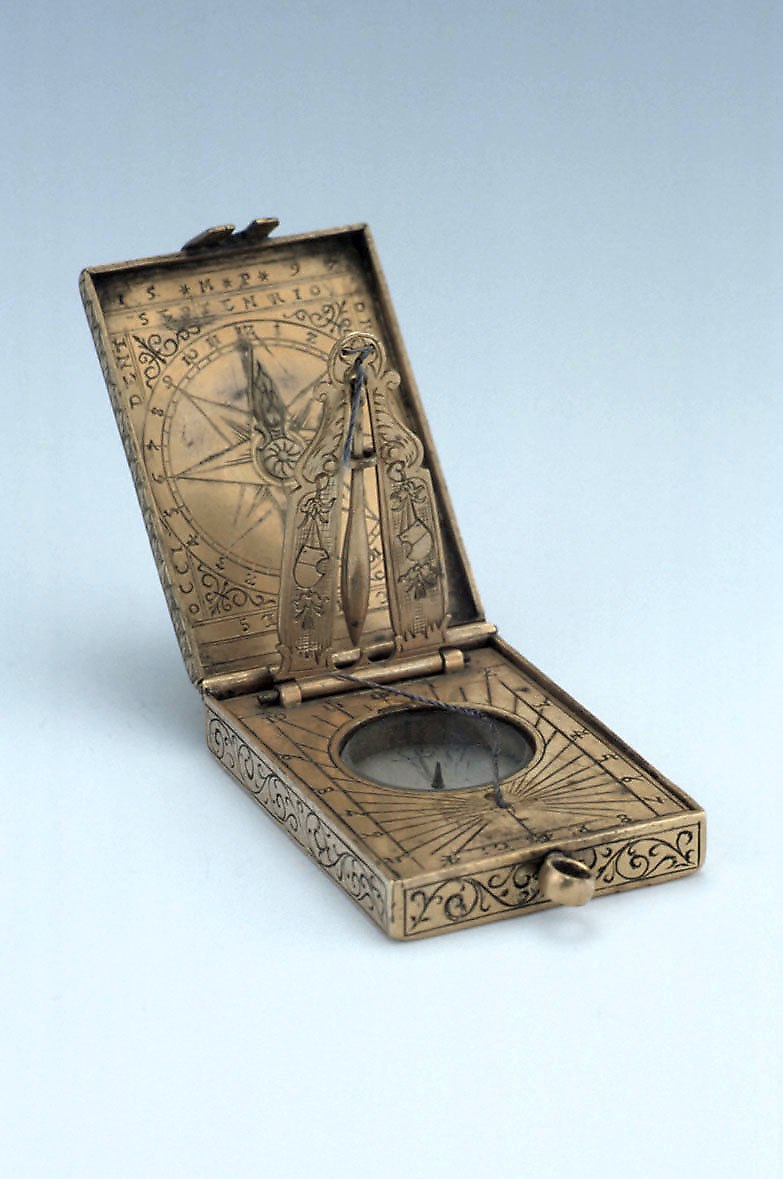
This German horizontal sundial, crafted from gilt and silvered brass, measures 54 x 32 x 11 mm. Created by Markus Purmann in 1597, the instrument features a rectangular box with a hinged lid. The lid incorporates a suspension ring that also acts as a locking mechanism. The interior of the lid contains a volvelle with a circular hour scale and a central rotating index. The main body of the instrument houses a string-gnomon sundial with a folding, decorated support equipped with a plummet. The base includes an inset compass with a silvered bowl marked for magnetic variation. The dial plate displays hours from 4 to 12 to 8, calibrated for a specific latitude of 48 degrees. The exterior surfaces of the brass box are finished with detailed engravings, including foliage, flowers, and an urn. The instrument is part of the Lewis Evans Collection held at the Museum of the History of Science, Oxford.

The horizontal string-gnomon sundial in its opened state, showing the compass, the gnomon support with soldiers, and the inner lid decoration.
The horizontal string-gnomon sundial in its opened state, showing the compass, the gnomon support with soldiers, and the inner lid decoration. — Museum of the History of Science, Oxford. Rights pending — permission not yet requested. Original source

Catalogue identity

Source
www.mhs.ox.ac.uk
Category
Tool · German horizontal dial
Maker / attribution
Markus Purmann
Reference
36320
Catalogue / lot identifier
36320
Source-reported date
1597
Source-reported place
Germany

Source-reported attribution and specifications are not independent authentication. A listing does not establish present ownership, current display, availability or permission to reproduce.

Object description

Construction and Functionality

The instrument is constructed from gilt and silvered brass, forming a small rectangular box measuring 54 by 32 by 11 millimeters. It features a hinged lid secured by a suspension ring, which also functions as a locking mechanism for the cover. The horizontal sundial is positioned within the main box, utilizing a string gnomon supported by a hinged, decorative folding structure. This support is spring-loaded to maintain a vertical orientation and includes an integrated plummet.

The internal dial plate is marked with a scale ranging from 4 to 12 to 8, with additional divisions for half-hour increments. A silvered-bowl compass, measuring 21 millimeters in diameter, is recessed into the base, marked to indicate magnetic variation. The latitude for which the dial is calibrated is stated on the plate as 48 degrees.

Evidence for this section
  • “The instrument consists of a hinged lid and a box with a suspension ring which also serves as a lock for retaining the lid.”
  • “The main box carries a horizontal string-gnomon sundial with a decorated folding gnomon support which is sprung to the vertical and incorporates a plummet.”
  • “The latitude of use is given as 'P: 48 G:'.”

Decorative Elements and Signatures

The instrument is heavily decorated with engraved motifs across its exterior and interior surfaces. The lid's outer face displays an engraved urn surrounded by floral and foliage patterns, while the sides of the box feature a repeating leaf design. The maker, Markus Purmann, identified his work using a stylized monogram consisting of the initials 'MP' accompanied by the date 1597.

The inner side of the cover features a volvelle consisting of a circular hour scale divided into half-hour segments, surrounding a central wind rose design with a rotating index. The edges of the dial plate are inscribed with the Latin names for the cardinal directions: 'SEPTENRIO', 'ORIENT', 'MERIDIES', and 'OCCIDENT'.

Evidence for this section
  • “The outer face of the cover is decorated with an engraved urn, flowers and foliage. Its sides carry a leaf pattern.”
  • “The maker Markus Purmann identifies himself only by the initials 'MP' combined in a characteristic way with the date: '15 [star] M [star] P [star] 97'.”
  • “A circular scale of hours 1 to 12, 1 to 12, divided to 1/2 surrounds a wind rose star and a rotating index is fixed at the centre.”

Provenance and Documentation

This object is part of the Museum of the History of Science, Oxford, identified by inventory number 36320. It originated from the Lewis Evans Collection, documented under the reference G. 363. The museum notes that the function of the hour scale located on the interior of the cover is not currently known.

The documentation identifies the maker through the signature found on the inner face of the cover, which combines the initials with the date of manufacture. The instrument is attributed to German manufacture based on the characteristics identified by the museum record.

Evidence for this section
  • “Provenance: Lewis Evans Collection G. 363.”
  • “The purpose of the hour scale is uncertain.”
  • “Dated 1597; German”

Open research questions

  • What was the intended purpose of the volvelle on the inside of the lid?
  • Is it possible to determine if the '48 G' latitude refers to a specific city where Purmann was active?

Source evidence

Recorded claims and source quotations for Horizontal string-gnomon sundial by Markus Purmann
FieldSource-reported valueSource quotation
MakerMarkus Purmann“Signed by Markus Purmann”
Date1597“Dated 1597”
MaterialGilt and silvered brass“Gilt and silvered brass”
Dimensions54 x 32 x 11 mm“54 x 32 x 11 mm”
Compass Diameter21 mm“The inset compass is 21 mm in diameter”
ProvenanceLewis Evans Collection“Provenance: Lewis Evans Collection G. 363.”
Latitude48 degrees“The latitude of use is given as 'P: 48 G:'”

Visible details

  • The gnomon support features two soldiers with lances
  • The exterior sides are decorated with a leaf pattern
  • Cardinal directions are marked on the dial plate edges
  • The lid interior features a volvelle with a wind rose star

Research qualifications

  • The intended purpose of the volvelle hour scale on the cover remains uncertain
  • The specific geographical location intended by the latitude 48 degrees remains unspecified

Photograph identity and source facts were screened before import; rights clearance remains pending.

Consulted source

Horizontal Dial

Reviewed 2026-10-26 · Record 65b15a5784

Terms in this record

Glossary explanations for terms named in this object’s record.