
Skip to content
The Encyclopedia of Horology

Tool · German horizontal dial

Horizontal Sundial with Compass

Partially verified

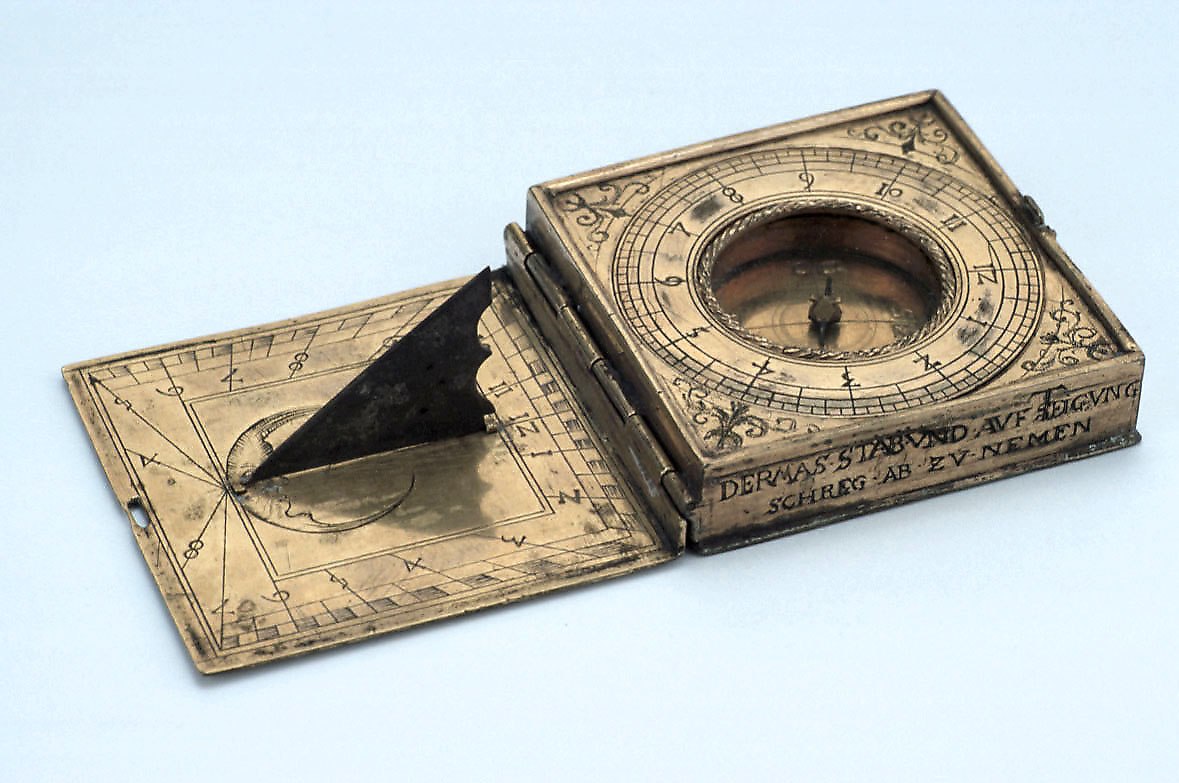
This horizontal dial is a German-made instrument from the later 16th century, constructed of gilt brass and silver and measuring 54 x 54 x 14 mm. Although the maker is unknown, the object features an inscription naming 'IOAN BAPTISTA NAVMAN' within a scroll around a crested coat of arms on the cover. The instrument consists of a square-section box with a hinged lid that opens flat. The interior lid features a horizontal sundial with hours marked 4 to 12 to 8, while the main box houses a 29 mm compass with a rotating scale of equal parts. The device incorporates German inscriptions on its sides and exhibits decorative stipple-engraved corners. Its provenance includes the Michel and Billmeir Collections. The silver folding gnomon is a reported replacement.

Horizontal dial showing the compass, gnomon, and hour scales.
Horizontal dial showing the compass, gnomon, and hour scales. — Museum of the History of Science, Oxford. Rights pending — permission not yet requested. Original source

Catalogue identity

Source
www.mhs.ox.ac.uk
Category
Tool · German horizontal dial
Maker / attribution
Not established
Reference
Not recorded
Catalogue / lot identifier
54946
Source-reported date
Later 16th century
Source-reported place
Germany

Source-reported attribution and specifications are not independent authentication. A listing does not establish present ownership, current display, availability or permission to reproduce.

Object description

Construction and Design

The instrument is configured as a square-section box formed of gilt brass and silver. Its design features a hinged lid that, when fully opened, rests on the same surface as the main box body. The exterior of the lid is adorned with a central crested coat of arms encircled by a scroll containing the name 'IOAN BAPTISTA NAVMAN', accompanied by four emblematic or mythological engravings in the corners.

The internal layout deviates from the common arrangement, as the sundial dial face is integrated into the inside of the lid rather than the main box. The sundial features an hour scale running from 4 to 12 to 8, with fractional graduations between 5 and 7. The silver folding gnomon, positioned above an engraved crescent moon, is described as a replacement.

Evidence for this section
  • “The instrument is in the form of square-section box with a lid. The lid is hinged in such a way that, when opened, it lies on the same surface as the rest of the instrument.”
  • “The inside face of the lid carries a horizontal dial with the hours running from 4 to 12 to 8”
  • “The silver folding gnomon is said to be a replacement and sits above an engraving figure of the crescent moon.”

Compass and Dial Mechanics

The base of the instrument contains a 29 mm diameter compass, the glass of which is held by a ropework ring-spring. Cardinal points are marked 'SE', 'OR', 'ME', and 'OC'. Enclosing the compass is a circular scale of equal parts numbered 1 to 12, featuring subdivisions for 1, 1/2, 1/4, and eighths.

Both the compass and the surrounding scale are designed to be rotated together. The corners of the face surrounding the compass are embellished with stipple-engraving, and the overall construction reflects German technical traditions from the latter half of the 16th century.

Evidence for this section
  • “The main box contains a compass of 29 mm diameter whose glass is held in place by a ropework ring-spring.”
  • “Around the compass is circular scale of equal parts 1 to 12, divided to 1, 1/2, 1/4 and eighths. The scale and compass can be rotated together.”

Inscriptions and Provenance

The instrument is unmarked by a maker but bears significant inscriptions on its sides: 'NICHTER KEIT IST EIN LERIN ALER GVENTEN KVNST' and 'DIE. VER . GVNGERVNG DERMAS . STAB . VND . AVF STEIGVNG . SCHREG . AB . ZV . NEMEN'. These German texts serve to identify the object's origin.

The instrument was previously part of the Michel Collection and the Billmeir Collection (57-84/54). Currently, it is held by the Museum of the History of Science, Oxford.

Evidence for this section
  • “the sides carry the inscriptions: 'NICHTER KEIT IST EIN LERIN ALER GVENTEN KVNST' and 'DIE. VER . GVNGERVNG DERMAS . STAB . VND . AVF STEIGVNG . SCHREG . AB . ZV . NEMEN'”
  • “Provenance: Michel Collection, Billmeir Collection (57-84/54).”

Open research questions

  • What is the specific meaning of the four emblematic images located on the corners of the lid?
  • Does the compass orientation align with standard German magnetic variation of the late 16th century?

Source evidence

Recorded claims and source quotations for Horizontal Sundial with Compass
FieldSource-reported valueSource quotation
Inventory Number54946“Inventory number: 54946”
MaterialGilt brass and silver“Gilt brass and silver”
Dimensions54 x 54 x 14 mm“54 x 54 x 14 mm”
Compass Diameter29 mm“contains a compass of 29 mm diameter”
ProvenanceMichel Collection, Billmeir Collection“Provenance: Michel Collection, Billmeir Collection (57-84/54)”
Inscription 1IOAN BAPTISTA NAVMAN“'IOAN BAPTISTA NAVMAN'”
Inscription 2NICHTER KEIT IST EIN LERIN ALER GVENTEN KVNST“'NICHTER KEIT IST EIN LERIN ALER GVENTEN KVNST'”

Visible details

  • Hinged lid opens to lie on the same plane as the box base
  • Compass glass secured by a ropework ring-spring
  • Cardinal points engraved as 'SE', 'OR', 'ME' and 'OC'
  • Silver gnomon sits atop an engraved crescent moon

Research qualifications

  • The silver folding gnomon is reported to be a later replacement
  • The precise significance of the four emblematic images on the cover remains unknown

Photograph identity and source facts were screened before import; rights clearance remains pending.

Consulted source

Horizontal Dial

Reviewed 2026-10-26 · Record 04225c80f1

Terms in this record

Glossary explanations for terms named in this object’s record.