
Skip to content
The Encyclopedia of Horology

Tool · German horizontal dial

Horizontal Sundial

Partially verified

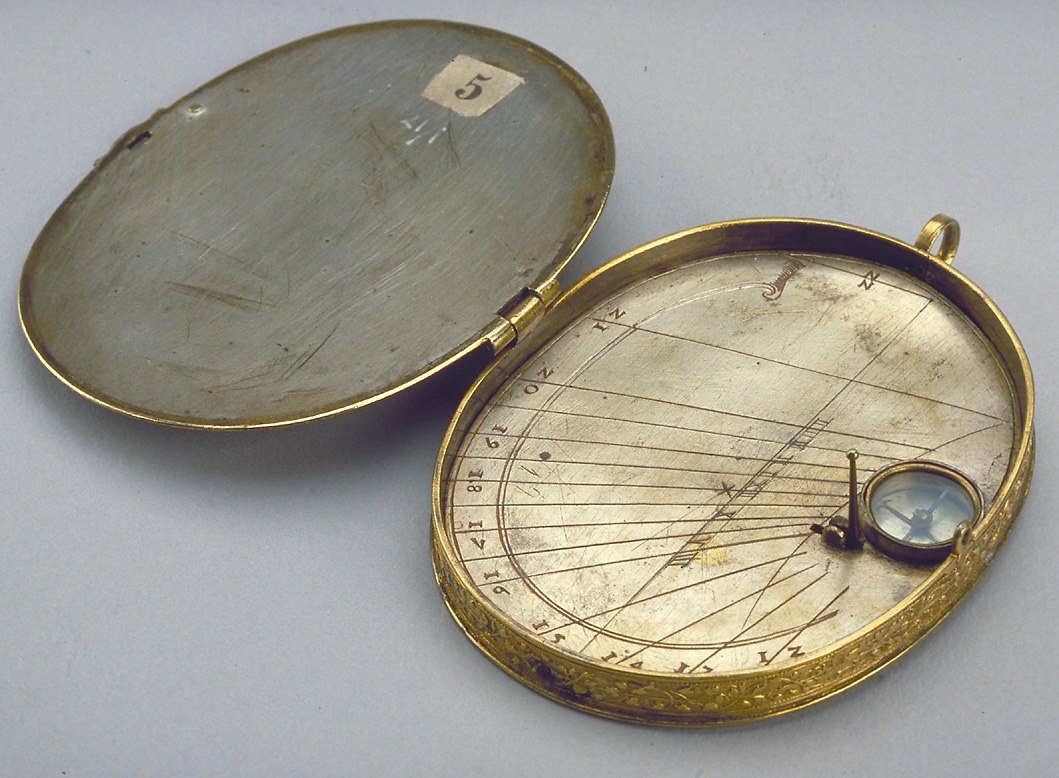
This horizontal dial is an elliptical gilt brass box measuring 72 x 90 x 12 mm. Designed as a portable scientific instrument, it features a suspension ring and a hook closure mechanism. The exterior of the box is decorated with engraving featuring vases, flowers, and foliage, while the interior of the lid remains blank. The instrument includes a foldable pin gnomon and a small integrated compass positioned on the dial plate. The sundial displays Italian hours ranging from 12 to 22. Additional common hour numerals (VIII, X, XII, I, II, III, IIII) are engraved along the equinox line. The instrument is unsigned and is of German origin. It was bequeathed to the British Museum as part of the Octavius Morgan Bequest in 1888.

Horizontal sundial in an elliptical gilt brass box with the lid open, displaying the compass and pin gnomon.
Horizontal sundial in an elliptical gilt brass box with the lid open, displaying the compass and pin gnomon. — © British Museum, London. Rights pending — permission not yet requested. Original source

Catalogue identity

Source
www.mhs.ox.ac.uk
Category
Tool · German horizontal dial
Maker / attribution
Not established
Reference
Not recorded
Catalogue / lot identifier
MLA 1888, 12-1.291
Source-reported date
Late 16th century ?
Source-reported place
Germany

Source-reported attribution and specifications are not independent authentication. A listing does not establish present ownership, current display, availability or permission to reproduce.

Object description

Construction and Decoration

The sundial is constructed in the form of an elliptical gilt brass box, measuring 72 by 90 by 12 mm. The exterior surface and the rim of the box are detailed with fine engravings, featuring motifs of vases, flowers, and foliage. The instrument is functional as a portable device, equipped with a suspension ring for carrying and a small hook to keep the box closed when not in use.

In contrast to the exterior, the interior of the lid is left plain, while the base of the box contains the dial plate. The dial is equipped with a small compass for orientation and a folding pin gnomon that can be raised for use.

Evidence for this section
  • “This dial is in the form of an elliptical gilt brass box with suspension ring, finely decorated on the external sides with vases, flowers and foliage.”
  • “The inside of the lid is blank, and the inside of the box has a dial plate with a small compass. The pin gnomon can be folded.”

Dialing and Markings

The instrument functions as a horizontal sundial, with hour lines primarily indicating Italian hours, which are marked from 12 to 22. These are standard features of the primary dial plate layout. However, the surface also contains common hour numerals including VIII, X, XII, I, II, III, and IIII, which are positioned along the equinox line.

The source notes that the engraving of the common hours differs from the rest of the instrument's execution. These markings are described as crude and are believed to have been added after the original manufacture of the dial. This distinction between the primary dial layout and the secondary hour lines suggests a modification to the instrument's utility at some point following its creation.

Evidence for this section
  • “The hour lines mark Italian hours from 12 to 22 and common hours marked along the equinox line, in a rather crude way, VIII, X, XII, I, II, III, IIII. These were probably engraved later.”

Provenance and Documentation

The sundial is currently held by the British Museum in London, registered under the accession number MLA 1888, 12-1.291. It entered the collection as part of the Octavius Morgan Bequest in 1888.

Specifically, it is cited in the catalogue by F. A. B. Ward, titled 'A Catalogue of European Scientific Instruments in the Department of Medieval and Later Antiquities of the British Museum'. This reference confirms the object's inclusion in established museum records regarding historical instrumentation, identifying it as a German-made, unsigned horizontal dial from the late 16th century.

Evidence for this section
  • “The instrument was bequeathed by Octavius Morgan Bequest in 1888 and is described in F. A. B. Ward, A Catalogue of European Scientific Instruments in the Department of Medieval and Later Antiquities of the British Museum (London, 1981), p. 24, no.21.”

Open research questions

  • What specific evidence differentiates the original Italian hour engravings from the subsequent common hour markings?
  • Does the compass needle or mounting hardware show signs of later repair or modification to match the secondary hour engravings?

Source evidence

Recorded claims and source quotations for Horizontal Sundial
FieldSource-reported valueSource quotation
Inventory numberMLA 1888, 12-1.291“MLA 1888, 12-1.291”
Dimensions72 x 90 x 12 mm“72 x 90 x 12 mm”
MaterialGilt brass“Gilt brass”
Dial typeHorizontal dial“Horizontal Dial”
OriginGerman“German”
DateLate 16th century ?“Late 16th century ?”
ProvenanceOctavius Morgan Bequest“The instrument was bequeathed by Octavius Morgan Bequest in 1888”

Visible details

  • Elliptical gilt brass box form
  • Foldable pin gnomon
  • Integrated compass on the dial plate
  • Engraved foliage decoration on the exterior rim

Research qualifications

  • Date is provided with a question mark by the source
  • Common hour engravings are considered potentially later additions

Photograph identity and source facts were screened before import; rights clearance remains pending.

Consulted source

Horizontal Dial

Reviewed 2026-10-26 · Record be4a2b522e

Terms in this record

Glossary explanations for terms named in this object’s record.