
Skip to content
The Encyclopedia of Horology

Tool · German horizontal dial

Horizontal Dial

Partially verified

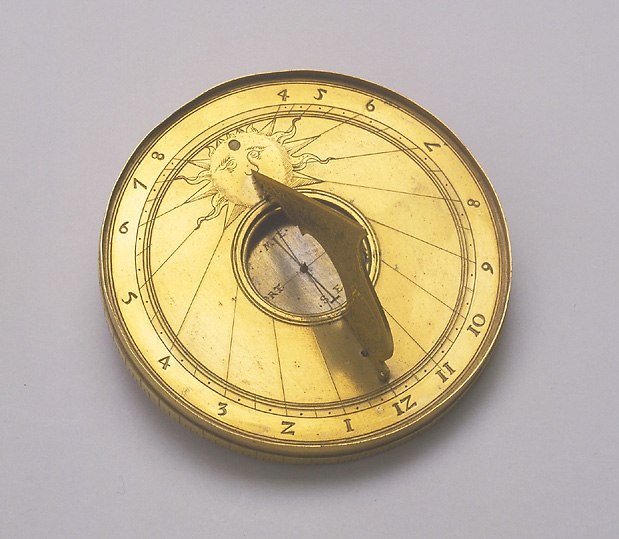
This horizontal sundial is crafted from gilt brass and measures 85 mm in diameter. It is an unsigned instrument from the 16th century, characterized by a circular box containing a central magnetic compass used for orientation towards the North. The dial surface is engraved with hour lines ranging from 4 to 12 to 8, featuring half-hour divisions marked by lines and quarter-hour divisions by points. A central sun effigy is engraved on the dial plate. The instrument features a folding triangular gnomon, which is decoratively shaped and etched with strapwork in light relief, allowing it to fold without obscuring the compass. The outer rim is engraved with an equal scale divided into 24 parts. Associated with the collection of Prince Mattias de' Medici, the piece was brought from Germany to Italy, where it is now preserved in the Istituto e Museo di Storia della Scienza.

Horizontal sundial with central compass and folding gnomon, 16th century.
Horizontal sundial with central compass and folding gnomon, 16th century. — Istituto e Museo di Storia della Scienza, Firenze. Rights pending — permission not yet requested. Original source

Catalogue identity

Source
www.mhs.ox.ac.uk
Category
Tool · German horizontal dial
Maker / attribution
Not established
Reference
Not recorded
Catalogue / lot identifier
2538
Source-reported date
16th century
Source-reported place
Germany

Source-reported attribution and specifications are not independent authentication. A listing does not establish present ownership, current display, availability or permission to reproduce.

Object description

Construction and Design

The sundial consists of a circular gilt brass box 85 mm in diameter. The main dial plate is engraved with an hour scale from 4 to 12 to 8, with additional markings for half and quarter hours. A distinct sun effigy is etched into the center of the plate. The instrument is equipped with a folding triangular gnomon that sits above a central compass, designed to collapse when not in use.

The gnomon surface displays decorative strapwork chiselled in relief. The outer rim of the circular box is also engraved with an equal scale divided into 24 parts, providing further measurement capabilities alongside the primary hour lines.

Evidence for this section
  • “Gilt brass; 85 mm in diameter”
  • “A circular box contains a central compass, with a magnetic declination mark, around which is drawn the hour diagram 4 to 12 to 8 with half hour divisions by lines and quarter hour divisions by points”
  • “The two faces of the gnomon are filled with decorative strapwork chiselled in light relief”

Compass and Orientation

Integral to the instrument is a compass designed for orienting the dial toward the magnetic north. The compass is set within the center of the dial plate. The dial includes a mark for magnetic declination, indicating the maker's intention for the user to account for local variations.

The compass case is engraved with directional markers indicating the cardinal points. These are abbreviated as 'ME', 'OCC', 'SE', and 'ORT'. The folding gnomon is shaped specifically to ensure that it does not obscure the compass view when folded down, reflecting the instrument's integrated functional design.

Evidence for this section
  • “It bears a compass to allow the instrument to be oriented towards North”
  • “The compass case is engraved for magnetic declination and with the initials of the cardinal points 'ME', 'OCC', 'SE', 'ORT'”

History and Provenance

Although the instrument remains unsigned, it is attributed to the 16th century and linked to German production.

The provenance of the object is established through its association with Prince Mattias de' Medici, who is credited with bringing the instrument from Germany. It is now part of the collection at the Istituto e Museo di Storia della Scienza in Florence, having been linked to a specific group of mining instruments.

Evidence for this section
  • “the style in which it is made and the fine and elaborate engravings suggest that the instrument was made as an object for a princely Renaissance collection”
  • “The instrument, which is linked to a group of mining instruments , was brought from Germany by Prince Mattias de' Medici”

Open research questions

  • What is the specific relationship between this object and the noted group of mining instruments?
  • Does the magnetic declination setting correspond to a specific geographical region or era of use?

Source evidence

Recorded claims and source quotations for Horizontal Dial
FieldSource-reported valueSource quotation
MaterialGilt brass“Gilt brass”
Diameter85 mm“85 mm in diameter”
OriginGerman“German”
Date16th century“16th century”
Compass markingsME, OCC, SE, ORT“initials of the cardinal points 'ME', 'OCC', 'SE', 'ORT'”
ProvenancePrince Mattias de' Medici“The instrument, which is linked to a group of mining instruments , was brought from Germany by Prince Mattias de' Medici.”

Visible details

  • Triangular folding gnomon with decorative strapwork
  • Central sun effigy engraving on dial plate
  • Cardinal points labeled 'ME', 'OCC', 'SE', 'ORT'
  • Equal scale engraved on the instrument rim

Research qualifications

  • The exact workshop or maker remains unidentified
  • The association with mining instruments is suggested but not documented in detail

Photograph identity and source facts were screened before import; rights clearance remains pending.

Consulted source

Horizontal Dial

Reviewed 2026-10-26 · Record 8980df35e0

Terms in this record

Glossary explanations for terms named in this object’s record.