
Skip to content
The Encyclopedia of Horology

Tool · German horizontal dial

Horizontal Dial by Ulrich Schniep

Partially verified

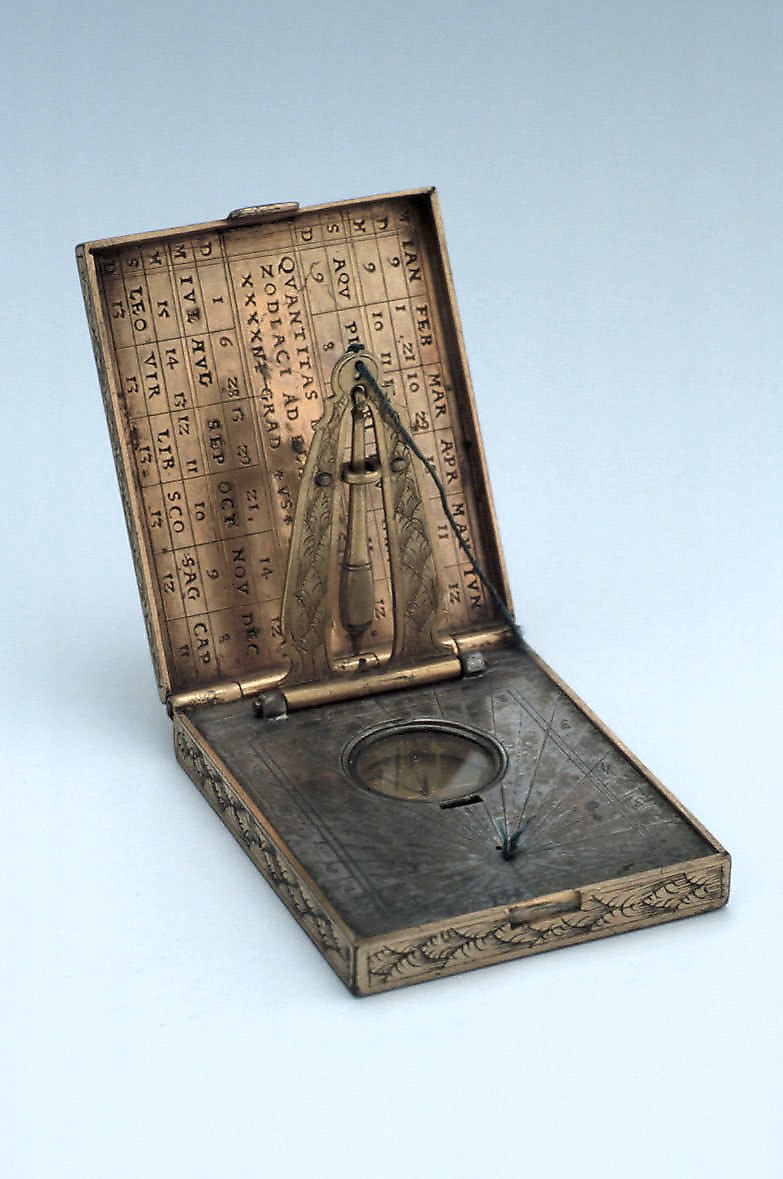
This horizontal dial, crafted in 1572 by Ulrich Schniep in Munich, is constructed from gilt brass and silver, measuring 59 x 46 x 10 mm. The instrument consists of a recessed cover leaf hinged to a main box with a suspension ring. The exterior features oak-leaf engraving on the sides and strapwork with foliate patterns on the underside. A lunar and horary volvelle is positioned on the outer face of the cover, while the interior features a table for the length of the day and zodiac degrees, signed with the initials 'VS'. The opposing face contains a horizontal string-gnomon dial with a sprung, folding brass gnomon support incorporating a plummet. An inset compass, measuring 17 mm in diameter, shows two distinct indications of magnetic variation. The instrument shows evidence of later modification, specifically regarding the latitude setting and the silver hour plate.

Horizontal dial in open position, revealing the internal string gnomon, compass, and zodiac/daylight table.
Horizontal dial in open position, revealing the internal string gnomon, compass, and zodiac/daylight table. — Museum of the History of Science, Oxford. Rights pending — permission not yet requested. Original source

Catalogue identity

Source
www.mhs.ox.ac.uk
Category
Tool · German horizontal dial
Maker / attribution
Ulrich Schniep
Reference
Not recorded
Catalogue / lot identifier
44205
Source-reported date
1572
Source-reported place
Germany

Source-reported attribution and specifications are not independent authentication. A listing does not establish present ownership, current display, availability or permission to reproduce.

Object description

Construction and Design

The horizontal sundial is housed in a gilt brass box with silver components, measuring 59 by 46 by 10 millimetres. The main assembly includes a recessed cover leaf that is hinged to the base and includes a suspension ring for portability. The exterior surfaces are adorned with decorative engravings; specifically, the sides display an oak-leaf pattern, while the underside of the case is finished with strapwork and foliate designs.

The internal layout of the dial features a horizontal string-gnomon dial. A brass gnomon support, which can be folded flat against the dial plate, is sprung to the vertical position and includes a plumb line to ensure accuracy during alignment. A 17-millimetre compass is set directly into the dial plate to assist with orientation.

Evidence for this section
  • “The instrument comprises a recessed cover leaf hinged to a main box with a suspension ring.”
  • “The sides are decorated with oak-leaf engraving and the underside has strapwork and foliate decoration.”
  • “The opposing face has a horizontal string-gnomon dial with a decorated folding brass gnomon support. The support is sprung to the vertical and incorporates a plummet.”

Functions and Astronomical Features

The instrument functions as a multifaceted timekeeping device incorporating several astronomical features. The outer face of the lid holds a lunar and horary volvelle, which includes scales for converting between equal, Italian, and Babylonian hours. It also provides a graphic representation of the moon's age and an aspectarium displaying polygons and symbols for planetary aspects.

On the inside of the cover, the maker included a reference table correlating the day of the month with zodiac signs and the duration of daylight. This table is inscribed with the maker's initials and the date 1572. The central portion of the volvelle disc also displays the inscription 'INDEX DIERVM AETATIS LVNAE' around a central cutout.

Evidence for this section
  • “The outer face of the cover carries a lunar and horary volvelle.”
  • “The inside face of the cover carries a table whose title incorporates the signature of the maker: 'QVANTITAS DIEI ET SINGNA [sic] ZODIACI AD ELEVATIO: POLI XXXXVI GRAD [star] VS [star] 1572 [star]'.”
  • “The next circular band carries the inscription 'INDEX DIERVM AETATIS LVNAE'”

Adaptations and Condition

The instrument displays clear evidence of having been adapted after its initial manufacture. Originally set for a latitude of 46 degrees, the dial shows an alteration to 44.5 degrees, evidenced by both a faint inscription and modifications to the gnomon support holes.

The compass is noted to contain two distinct variation lines, one indicating an eastern variation and a later, heavier line marking a westward variation. Furthermore, the silver hour plate is considered a potential later replacement, given the numbering style and the division of the hour lines.

Evidence for this section
  • “The sundial was originally made for use in latitude 46? but appears to have been later adapted for latitude 441/2?.”
  • “The silver hour plate may be a replacement; the numbering of the hour lines which run 4 to 12 to 8 and are divided to 1/2 appears more recent.”
  • “The compass is 17 mm in diameter and is marked with a cross for the four cardinal points 'S', 'OR', 'M' and 'OC'.”

Open research questions

  • What is the definitive period for the replacement of the silver hour plate?
  • Do other known instruments by Ulrich Schniep share the same abbreviated 'VS' signature format due to space constraints?

Source evidence

Recorded claims and source quotations for Horizontal Dial by Ulrich Schniep
FieldSource-reported valueSource quotation
MakerUlrich Schniep“Signed by Ulrich Schniep”
Date1572“Dated 1572; Munich”
MaterialGilt brass and silver“Gilt brass and silver; 59 x 46 x 10 mm”
Inventory Number44205“Inventory number: 44205”
Inscription[star] VS [star] 1572 [star]“'[star] VS [star] 1572 [star]'”
Compass Diameter17 mm“The compass is 17 mm in diameter”
ProvenanceLewis Evans Collection“Provenance: Lewis Evans Collection G. 382”

Visible details

  • Oak-leaf engraving along the case sides
  • Folding brass gnomon support with an integrated plummet
  • Inset compass with dual indicators of magnetic variation
  • Interior table detailing day length and zodiac signs

Research qualifications

  • The silver hour plate may be a replacement
  • The latitude indication has been altered from 46 degrees to 44.5 degrees

Photograph identity and source facts were screened before import; rights clearance remains pending.

Consulted source

Horizontal Dial

Reviewed 2026-10-26 · Record 6b5718fc0b

Terms in this record

Glossary explanations for terms named in this object’s record.