
Skip to content
The Encyclopedia of Horology

Tool · German horizontal dial

Horizontal string-gnomon dial by Ulrich Schniep

Partially verified

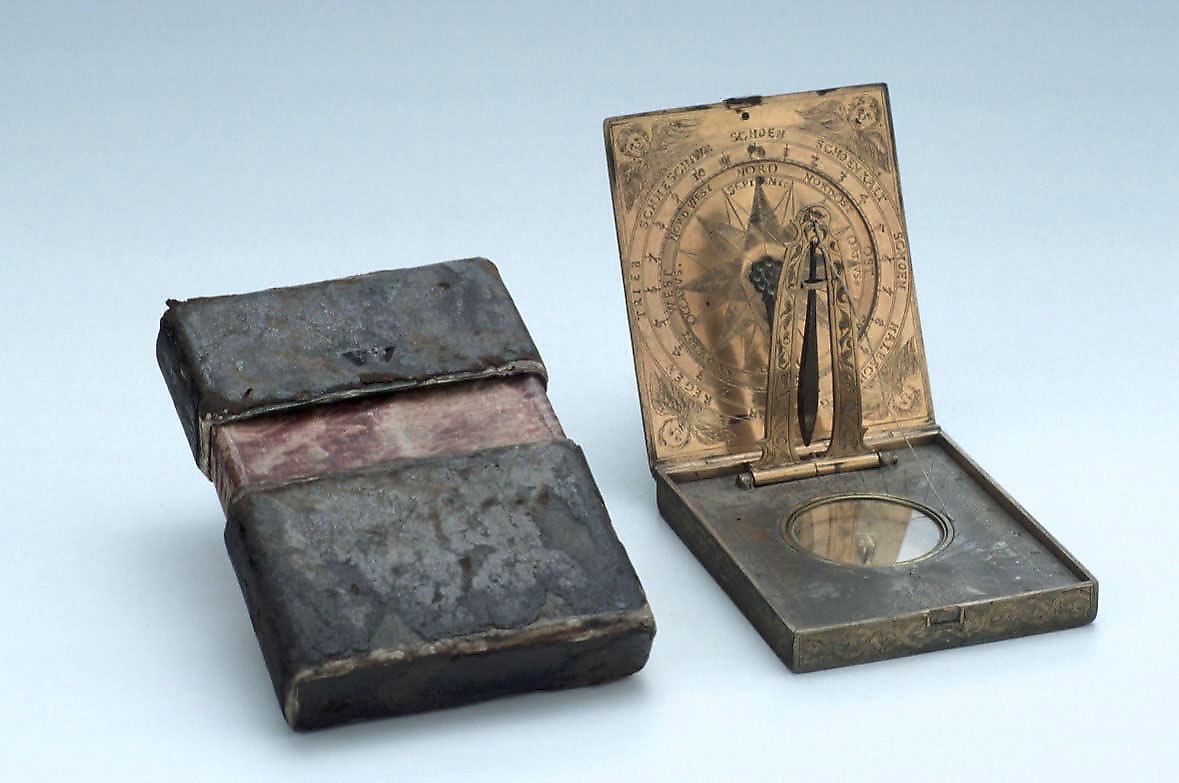
This horizontal sundial, crafted in Munich in 1568, is signed with the initials 'VS' by the maker Ulrich Schniep. Constructed from gilt and silvered brass, the instrument measures 75 x 63 x 11 mm and comprises a hinged, lidded box containing a horizontal string-gnomon dial. The dial plate features a scale of hours from 4 to 12 to 8, with half-hour marks, and includes an inset 30 mm diameter compass. A decorated, sprung gnomon support houses a plummet. The interior of the hinged lid features a wind rose, hour scale, and a rotating index. Exterior surfaces are embellished with engravings, including a goddess on a sea serpent on the lid and strapwork and foliage motifs on the underside. The sundial remains with its original leather-covered pasteboard case, originating from the Billmeir Collection.

Horizontal sundial with leather-covered pasteboard case, open to reveal the horizontal string-gnomon dial and internal wind rose.
Horizontal sundial with leather-covered pasteboard case, open to reveal the horizontal string-gnomon dial and internal wind rose. — Museum of the History of Science, Oxford. Rights pending — permission not yet requested. Original source

Catalogue identity

Source
www.mhs.ox.ac.uk
Category
Tool · German horizontal dial
Maker / attribution
Ulrich Schniep
Reference
Not recorded
Catalogue / lot identifier
39935
Source-reported date
1568
Source-reported place
Germany

Source-reported attribution and specifications are not independent authentication. A listing does not establish present ownership, current display, availability or permission to reproduce.

Object description

Construction and Dial Design

The instrument is housed in a gilt and silvered brass box featuring a hinged lid secured by a clasp. The primary horizontal dial is situated within the main box and utilizes a string gnomon supported by an ornate, sprung mechanism. This support also facilitates the use of an integral plummet. The silvered dial plate is calibrated for the latitude of 48 degrees, indicated as 'ELEVATCIO POLI 48 GR:', and bears the hour scale ranging from 4 through 12 to 8, with individual markings for half hours.

The internal face of the hinged lid serves as an additional scientific tool, featuring a wind rose with cardinal directions labeled in Latin alongside German terms for the eight principal directions. A rotating index is provided at the center, surrounded by a secondary scale of hours and a series of inscriptions relating the classical winds to traditional weather forecasts.

Evidence for this section
  • “The main box carries a horizontal string-gnomon dial with a decorated sprung gnomon support housing a plummet.”
  • “The silvered dial plate has a scale of hours from 4 to 12 to 8, with the half hours marked.”
  • “ELEVATCIO POLI 48 GR:”
  • “The inside face of the cover carries a wind rose”

Exterior Decoration and Compass

The outer surfaces of the sundial exhibit detailed metalwork. The lid displays an oval engraving depicting a goddess riding a sea serpent, accompanied by a ship in the background, all framed by foliage. The base of the instrument is decorated with strapwork and foliage engraving, consistent with the lid's decorative scheme.

The 30 mm diameter inset compass is positioned on the main plate. It is oriented with a cross of directions marked 'S', 'OR', 'M', and 'OC' and includes specific markings for magnetic variation. The entire assembly, including the dial and compass, is accompanied by a leather-covered pasteboard case, which is preserved with the instrument.

Evidence for this section
  • “The outer face of the lid depicts a goddess on a sea serpent with a ship in the background of the oval engraving.”
  • “the underside has strapwork and foliage engraving.”
  • “The inset compass is 30 mm in diameter with a cross of direction marked 'S', 'OR', 'M' and 'OC'; it is also marked for variation.”

Signatures and Provenance

The maker is identified by the initials 'VS' engraved upon the dial plate. Historical records attribute the instrument to the Munich-based craftsman Ulrich Schniep. The signature is accompanied by the date '1568' framed by stars.

The history of the object is documented through the Billmeir Collection, listed with the reference 57-84/196. The instrument is currently maintained by the Museum of the History of Science in Oxford, recorded under inventory number 39935.

Evidence for this section
  • “The sundial , signed 'VS' by the Munich -based craftsman Ulrich Schniep”
  • “The plate carries the signature 'VS' and the date '[star]1568[star]'”
  • “Provenance: Billmeir Collection (57-84/196).”

Open research questions

  • What is the specific significance of the weather inscriptions linked to the eight classical winds?
  • Has the magnetic variation marked on the compass been correlated with 16th-century Munich readings?

Source evidence

Recorded claims and source quotations for Horizontal string-gnomon dial by Ulrich Schniep
FieldSource-reported valueSource quotation
MakerUlrich Schniep“Signed by Ulrich Schniep”
Date1568“Dated 1568”
LocationMunich“Munich”
MaterialGilt and silvered brass“Gilt and silvered brass”
Dimensions75 x 63 x 11 mm“75 x 63 x 11 mm”
SignatureVS“The plate carries the signature 'VS'”
ProvenanceBillmeir Collection“Provenance: Billmeir Collection (57-84/196).”

Visible details

  • Internal wind rose features Latin and German inscriptions
  • Sprung gnomon support contains a suspended plummet
  • Compass marked with directional cross and variation
  • Exterior displays strapwork and foliage engraving

Research qualifications

  • Variation of compass not specified in historical context
  • Exact nature of the weather predictions indicated on the lid

Photograph identity and source facts were screened before import; rights clearance remains pending.

Consulted source

Horizontal Dial

Reviewed 2026-10-26 · Record 6b80ab5620

Terms in this record

Glossary explanations for terms named in this object’s record.