
Skip to content
The Encyclopedia of Horology

Tool · German horizontal dial

Horizontal Dial by Christoph Trechsler

Partially verified

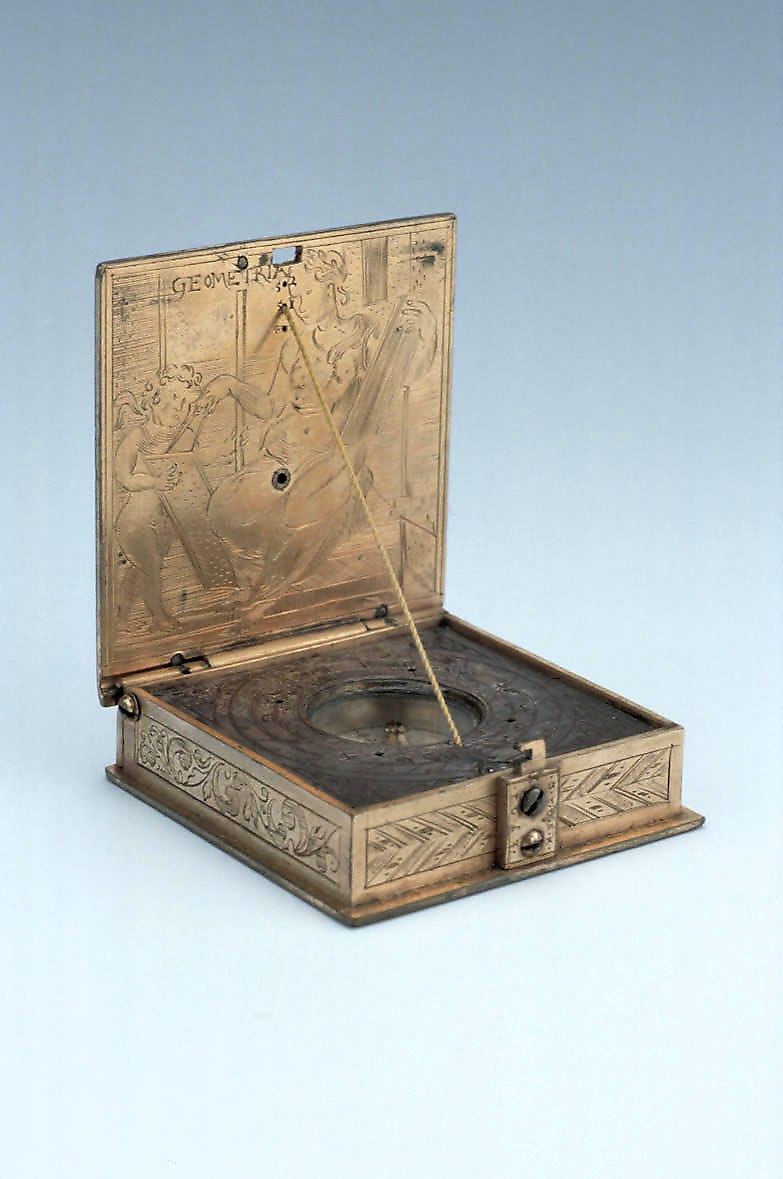
This 1613 gilt brass horizontal dial was made in Dresden by Christoph Trechsler. Measuring 15 x 58 x 61 mm, the object functions as a portable timekeeping device adjustable for three specific latitudes. The exterior lid features a pierced lunar volvelle with an aspectarium, surrounded by names of the twelve principal winds in Latin and spandrel decorations of flowers and fruits. The interior lid is engraved with an allegorical representation of 'GEOMETRIA', featuring a woman holding dividers. The base contains a central compass marked with cardinal point initials, set within a silver plate featuring hour lines for latitudes 48°, 51°, and 52°. The exterior of the box features decorative arabesque and geometrical motifs. The instrument is signed on the catch with the abbreviation 'C ? T ? D ? E ? M ? 1613', expanded by the source as Christoph Trechsler der Elter Mechanicus.

Horizontal sundial by Christoph Trechsler, 1613, showing the open lid with Geometria engraving and the internal compass dial.
Horizontal sundial by Christoph Trechsler, 1613, showing the open lid with Geometria engraving and the internal compass dial. — Museum of the History of Science, Oxford. Rights pending — permission not yet requested. Original source

Catalogue identity

Source
www.mhs.ox.ac.uk
Category
Tool · German horizontal dial
Maker / attribution
Christoph Trechsler
Reference
Not recorded
Catalogue / lot identifier
49305
Source-reported date
1613
Source-reported place
Germany

Source-reported attribution and specifications are not independent authentication. A listing does not establish present ownership, current display, availability or permission to reproduce.

Object description

Construction and Exterior Features

The instrument is constructed from gilt brass, measuring 15 mm in height, 58 mm in width, and 61 mm in length. Its exterior design incorporates both functional and decorative elements. The top of the lid serves as a housing for a pierced lunar volvelle, which includes an aspectarium and is ringed by Latin inscriptions identifying twelve principal winds, such as 'AQVILO' and 'ZEPHIRVS'.

The spandrel areas of the lid are adorned with engraved floral and fruit motifs. Further decorative detailing is present on the edges of the box, which feature engraved arabesques and geometric patterns. The closure mechanism is secured by a catch, which also serves as the location for the maker's signature.

Evidence for this section
  • “The outer side of the lid has a pierced lunar volvelle with aspectarium and the twelve principal winds named in Latin.”
  • “The decoration consists of flowers and fruits in the spandrel spaces.”
  • “the edges are decorated with arabesques and geometrical motifs.”

Interior Mechanism and Dialing

The interior lid features an allegorical engraving of 'GEOMETRIA', depicted as a woman holding a pair of dividers. Below this, the instrument contains a central compass marked with the cardinal point initials 'SE', 'OR', 'ME', and 'OC'.

The silver plate inside the box is engraved with hour lines ranging from 4 to 12 to 8. These lines are configured to accommodate three specific latitudes (48°, 51°, and 52°), and are divided into half-hour increments. Adjustment holes are provided on the lid to accommodate the string used as a gnomon for these settings.

Evidence for this section
  • “The inner face of the lid has a symbolic engraving of 'GEOMETRIA' with a pair of dividers in her hands.”
  • “Lines for common hours are engraved on a silver plate inside the box from 4 to 12 to 8 around the compass”
  • “The hour lines are marked for the three latitudes mentioned above divided to the half-hour.”

Signatures and Provenance

The object is signed by the maker on the closure catch. The inscription is engraved in an abbreviated form: 'C ? T ? D ? E ? M ? 1613'. The museum documentation interprets this as referring to Christoph Trechsler der Elter Mechanicus.

The base of the instrument includes a table of latitudes covering 24 different locations, suggesting its utility as a travel device.

Evidence for this section
  • “On the closure catch is engraved the signature 'C ? T ? D ? E ? M ? 1613': Christoph Trechsler Der Elter Mechanicus.”
  • “On the bottom of the box is a table of latitudes for 24 places”
  • “Holding museum: Museum of the History of Science, Oxford”

Open research questions

  • What are the 24 locations listed in the table of latitudes on the base of the dial?
  • Is there evidence for which specific locations in 1613 aligned with the 48, 51, and 52-degree latitudinal settings provided?

Source evidence

Recorded claims and source quotations for Horizontal Dial by Christoph Trechsler
FieldSource-reported valueSource quotation
MakerChristoph Trechsler“Signed by Christoph Trechsler”
Date1613“Dated 1613; Dresden”
MaterialGilt brass“Gilt brass; 15 x 58 x 61 mm”
SignatureC ? T ? D ? E ? M ? 1613“On the closure catch is engraved the signature 'C ? T ? D ? E ? M ? 1613': Christoph Trechsler Der Elter Mechanicus.”
Latitudes48, 51 and 52 degrees“holes for adjusting the string for latitudes 48?, 51? and 52?.”
Compass markersSE, OR, ME, OC“marked with the initials of the cardinal points 'SE', 'OR', 'ME', 'OC'.”
Inventory49305“Inventory number: 49305”

Visible details

  • Internal compass marked SE, OR, ME, OC
  • Engraved figure of Geometria on interior lid
  • Latitudinal adjustment holes at 48, 51, 52 degrees
  • Floral and geometric engraved exterior decoration

Research qualifications

  • The specific attribution of the abbreviation on the catch relies on historical expansion by the source
  • The current string used as a gnomon may not be original to the 1613 construction

Photograph identity and source facts were screened before import; rights clearance remains pending.

Consulted source

Horizontal Dial

Reviewed 2026-10-26 · Record 5db43e4011

Terms in this record

Glossary explanations for terms named in this object’s record.