
Skip to content
The Encyclopedia of Horology

Clock · Hooded wall clock

Hooded wall clock with calendar

Partially verified

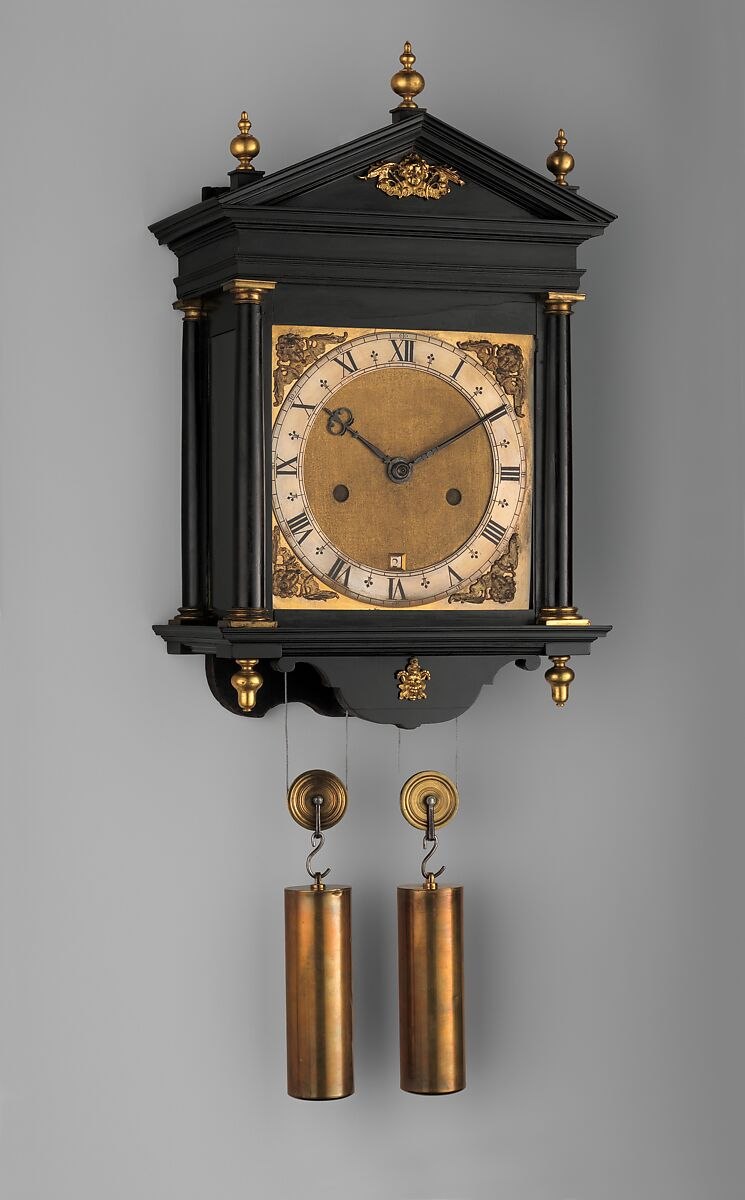
The Metropolitan Museum of Art documents this English hooded wall clock with calendar, dated to approximately 1660–65 and made by London clockmaker Ahasuerus I Fromanteel. According to the museum, the piece demonstrates the early English adoption of pendulum regulation, uniting a traditional verge escapement with a short pendulum derived from Christiaan Huygens' invention. The clock features an architectural black hooded case with a triangular pediment, gilt finials, columns, and a winged cherub mount. The dial displays a silvered chapter ring with a calendar aperture above VI, driven by twin weights suspended below.

Ahasuerus I Fromanteel hooded wall clock with calendar, ca. 1660–65, The Metropolitan Museum of Art (1974.28.93)
Ahasuerus I Fromanteel hooded wall clock with calendar, ca. 1660–65, The Metropolitan Museum of Art (1974.28.93) — The Metropolitan Museum of Art. Rights pending — permission not yet requested. Original source

Catalogue identity

Source
www.metmuseum.org
Category
Clock · Hooded wall clock
Maker / attribution
Ahasuerus I Fromanteel
Reference
1974.28.93
Catalogue / lot identifier
Source URL identifies the listing
Source-reported date
ca. 1660–65
Country
United Kingdom

Source-reported attribution and specifications are not independent authentication. A listing does not establish present ownership, current display, availability or permission to reproduce.

Object description

Case Construction and Decorative Elements

The object features a black architectural hooded case characterized by a triangular pediment. Decorative elements include three gilt top finials and flanking black columns with gilt capitals and bases.

Ornamentation is observed on the pediment, where a gilt winged cherub head is applied within the tympanum, and on the lower apron, which features a smaller gilt mount.

Evidence for this section
  • “Black architectural wooden hood featuring a triangular pediment, three gilt top finials, and flanking black columns with gilt capitals and bases”
  • “A gilt winged cherub head applied within the pediment tympanum and a smaller gilt mount beneath the lower apron”

Dial and Calendrical Features

The brass dial plate is square and embellished with pierced cherub spandrels. The time is indicated on a silvered chapter ring with Roman numerals.

The dial includes two winding holes and a square calendar aperture positioned directly above the VI numeral.

Evidence for this section
  • “Square brass dial plate with pierced cherub spandrels, silvered Roman numeral chapter ring, two winding holes, and a square calendar aperture positioned directly above VI”

Mechanism and Regulation

The clock utilizes a traditional verge escapement, regulated by a short pendulum derived from the invention of Christiaan Huygens.

Power is provided by two cylindrical brass driving weights suspended by cords and grooved pulleys beneath the wall bracket.

Evidence for this section
  • “traditional verge escapement, now regulated by the newly developed short pendulum derived from Huygens’ invention”
  • “Two cylindrical brass driving weights suspended below the wall bracket via cords and grooved pulleys”

Open research questions

  • What is the physical composition of the architectural hood?
  • What is the specific material of the calendar aperture lining?
  • Are there additional visible mounting marks on the rear of the case?

Source evidence

Recorded claims and source quotations for Hooded wall clock with calendar
FieldSource-reported valueSource quotation
MakerAhasuerus I Fromanteel“Clockmaker: Ahasuerus I Fromanteel ca. 1660–65”
Dateca. 1660–65“about 1660–65 by Ahasuerus I Fromanteel”
Accession Number1974.28.93“hooded wall clock ( 1974.28.93 ) of about 1660–65”
EscapementVerge escapement with short pendulum“traditional verge escapement, now regulated by the newly developed short pendulum derived from Huygens’ invention”
MakerAhasuerus I Fromanteel“Clockmaker: Ahasuerus I Fromanteel ca. 1660–65”
Accession Number1974.28.93“The Museum’s hooded wall clock ( 1974.28.93 )”
Estimated Dateca. 1660–65“of about 1660–65”

Visible details

  • Black architectural wooden hood featuring a triangular pediment, three gilt top finials, and flanking black columns with gilt capitals and bases
  • Square brass dial plate with pierced cherub spandrels, silvered Roman numeral chapter ring, two winding holes, and a square calendar aperture positioned directly above VI
  • A gilt winged cherub head applied within the pediment tympanum and a smaller gilt mount beneath the lower apron
  • Two cylindrical brass driving weights suspended below the wall bracket via cords and grooved pulleys

Research qualifications

  • Source text is a thematic collections essay discussing multiple historical horology objects rather than an individual collection record page
  • Movement plates, verge escapement, and pendulum assembly remain enclosed within the hood case and are not visible in the photograph

Photograph identity and source facts were screened before import; rights clearance remains pending.

Terms in this record

Glossary explanations for terms named in this object’s record.