
Skip to content
The Encyclopedia of Horology

Clock · Hooded wall clock

A George III mahogany hooded wall clock, John Ellicott

Partially verified

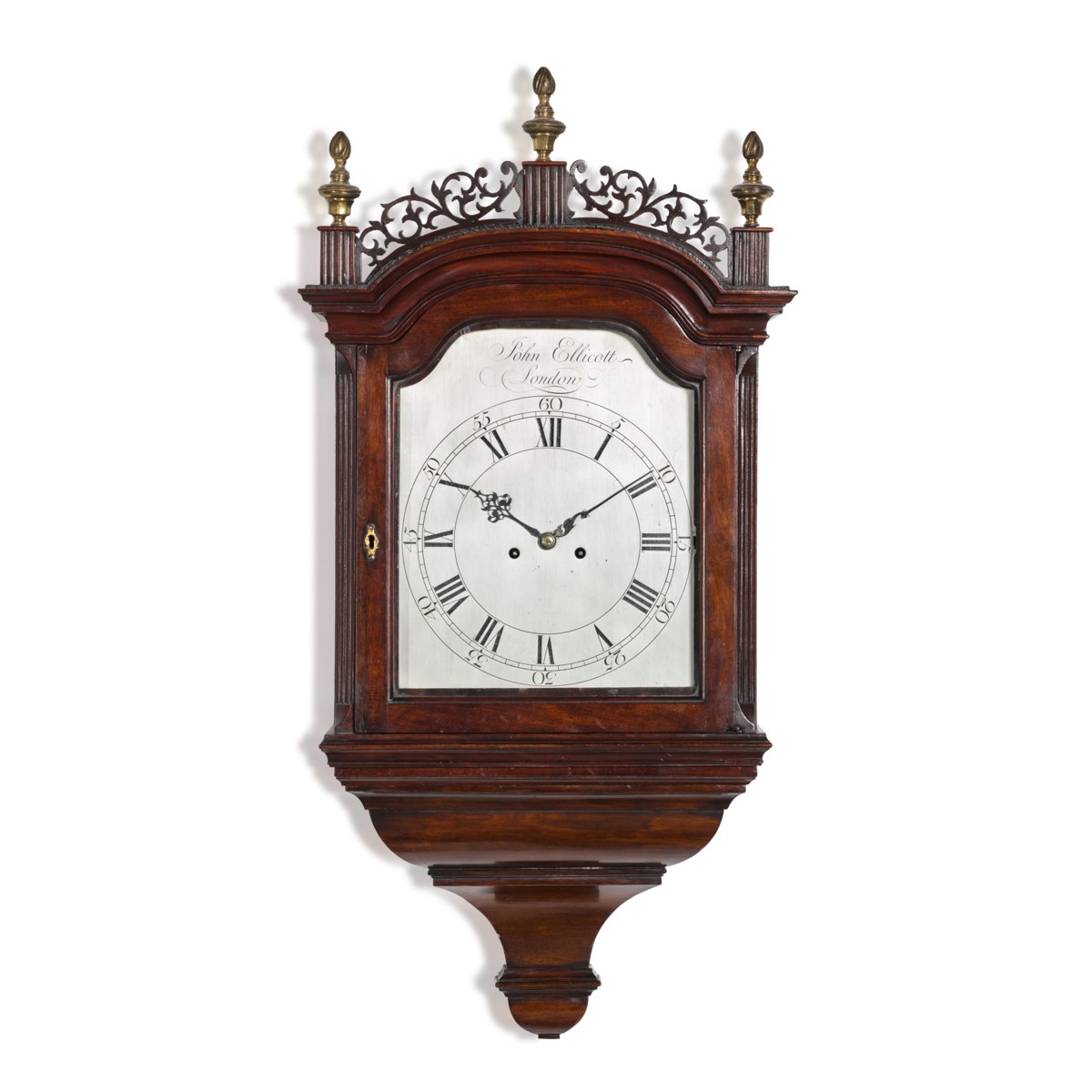
This George III hooded wall clock, dating to circa 1760, features a 10-inch silvered dial signed 'John Ellicott, London' in the shallow arch. The dial includes Roman hours, outer Arabic five-minute divisions, twin winding apertures, and a strike/silent lever located at III. The solid mahogany case is surmounted by pierced foliate cresting and three flambeau finials, flanked by fluted canted hood corners and scale side frets. It rests on a convex and concave moulded integral bracket that slides to reveal a hidden key compartment. The source reports that the movement features a fusee mechanism with five knopped pillars, verge escapement, and rack striking on a bell.

Frontal view of a George III mahogany hooded wall clock by John Ellicott, circa 1760
Frontal view of a George III mahogany hooded wall clock by John Ellicott, circa 1760 — Sotheby's. Rights pending — permission not yet requested. Original source

Catalogue identity

Source
www.sothebys.com
Category
Clock · Hooded wall clock
Maker / attribution
John Ellicott
Reference
Not recorded
Catalogue / lot identifier
94
Source-reported date
circa 1760
Source-reported place
United Kingdom

Source-reported attribution and specifications are not independent authentication. A listing does not establish present ownership, current display, availability or permission to reproduce.

Object description

Dial and Attribution

The clock features an arched dial measuring 10 inches across with a silvered finish. The chapter ring displays Roman numerals for the hours and outer Arabic five-minute numerals, accompanied by central pierced hands, twin winding apertures flanking the arbor, and a strike/silent lever situated at the III position.

In the shallow arch above the chapter ring, the dial plate is inscribed "John Ellicott, London". The auction cataloguing attributes the clock to John Ellicott and dates it to circa 1760, noting in biographical remarks that Ellicott (1706–1772) was elected a Fellow of the Royal Society in 1738 and later served as clockmaker to King George III.

Evidence for this section
  • “10-inch silvered dial with strike/silent lever at III”
  • “signed in the shallow arch John Ellicott, London”
  • “A George III mahogany hooded wall clock, John Ellicott, London, circa 1760”
  • “In 1738 he was elected a Fellow of the Royal Society and served as a Councillor for three years. Later he became clockmaker to King George III”

Case Architecture and Construction

The clock is housed in a solid mahogany case measuring 84 cm (33 in.) high overall. The upper superstructure consists of a shallow arched top fitted with pierced foliate cresting and surmounted by three flambeau finials, set above fluted canted hood corners and scale side frets.

The case terminates in an integral bracket with convex and concave mouldings ending in a shaped apron. According to the auction description, this bracket slides to reveal an internal key compartment, though this sliding function cannot be observed directly from the closed frontal photograph.

Evidence for this section
  • “the solid mahogany case with shallow arch top, pierced foliate cresting and flambeau finials above scale side frets and fluted canted hood corners”
  • “the convex and concave moulded integral bracket sliding to reveal a key compartment”
  • “84cm. 33in. high overall”

Reported Movement and Internal Mechanics

Because the clock is pictured with the hood closed and no internal views are provided, internal mechanical features cannot be verified visually. The cataloguing reports a fusee movement constructed with five knopped pillars, regulated by a verge escapement, and featuring rack striking on a bell.

Any assessment of the mechanical originality, subsequent restoration, or present operating condition of the movement is not detailed in the source and relies on the auctioneer's summary.

Evidence for this section
  • “the fusee movement with five knopped pillars, verge escapement and rack striking on a bell”

Open research questions

  • Does the fusee movement retain its original verge escapement and crown wheel, or has it undergone later conversion or restoration?
  • How does the sliding mechanism of the integral bracket operate, and does the key compartment retain a period winding key?
  • What recorded ownership exists prior to the 1999 acquisition from Anthony Woodburn?

Source evidence

Recorded claims and source quotations for A George III mahogany hooded wall clock, John Ellicott
FieldSource-reported valueSource quotation
Maker SignatureJohn Ellicott, London“signed in the shallow arch John Ellicott, London”
Dial Size and Features10-inch silvered dial with strike/silent lever at III“10-inch silvered dial with strike/silent lever at III”
Movement MechanismFusee movement with five knopped pillars, verge escapement, and rack striking on a bell“the fusee movement with five knopped pillars, verge escapement and rack striking on a bell”
Case DesignSolid mahogany case with shallow arch top, pierced foliate cresting, and flambeau finials“the solid mahogany case with shallow arch top, pierced foliate cresting and flambeau finials above scale side frets and fluted canted hood corners”
Bracket FeatureConvex and concave moulded integral bracket sliding to reveal a key compartment“the convex and concave moulded integral bracket sliding to reveal a key compartment”
Overall Height84 cm (33 in.)“84cm. 33in. high overall”
ProvenanceAnthony Woodburn, 1999“Anthony Woodburn, 1999”
Consignment ContextProperty of a Private Clock Collector (Lots 88-94)“Property of a Private Clock Collector (Lots 88-94)”
Auction Estimate£7,000 - £10,000“Estimate 7,000 - 10,000 GBP”

Visible details

  • Arched solid mahogany wall clock case surmounted by pierced foliate fretwork cresting and three brass flambeau finials
  • Silvered dial with black Roman hour numerals, Arabic five-minute markers, and central pierced hands
  • Signature inscribed 'John Ellicott / London' within the upper arch of the dial plate
  • Two winding winding holes flanking the hand arbor and a keyhole with escutcheon on the left case door frame
  • Moulded stepped lower bracket terminating in a shaped pendant apron

Research qualifications

  • Movement details including fusee, five knopped pillars, verge escapement, and bell are source-reported and concealed within the case
  • The sliding mechanism of the integral bracket and internal key compartment cannot be confirmed visually from the closed frontal photograph

Photograph identity and source facts were screened before import; rights clearance remains pending.

Consulted source

A George III mahogany hooded wall clock, John Ellicott, London, circa

Reviewed 2026-10-21 · Record aa5c023e60

Terms in this record

Glossary explanations for terms named in this object’s record.