
Skip to content
The Encyclopedia of Horology

Pocket watch · Enamelled pocket watch

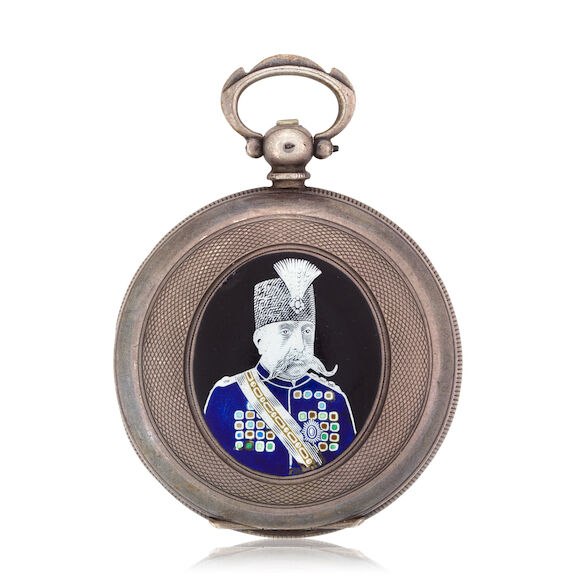
Gustave Jacot enamelled silver pocket watch depicting Muzzafar al-Din Shah Qajar

Partially verified

According to Bonhams, this pocket watch was produced by Gustave Jacot in Le Locle, Switzerland, dating to circa 1900. Housed in a silver case, the front lid features an oval polychrome enamel portrait medallion identified by the auction house as depicting Muzzafar al-Din Shah Qajar (reg. 1896–1907), framed by engine-turned engraving. The case is stamped 'GUSTAVE JACOT LOCLE 0.875 84' alongside pseudo-English hallmarks. The auction house reports a white and black enamel dial bearing Arabic numerals, floral decoration, and a Turkish inscription naming Burhanzade Ali Vehbi of İzmir, driven by a Swiss lever movement with a cut and compensated bimetallic balance.

Front view of closed silver pocket watch featuring polychrome enamel portrait medallion
Front view of closed silver pocket watch featuring polychrome enamel portrait medallion — Bonhams. Rights pending — permission not yet requested. Original source

Catalogue identity

Source
www.bonhams.com
Category
Pocket watch · Enamelled pocket watch
Maker / attribution
Gustave Jacot
Reference
Not recorded
Catalogue / lot identifier
121
Source-reported date
circa 1900
Country
Switzerland

Source-reported attribution and specifications are not independent authentication. A listing does not establish present ownership, current display, availability or permission to reproduce.

Persian connection and manufacture

Persian connection and manufacture
EvidenceWhat the record supportsWhat remains unproved
ManufactureBonhams names Gustave Jacot, Le Locle, Switzerland, circa 1900.Persian manufacture from the portrait subject.
PortraitAuction identification as Muzzafar al-Din Shah Qajar.Ownership, use or commission by that ruler.
Merchant inscriptionCatalogue reports a Turkish inscription naming Burhanzade Ali Vehbi of İzmir.That all inscriptions or markets connected to this watch were Persian.

Evidence checklist

  1. Separate the maker’s location from the subject of a portrait or inscription.
  2. Keep auction statements attributed, including commission and condition claims.
  3. Match internal or reverse views to the exact listing before extending a description.

A Swiss maker, an Iranian portrait and an Ottoman merchant can coexist on one object. Keep those roles distinct instead of assigning one national origin to every part of its history.

Persian and Iranian horology · regional evidence

Object description

Object Identity and Provenance

The timepiece is attributed to Gustave Jacot of Le Locle, Switzerland, and is dated by the auction house to circa 1900. The dial bears an inscription in Turkish identifying the merchant Burhanzade Ali Vehbi of İzmir, noted by the source as an importer of watches and clocks active during the late Ottoman period.

The front of the case features an enamel portrait identified by the auction house as Muzzafar al-Din Shah Qajar (reigned 1896–1907). No provenance documentation prior to the current auction lot is provided.

Evidence for this section
  • “by Gustave Jacot Le Locle, Switzerland, circa 1900”
  • “Inscriptions: 'Burhanzade 'Ali Vehbi Izmir'. Burhanzade Ali Vehbi Efendi was a merchant and importer of watches and clocks active in İzmir during the late Ottoman period.”
  • “the silver case decorated in polychrome enamel to the front with a portrait of the shah”

Case Construction and Exterior

The watch is housed in a silver case featuring a polychrome enamel portrait medallion on the front lid. The case is stamped 'GUSTAVE JACOT LOCLE 0.875 84' and includes pseudo-English hallmarks.

A silver suspension bow and round pendant are located at the 12 o'clock position. The object measures 7 cm in maximum length.

Evidence for this section
  • “the silver case decorated in polychrome enamel to the front with a portrait of the shah”
  • “the case stamped 'GUSTAVE JACOT LOCLE 0.875 84' and with pseudo-English hallmarks”
  • “7 cm. max.”

Dial and Movement

The auction catalogue describes the watch as having a white and black enamel dial featuring Arabic numerals and floral decoration. The internal mechanism is reported as a Swiss lever movement with a cut and compensated bi-metallic balance.

These internal components and the dial face were not physically observed as the provided image displays only the closed watch.

Evidence for this section
  • “the white and black enamel dial with Arabic numerals, painted with floral decoration and inscription in Turkish”
  • “Swiss lever, cut and compensated bi-metallic balance movement”
  • “dial 4.1 cm”

Open research questions

  • What is the significance of the number '84' within the Gustave Jacot stamp sequence?
  • Are the 'pseudo-English hallmarks' consistent with specific Swiss export practices to the Ottoman Empire during this period?

Source evidence

Recorded claims and source quotations for Gustave Jacot enamelled silver pocket watch depicting Muzzafar al-Din Shah Qajar
FieldSource-reported valueSource quotation
Case decorationPolychrome enamel portrait of the shah on silver“the silver case decorated in polychrome enamel to the front with a portrait of the shah”
Case markingsGUSTAVE JACOT LOCLE 0.875 84 and pseudo-English hallmarks“the case stamped 'GUSTAVE JACOT LOCLE 0.875 84' and with pseudo-English hallmarks”
Dial descriptionWhite and black enamel dial with Arabic numerals and Turkish inscription“the white and black enamel dial with Arabic numerals, painted with floral decoration and inscription in Turkish”
Escapement and balanceSwiss lever with cut and compensated bi-metallic balance“Swiss lever, cut and compensated bi-metallic balance movement”
Inscribed merchantBurhanzade 'Ali Vehbi Izmir“Inscriptions: 'Burhanzade 'Ali Vehbi Izmir'. Burhanzade Ali Vehbi Efendi was a merchant and importer of watches and clocks active in İzmir during the late Ottoman period.”
Total length7 cm“7 cm. max.”
Dial diameter4.1 cm“dial 4.1 cm”

Visible details

  • Centrally positioned oval enamel medallion depicting a uniformed portrait with a feathered headdress against a black background.
  • Engine-turned patterned engraving surrounding the central enamel oval on the silver case front.
  • Shaped silver suspension bow and round pendant positioned at 12 o'clock.

Research qualifications

  • The dial and movement are described in the catalogue text but are not visible in the provided photograph of the closed case.
  • Internal hallmarks and maker stamps are not visible in the exterior photograph.

Photograph identity and source facts were screened before import; rights clearance remains pending.

Terms in this record

Glossary explanations for terms named in this object’s record.