
Skip to content
The Encyclopedia of Horology

Tool · Latin-inscribed astrolabe

German astrolabe

Partially verified

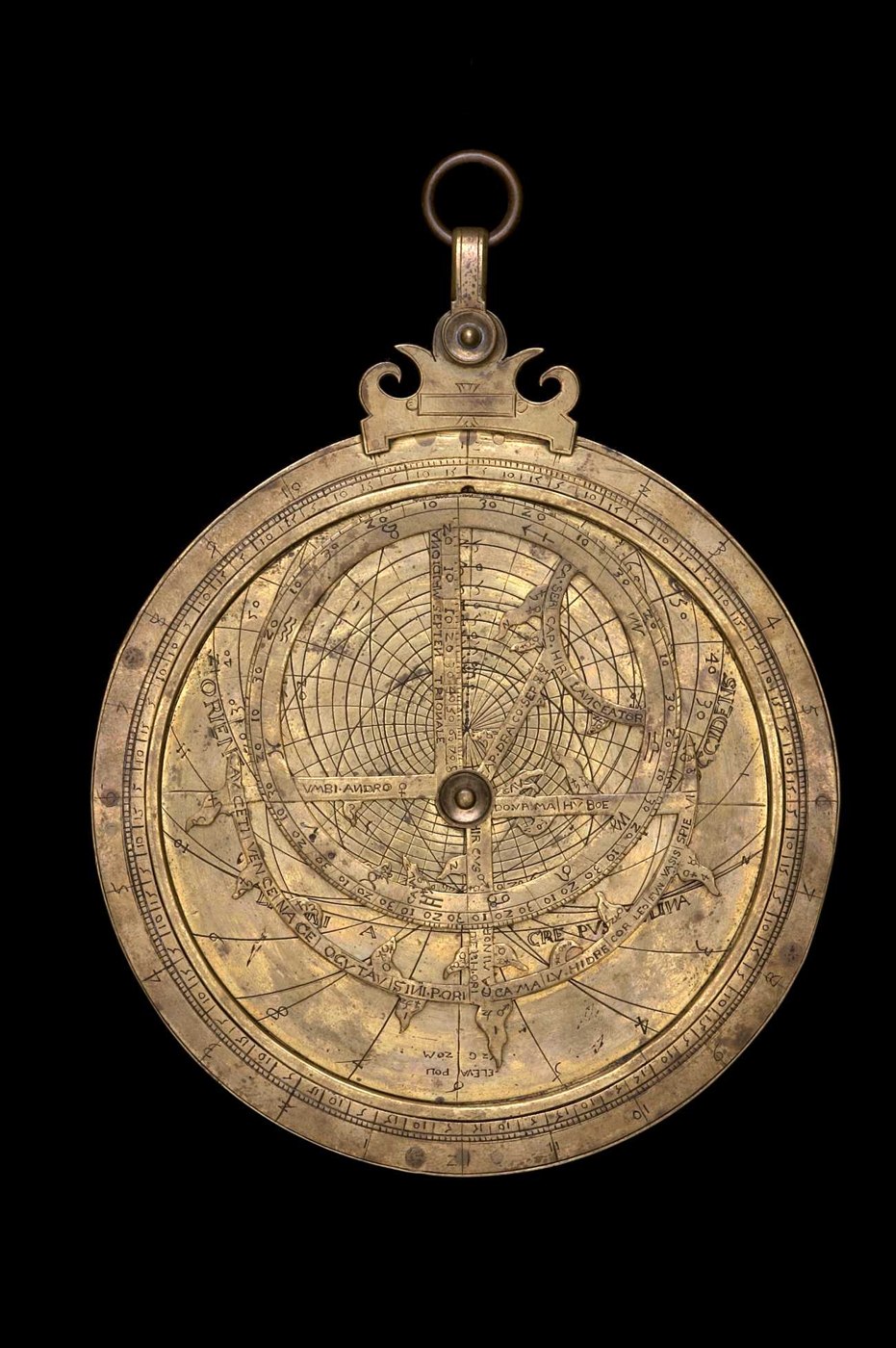
This 16th-century brass astrolabe, inventory number 39887, is attributed to Germany. The instrument includes a mater, rete with 25 stars, two plates for latitude 52 degrees, and an alidade. The mater and limb feature a three-piece construction with the limb and inner ring pinned to the back plate. The back of the instrument remains largely blank, with a single degree scale, intended to accommodate a Geminus-style sundial. The instrument was acquired by the History of Science Museum in 1924, having been presented by Lewis Evans. Records indicate the alidade, pin, horse, throne, shackle, and ring were restored by dealer Percy Webster in 1908.

Full view of the astrolabe front showing the rete, mater, throne, shackle, and ring.
Full view of the astrolabe front showing the rete, mater, throne, shackle, and ring. — History of Science Museum, University of Oxford. Rights pending — permission not yet requested. Original source

Catalogue identity

Source
www.mhs.ox.ac.uk
Category
Tool · Latin-inscribed astrolabe
Maker / attribution
Not established
Reference
Not recorded
Catalogue / lot identifier
39887
Source-reported date
16th century
Source-reported place
Germany

Source-reported attribution and specifications are not independent authentication. A listing does not establish present ownership, current display, availability or permission to reproduce.

Object description

Construction and Mater

The astrolabe is constructed primarily of brass and features a mater and limb assembly consisting of three distinct pieces. The limb and an inner ring are pinned, or possibly soldered, to the back plate. The mater itself is inscribed with latitude information, specifically 'ELEVA POLI 48 G'.

The central hole of the mater is notably coarse and not perfectly circular. This finish is attributed to the thin nature of the brass sheet used for the plate, which lacked the thickness required for milling or filing, necessitating the use of a sharp tool to cut the opening.

The throne attached to the mater is of a simple type with a notched base, featuring engraved rectangle decoration and single-line edge tracing.

Evidence for this section
  • “Constructed in at least three pieces: 1) limb with 2) inner ring, both pinned (soldered?) to the 3)back plate”
  • “The workmanship around the central hole is rather crude.”
  • “The throne is of the simple type made of brass attached with notched base”

Rete and Star Map

The rete, which is of a distinct and unusual type, contains 25 stars marked with flamant pointers. It features an ecliptic inscribed with the twelve zodiacal signs.

The meridian and the east-west line are counter-changed at the pivot, and the rete includes a curved strap within the ecliptic. These features, along with the blunt nature of the pointers, have led to skepticism regarding the authenticity of the rete, with some suggesting it may be a modern creation.

Evidence for this section
  • “The rete contains 25 stars.”
  • “This rete is rather unusual and has attracted suspicion that this instrument is a modern fake.”
  • “All of the strapwork is much thicker than normal.”

Provenance and Restoration

The instrument was acquired by Lewis Evans, who purchased it from the London dealer Percy Webster in 1908.

Upon acquisition, Webster performed restorative work on the instrument, which included manufacturing a new alidade, pin, horse, throne, shackle, and ring. The object was later presented to the History of Science Museum in 1924, accessioned under the number 1924-0/2075.

Evidence for this section
  • “Evans bought it from Percy Webster, his main London dealer, in 1908.”
  • “He records that Webster had just restored it by making the alidade, pin, horse, throne, shackle, and ring”
  • “It had probably been adapted in this way by a 19th-century owner”

Open research questions

  • What is the definitive period of origin for the mater versus the rete?
  • Are there metallurgical differences between the plate materials and the replacement components provided by Percy Webster?

Source evidence

Recorded claims and source quotations for German astrolabe
FieldSource-reported valueSource quotation
Inventory number39887“Inventory no. 39887”
Place of manufactureGermany“Place Germany”
MaterialBrass“Material Brass”
Date16th century“Date 16th century”
AcquisitionPresented by Lewis Evans in 1924“Presented by Lewis Evans in 1924”
Alidade typeDouble-ended, counter-changed“Alidade Double-ended, counter-changed.”
Restoration detailsAlidade, pin, horse, throne, shackle, and ring were restored by Percy Webster in 1908“Webster had just restored it by making the alidade, pin, horse, throne, shackle, and ring”

Visible details

  • The zodiac on the rete is labeled with twelve zodiacal symbols.
  • The throne is of a simple type attached with a notched base.

Research qualifications

  • The authenticity of the instrument has been doubted by some observers.
  • The rete is of an unusual type that has attracted suspicion of being a modern fake.

Photograph identity and source facts were screened before import; rights clearance remains pending.

Consulted source

Astrolabe, inventory 39887 (Germany, 16th century)

Reviewed 2026-10-26 · Record 0580d58324

Terms in this record

Glossary explanations for terms named in this object’s record.