
Skip to content
The Encyclopedia of Horology

Tool · Latin-inscribed astrolabe

Brass Astrolabe with Universal Projection

Partially verified

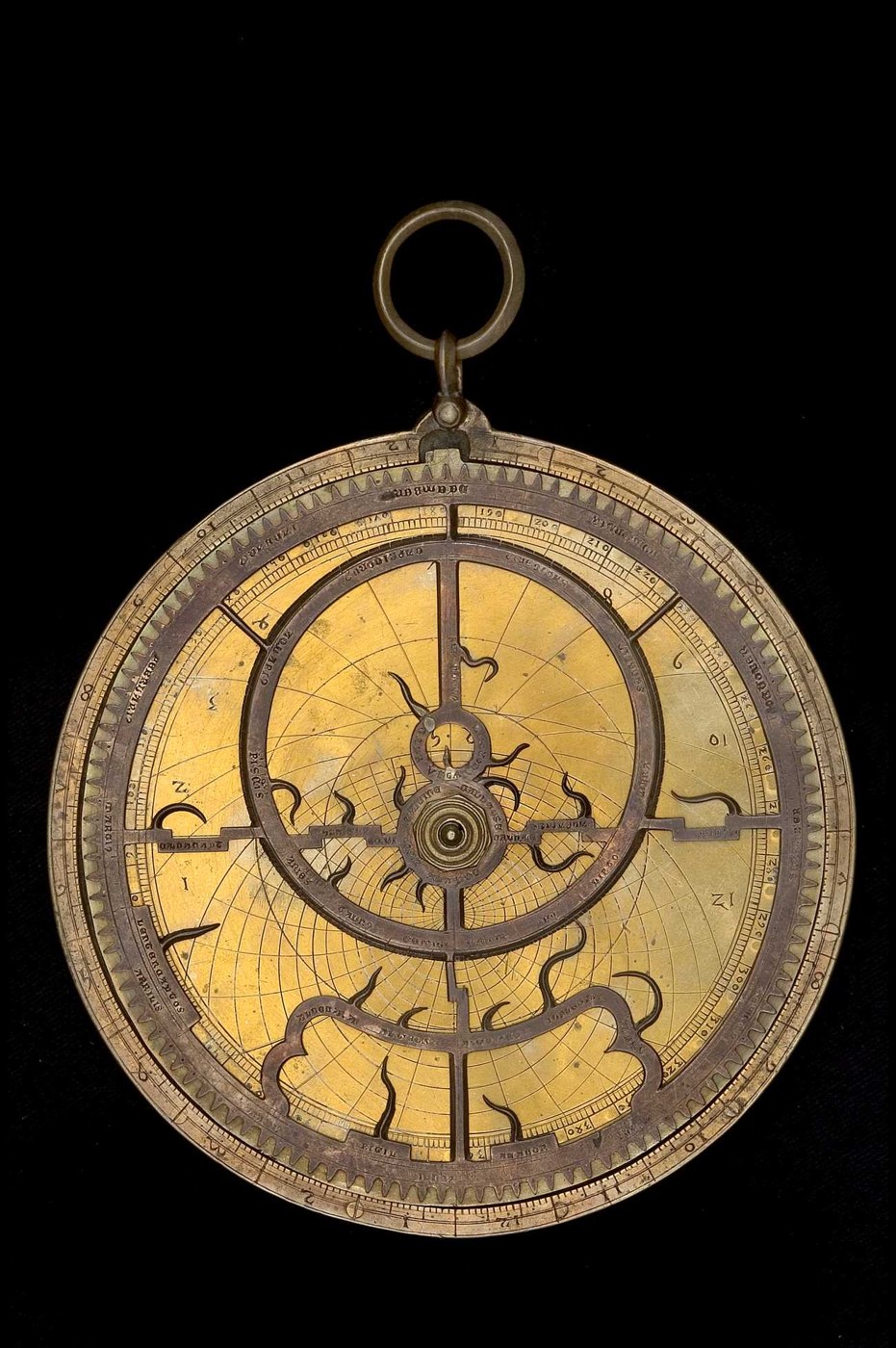
This brass astrolabe, designated by inventory number 52869, is attributed to Europe and dated to circa 1400. It is described as a rare western-made example of an astrolabe featuring a Saphea Azarchelis universal projection, which enables use in any latitude. The instrument is constructed from two soldered and riveted pieces for the mater and limb. It includes a rete with twenty-three stars marked with flamant pointers and a toothed Tropic of Capricorn. The instrument's throne is of the simple type, integrated with the base, and features an omega-type shackle. The back of the instrument displays five scales—degree, zodiacal signs, calendar, unequal hours, and a shadow square—engraved in Roman capitals, while the rete and womb are engraved in Lombardic capital script. Acquired in 1957 via a gift from J. A. Billmeir, the instrument is held at the History of Science Museum in Oxford.

The front face of the astrolabe, displaying the rete with stars and the universal projection plate underneath.
The front face of the astrolabe, displaying the rete with stars and the universal projection plate underneath. — History of Science Museum, University of Oxford. Rights pending — permission not yet requested. Original source

Catalogue identity

Source
www.mhs.ox.ac.uk
Category
Tool · Latin-inscribed astrolabe
Maker / attribution
Not established
Reference
52869
Catalogue / lot identifier
1957-84/175A
Source-reported date
ca. 1400
Source-reported place
Europe

Source-reported attribution and specifications are not independent authentication. A listing does not establish present ownership, current display, availability or permission to reproduce.

Object description

Construction and Design

The astrolabe is manufactured from brass, featuring a two-piece soldered and riveted mater and limb assembly. The throne is a simple, integrated tab design supporting an omega-shaped shackle, which connects to a squared cross-section suspension ring.

The instrument includes two plates calibrated for latitudes ranging between 42° and 51°. The rete incorporates an indicator-line design holding twenty-three stars with flamant pointers and a specific, toothed Tropic of Capricorn edge.

Evidence for this section
  • “The mater and limb are of two pieces, soldered and riveted construction.”
  • “The throne is of the simple type made of brass attached with integrated base”
  • “The rete is of the indicator-line (full) type.”

Engraving and Scales

The astrolabe exhibits two distinct engraving styles. The rete and the womb are inscribed in a Lombardic capital script, whereas the back of the instrument utilizes Roman capitals. The source indicates that the script on the back suggests it was engraved at a later date than the other components.

The back surface contains five functional scales: degree, zodiacal signs, calendar, unequal hours, and a shadow square, the latter being a box-type configuration in the lower two quadrants.

Evidence for this section
  • “The script on the back of the instrument suggests that it was engraved at a later date.”
  • “Unlike the rete and the womb, which were engraved in a Lombardic capital script, the back was engraved in Roman capitals.”

Provenance and History

This instrument is part of the History of Science Museum's collection in Oxford, having been presented by J. A. Billmeir in 1957. The astrolabe is identified by the accession number 1957-84/175A, with records indicating Billmeir acquired the object during the period of 1955 to 1957.

The projection type is identified as the Saphea Azarchelis, a system originating in eleventh-century Toledo.

Evidence for this section
  • “Presented by J. A. Billmeir in 1957”
  • “Accession 1957-84/175A”
  • “It is believed that this is the only known western-made example to survive from the middle ages.”

Open research questions

  • What specific evidence differentiates the engraving period of the back from the rest of the astrolabe?
  • What are the precise historical origins or workshop associations for an object attributed to medieval Europe without a maker's mark?

Source evidence

Recorded claims and source quotations for Brass Astrolabe with Universal Projection
FieldSource-reported valueSource quotation
MaterialBrass“Material Brass”
Dateca. 1400“Date ca. 1400”
Inventory Number52869“Inventory no. 52869”
ProvenancePresented by J. A. Billmeir in 1957“Presented by J. A. Billmeir in 1957”
Star Count23“The rete contains 23 stars.”
Engraving ScriptLombardic capital and Roman capital“Unlike the rete and the womb, which were engraved in a Lombardic capital script, the back was engraved in Roman capitals.”
Projection TypeSaphea Azarchelis“The womb bears a Saphea Azarchelis universal projection.”

Visible details

  • The rete features a distinct toothed Tropic of Capricorn.
  • The back contains a shadow square divided into twelve segments.
  • The rete is secured by a nut and bolt mechanism that appears as a later replacement.
  • The inscription script differs between the back and the main body.

Research qualifications

  • The exact origin within Europe remains unverified.
  • The threaded pin and nut are suggested as later additions.

Photograph identity and source facts were screened before import; rights clearance remains pending.

Consulted source

Astrolabe, inventory 52869 (Europe, ca. 1400)

Reviewed 2026-10-26 · Record b0434102ef

Terms in this record

Glossary explanations for terms named in this object’s record.