
Skip to content
The Encyclopedia of Horology

Tool · Latin-inscribed astrolabe

Astrolabe by Georg Hartmann

Partially verified

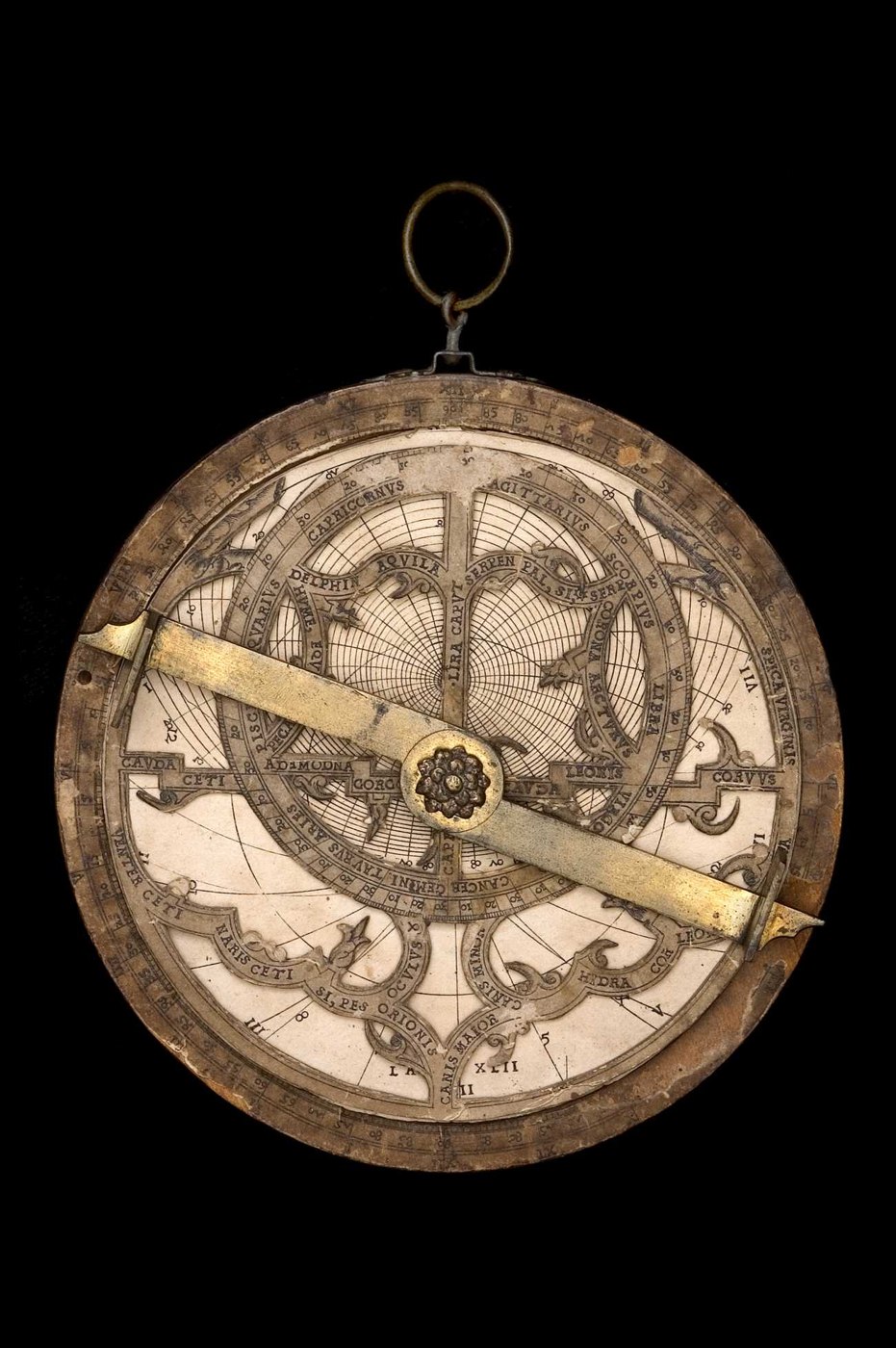
This astrolabe, inventory number 49296, was produced in Nuremberg by Georg Hartmann in 1542. The instrument is constructed primarily of wood, featuring turned mater and limb construction with applied paper elements. Its throne, ring, and shackle components are crafted from brass. The design includes a rete of the simple indicator-line type with a Moorish arch, marked with 29 stars and zodiacal signs. Three plates accompany the instrument, covering latitudes from 39° to 54°. The back face contains eight distinct scales including degree, zodiacal, calendar, unequal hours, and a shadow square, the latter of which incorporates the Arms of Nuremberg. The maker's signature is inscribed on the back as 'GEORGIVS HARTMAN NOREMBERGE, FACIEBAT ANNO MDXXXXII'. It was presented to the History of Science Museum by Lewis Evans in 1924, following his acquisition of the piece from a dealer in Venice in 1895.

Front view of the 1542 wood and brass astrolabe by Georg Hartmann, showing the rete, pin, and alidade.
Front view of the 1542 wood and brass astrolabe by Georg Hartmann, showing the rete, pin, and alidade. — History of Science Museum, University of Oxford. Rights pending — permission not yet requested. Original source

Catalogue identity

Source
www.mhs.ox.ac.uk
Category
Tool · Latin-inscribed astrolabe
Maker / attribution
Georg Hartmann
Reference
Not recorded
Catalogue / lot identifier
49296
Source-reported date
1542
Source-reported place
Nuremberg

Source-reported attribution and specifications are not independent authentication. A listing does not establish present ownership, current display, availability or permission to reproduce.

Object description

Construction and Design

The astrolabe is primarily constructed of wood, consisting of a single turned piece that forms both the mater and the limb. The surfaces are finished with pasted paper, which carries the various scales and markings. The instrument is further equipped with brass components, including a bracket-type throne, a simple round cross-section ring, and an eye-bolt shackle.

The rete follows an indicator-line style with a Moorish arch, providing positions for 29 stars and the ecliptic zodiac. It is secured to the main body via a foliate decorated pin. Three plates are included, offering latitude ranges between 39° and 54°.

Evidence for this section
  • “The mater and limb are of one-piece construction. Single piece, turned, with paper pasted on.”
  • “The throne is of the bracket type made of brass and has a simple, round cross-section ring made of brass”
  • “The rete is of the indicator-line (simple) type. Moorish arch.”

Scales and Markings

The back of the astrolabe is densely inscribed with eight distinct scales. These include a degree scale around the outer circle, zodiacal signs, a calendar scale, unequal hours, and a four-part shadow square. The shadow square incorporates the arms of Nuremberg within its center.

The rete holds a circular, concentric scale for zodiacal signs, numbered every 10 units. The star markings consist of dagger pointers denoting specific celestial positions, with star names inscribed directly onto the rete.

Evidence for this section
  • “The back contains 8 scales of the following types: Degree; Zodiacal signs; Calendar; Unequal hours; Shadow square.”
  • “Arms of Nuremberg are contained within the shadow square.”
  • “The rete contains 1 scale of the following type: Zodiacal signs.”

Signature and Provenance

The maker's signature is prominently placed on the back of the astrolabe, reading 'GEORGIVS HARTMAN NOREMBERGE, FACIEBAT ANNO MDXXXXII'. This confirms its production in Nuremberg in 1542.

Regarding the object's history, the museum records note that the astrolabe was presented by Lewis Evans in 1924. Evans acquired the instrument from a dealer in Venice in 1895.

Evidence for this section
  • “The back is inscribed: with a maker's signature marked as GEORGIVS HARTMAN NOREMBERGE, FACIEBAT ANNO MDXXXXII.”
  • “Presented by Lewis Evans in 1924”
  • “An early or perhaps the original owner was Leonardo Botallo (1530-1587)”

Open research questions

  • What is the definitive evidence for the identification of the ink inscription as that of Leonardo Botallo?
  • Were all 29 star pointers original, and do the damaged pointers significantly obscure star identification?

Source evidence

Recorded claims and source quotations for Astrolabe by Georg Hartmann
FieldSource-reported valueSource quotation
MakerGeorg Hartmann“Maker Georg Hartmann”
Date1542“Date 1542”
PlaceNuremberg“Place Nuremberg”
MaterialWood“Material Wood”
Inventory Number49296“Inventory no. 49296”
InscriptionGEORGIVS HARTMAN NOREMBERGE, FACIEBAT ANNO MDXXXXII“GEORGIVS HARTMAN NOREMBERGE, FACIEBAT ANNO MDXXXXII”
AcquisitionPresented by Lewis Evans in 1924“Presented by Lewis Evans in 1924”
Rete stars29 stars“The rete contains 29 stars.”

Visible details

  • Shadow square on the back contains the Arms of Nuremberg.
  • Rete features 29 stars marked with dagger pointers.
  • Mater and limb consist of a single turned piece with paper.
  • Includes a double-ended, counter-changed alidade.

Research qualifications

  • The exact original owner remains unverified, although the auction description suggests it may have belonged to Leonardo Botallo.
  • Some star pointers on the rete are reported as damaged.

Photograph identity and source facts were screened before import; rights clearance remains pending.

Consulted source

Astrolabe, inventory 49296 (Nuremberg, 1542)

Reviewed 2026-10-26 · Record 604da626a0

Terms in this record

Glossary explanations for terms named in this object’s record.