
Skip to content
The Encyclopedia of Horology

Clock · Bracket clock

George III mahogany bracket clock by John Long

Partially verified

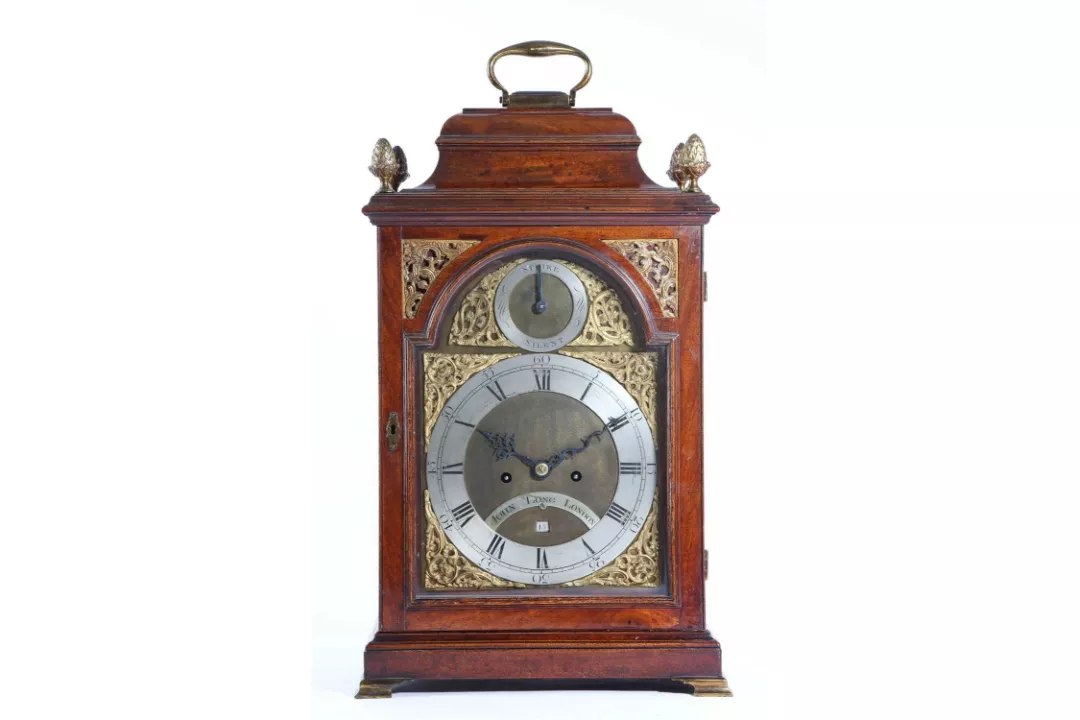
This George III bracket clock features a mahogany case surmounted by a carrying handle and cone finials, housing an eight-day brass five-pillar movement striking on a bell. The auction source notes that the movement has a replaced anchor escapement and an engraved Rococo backplate. The arched dial incorporates a silvered chapter ring with Roman and Arabic numerals, pierced gilt-metal foliate and scroll spandrels, a date aperture, and an upper strike/silent dial. It is signed 'John Long London', whom the catalogue notes was apprenticed in London in 1767.

Front view of George III mahogany bracket clock by John Long
Front view of George III mahogany bracket clock by John Long — Woolley & Wallis. Rights pending — permission not yet requested. Original source

Catalogue identity

Source
www.the-saleroom.com
Category
Clock · Bracket clock
Maker / attribution
John Long
Reference
Not recorded
Catalogue / lot identifier
54
Source-reported date
c.1780
Country
United Kingdom

Source-reported attribution and specifications are not independent authentication. A listing does not establish present ownership, current display, availability or permission to reproduce.

Object description

Case and Exterior

The mahogany case is of a bell-top design, fitted with a brass carrying handle and front corner cone finials. The case features side apertures for fret panels, which are noted in the auction description as being missing.

The clock is reported to measure 50cm in height, 30.2cm in width, and 18cm in depth.

Evidence for this section
  • “the case with cone finials and fret panels to the sides, now missing”
  • “50cm high, 30.2cm wide, 18cm deep”

Dial and Ornamentation

The arched dial features a silvered chapter ring with Roman and Arabic numerals. It includes a central date aperture and an upper strike/silent subsidiary dial. Gilt-metal foliate and scroll spandrels are positioned in the corners and the arch.

The dial plate is signed 'John Long London' below the hand arbor.

Evidence for this section
  • “the arched dial with a silvered chapter ring with Roman and Arabic numerals, with date aperture and strike / silent dial, with gilt metal scrolls and foliage spandrels”
  • “signed 'John Long London'”

Mechanism and Attribution

The movement is a brass eight-day, five-pillar mechanism that strikes on a bell, featuring an engraved Rococo backplate. The original escapement has been substituted with an anchor escapement.

The clock is attributed to John Long, with a catalogue note referencing his apprenticeship in London in 1767.

Evidence for this section
  • “the brass five pillar eight day movement striking on a bell”
  • “with a replaced anchor escapement”
  • “the backplate with Rococo engraved decoration”
  • “John Long is recorded in Baillie, G.H. 'Watchmakers & Clockmakers of the World' as apprenticed in London in 1767.”

Open research questions

  • What specific archival records confirm the existence and professional career of John Long in London beyond the 1767 apprenticeship entry?
  • Do the dimensions and case features of this lot match known examples of bracket clocks from the late 18th century attributed to the same maker?

Source evidence

Recorded claims and source quotations for George III mahogany bracket clock by John Long
FieldSource-reported valueSource quotation
MakerJohn Long, London“BY JOHN LONG, LONDON, C.1780”
Movement typeBrass five pillar eight day movement“the brass five pillar eight day movement striking on a bell”
EscapementReplaced anchor escapement“with a replaced anchor escapement”
Dial signatureJohn Long London“signed 'John Long London'”
Dimensions50cm high, 30.2cm wide, 18cm deep“50cm high, 30.2cm wide, 18cm deep”

Visible details

  • Mahogany bell-top case fitted with a brass carrying handle and two front corner cone finials.
  • Arched dial with an upper Strike/Silent subsidiary ring and pierced gilt-brass spandrels in the corners and arch.
  • Main silvered chapter ring marked with Roman hour numerals and Arabic five-minute outer markers.
  • Two winding squares flank the central hand arbor above an aperture displaying the date.
  • The dial plate is signed 'John Long London' below the hand arbor.

Research qualifications

  • Source notes the original escapement has been replaced with an anchor escapement.
  • Catalogue description states that the fret panels to the sides are missing.
  • Attribution to John Long and date c.1780 are source-reported.

Photograph identity and source facts were screened before import; rights clearance remains pending.

Terms in this record

Glossary explanations for terms named in this object’s record.