Skip to content
The Encyclopedia of Horology

Pocket watch · Verge & pair-cased watch

George II gold pair-cased pocket watch by James Chater

Partially verified

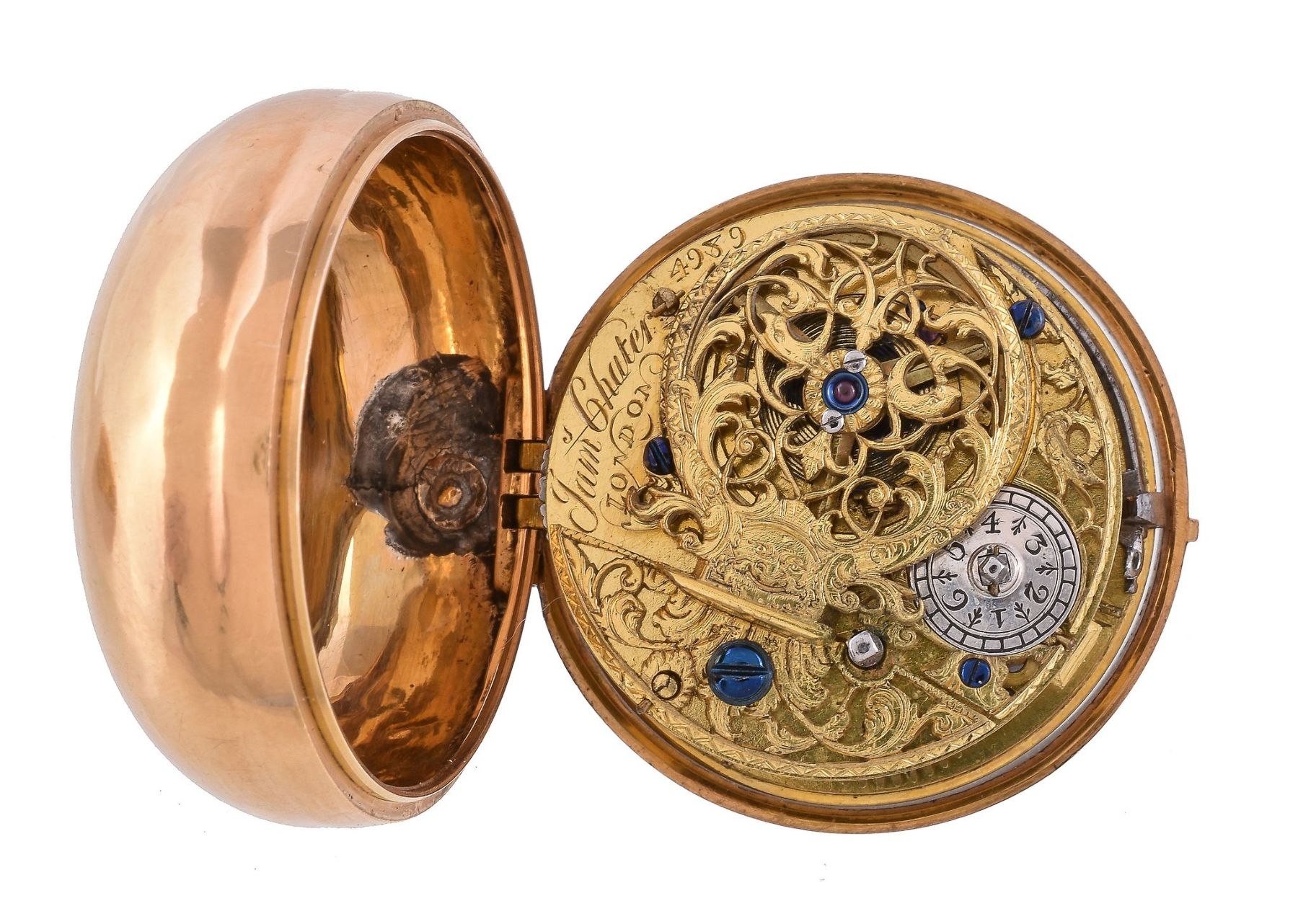
This George II gold pair-cased pocket watch was produced in London circa 1739 by James Chater. The watch features a gilt full-plate single-fusee movement, originally constructed with a verge escapement and later converted to an English lever escapement. The backplate incorporates an intricately pierced and engraved foliate balance cock with a grotesque mask, a central ruby cabochon endstone, a silvered regulation disc, and blued steel screws. The outer gold case is chased in high relief with a scene depicting Roman Charity, surrounded by scrollwork and trophy panels.

Backplate of the gilt movement showing the balance cock, regulation disc, and signature Jams Chater
Backplate of the gilt movement showing the balance cock, regulation disc, and signature Jams Chater — Dreweatts. Rights pending — permission not yet requested. Original source

Catalogue identity

Source
auctions.dreweatts.com
Category
Pocket watch · Verge & pair-cased watch
Form
Pair-cased pocket watch
Maker / attribution
James Chater
Reference
Not recorded
Catalogue / lot identifier
105
Source-reported date
circa 1739
Source-reported place
United Kingdom
Source-reported serial
4989

Source-reported attribution and specifications are not independent authentication. A listing does not establish present ownership, current display, availability or permission to reproduce.

Object description

Movement and Mechanism

The watch features a gilt full-plate single-fusee verge movement with four square baluster pillars pinned through the backplate. It includes a scroll-pierced stop-iron block and has undergone a later conversion to an English lever escapement. The mechanism is regulated by a sprung three-arm balance with a Tompion-type adjustment and a ruby cabochon endstone.

The backplate is engraved with a fine symmetrical foliate scroll-pierced balance cock featuring a grotesque mask at the junction of the broad foot. It is flanked by a silvered regulation disc with adjacent applied scroll-pierced infill and is signed 'Jam s Chater, LONDON, 4989'.

Evidence for this section
  • “The gilt full plate single fusee verge movement with four square baluster pillars pinned through the backplate, scroll-pierced stop-iron block and later conversion to English lever escapement”
  • “fine symmetrical foliate scroll pierced and engraved balance cock with faceted bright-cut rim and grotesque mask at the junction of the conforming pierced broad foot flanked by silvered regulation disc with adjacent applied scroll pierced infill opposing signature Jam s Chater, LONDON, 4989”
Dial and Case Description

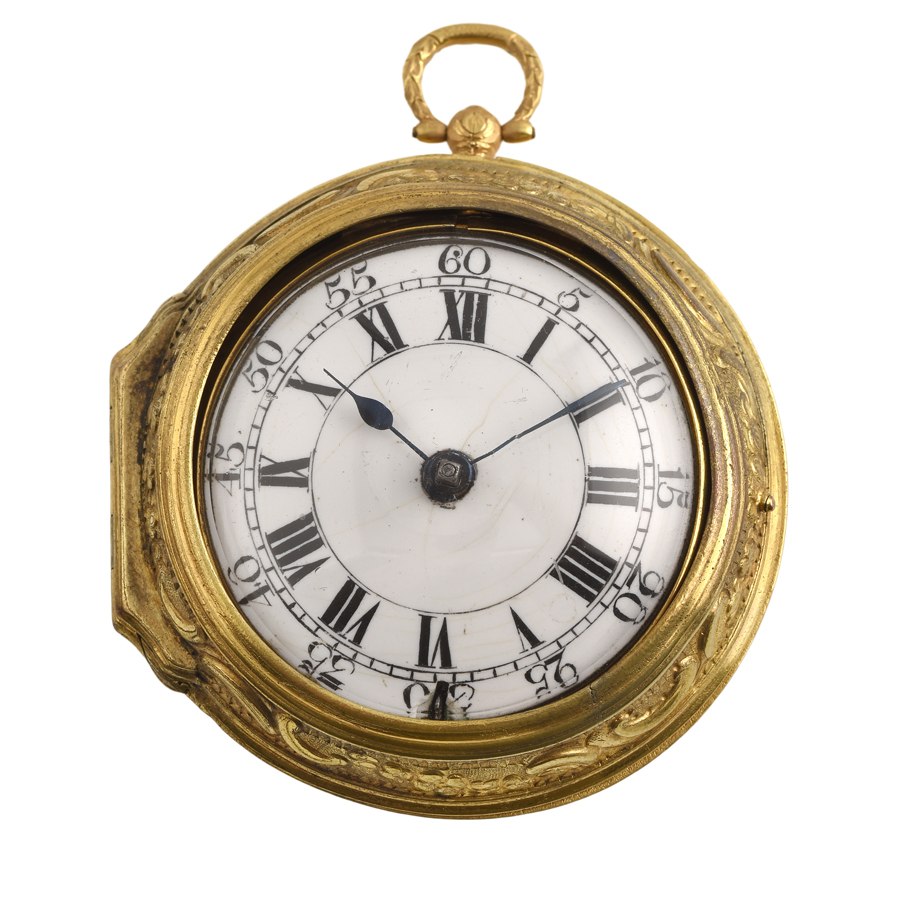
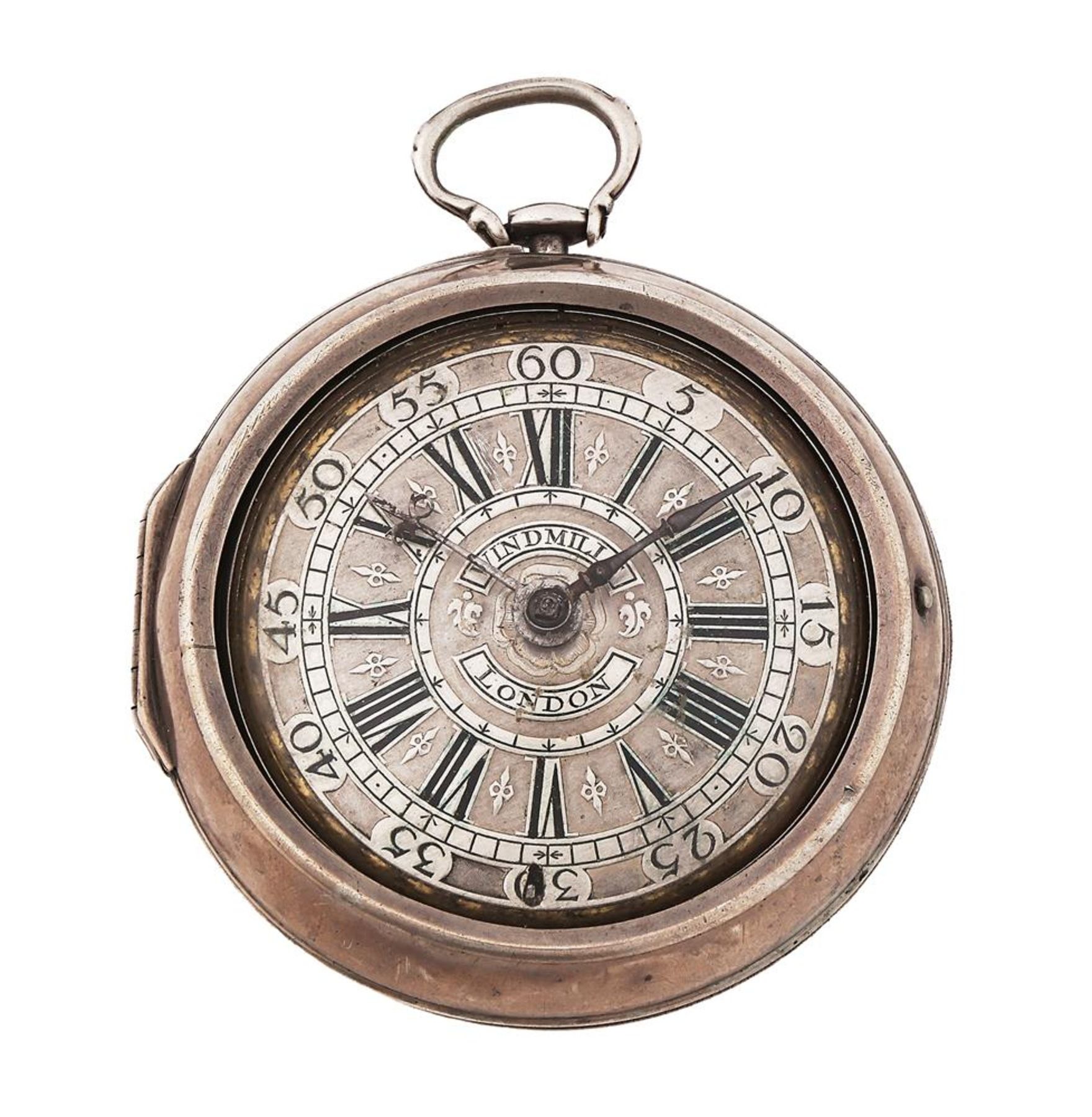
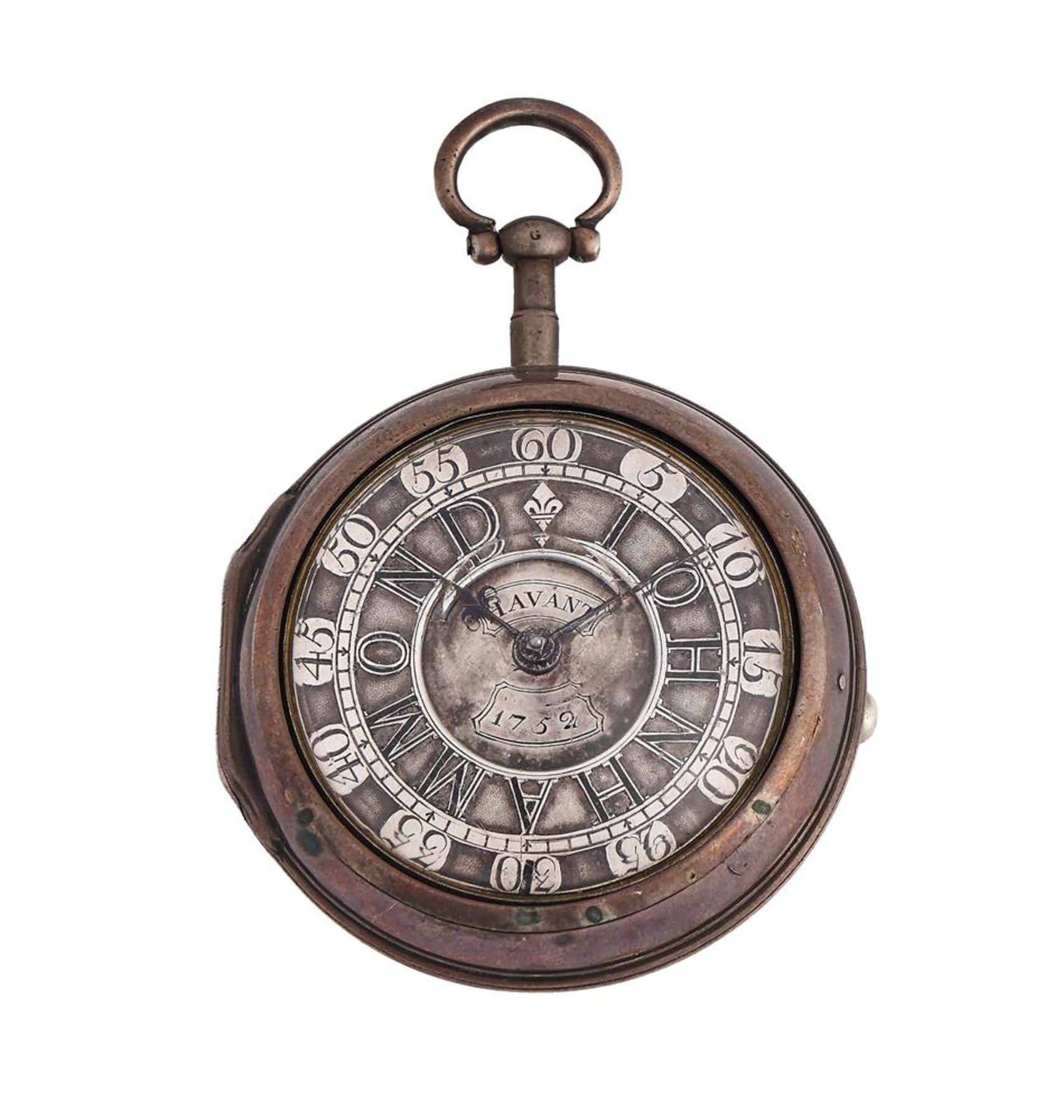
The timepiece has a circular gold champleve dial featuring a matted center with engraved ribbon panel signature banners reading 'CHATER, LONDON'. The chapter ring displays Roman numerals with fluer-de-lys half-hour markers and an outer track of Arabic lozenge five-minute numerals. The watch is fitted with blued steel beetle and poker hands.

The plain inner gold case is indistinctly stamped, with a potential date letter 'd' for 1739 and an indistinct maker's mark 'R.D'. The outer gold case is decorated in high relief with a scene traditionally titled 'Roman Charity', depicting Pero suckling her father Cimon, surrounded by a quartered scroll design and panels of musical and martial trophies.

Evidence for this section
  • “circular gold champleve dial with ribbon panel signature banners engraved CHATER, LONDON to the scroll decorated matted centre”
  • “the plain inner case indistinctly stamped probably with date letter d for 1739 and indistinct maker's mark R.D (?) . to interior”
  • “outer case decorated in relief with scene traditionally entitled Roman Charity depicting Cimon been suckled by Pero within a quartered scroll surround and alternating panels of musical and martial trophies”

Attributions and Provenance

The outer case decoration is tentatively attributed to Augustin Heckel, a German émigré who arrived in London between 1715 and 1720. The layout and execution of the scrollwork and cartouche are compared to designs illustrated in 'The Art of the Gold Chaser in Eighteenth-Century London'.

Provenance includes a private collection in Hampshire (ref. C27), with a recorded purchase at Phillips, London, on 26th June 2001 (lot 167).

Evidence for this section
  • “the outer case decoration possibly by Augustin Heckel”
  • “Provenance: Private collection, Hampshire (ref. C27); purchased at Phillip s, London, 26th June 2001 (lot 167)”

Open research questions

  • What specific archival evidence connects the inner case maker's mark 'R.D' to a specific silversmith?
  • Does the 'd' date letter consistently align with the construction period of 1739 for this specific case size?

Source evidence

Recorded claims and source quotations for George II gold pair-cased pocket watch by James Chater
FieldSource-reported valueSource quotation
Movement typeGilt full plate single fusee verge with later lever conversion“The gilt full plate single fusee verge movement with four square baluster pillars pinned through the backplate, scroll-pierced stop-iron block and later conversion to English lever escapement”
Outer case sceneRoman Charity“outer case decorated in relief with scene traditionally entitled Roman Charity depicting Cimon been suckled by Pero”
Outer case diameter49mm overall“the outer case 49mm (1.875ins) diameter overall.”
MakerJames Chater“James Chater senior is recorded in Baillie, G.H. Watchmakers & Clockmakers of the World as being admitted to the Clockmakers' Company 1718”
Dimensions36mm pillar plate; 49mm outer case“the pillar plate 36mm (1.375ins) diameter, the outer case 49mm (1.875ins) diameter overall.”

Visible details

  • Pierced and engraved balance cock with a central ruby cabochon endstone
  • Silvered regulation disc calibrated with Arabic numerals
  • Blued steel screws visible on the gilt backplate
  • Engraved signature on the backplate reading 'Jams Chater, LONDON, 4989'
  • Plain polished gold inner case open to display the movement

Research qualifications

  • Movement was later converted from verge to English lever escapement
  • Outer case chasing is only tentatively attributed to Augustin Heckel
  • Inner case date letter and maker's mark are indistinct

Photograph identity and source facts were screened before import; rights clearance remains pending.

Terms in this record

Glossary explanations for terms named in this object’s record.