
Skip to content
The Encyclopedia of Horology

Tool · French astrolabe

Geographical Astrolabe

Partially verified

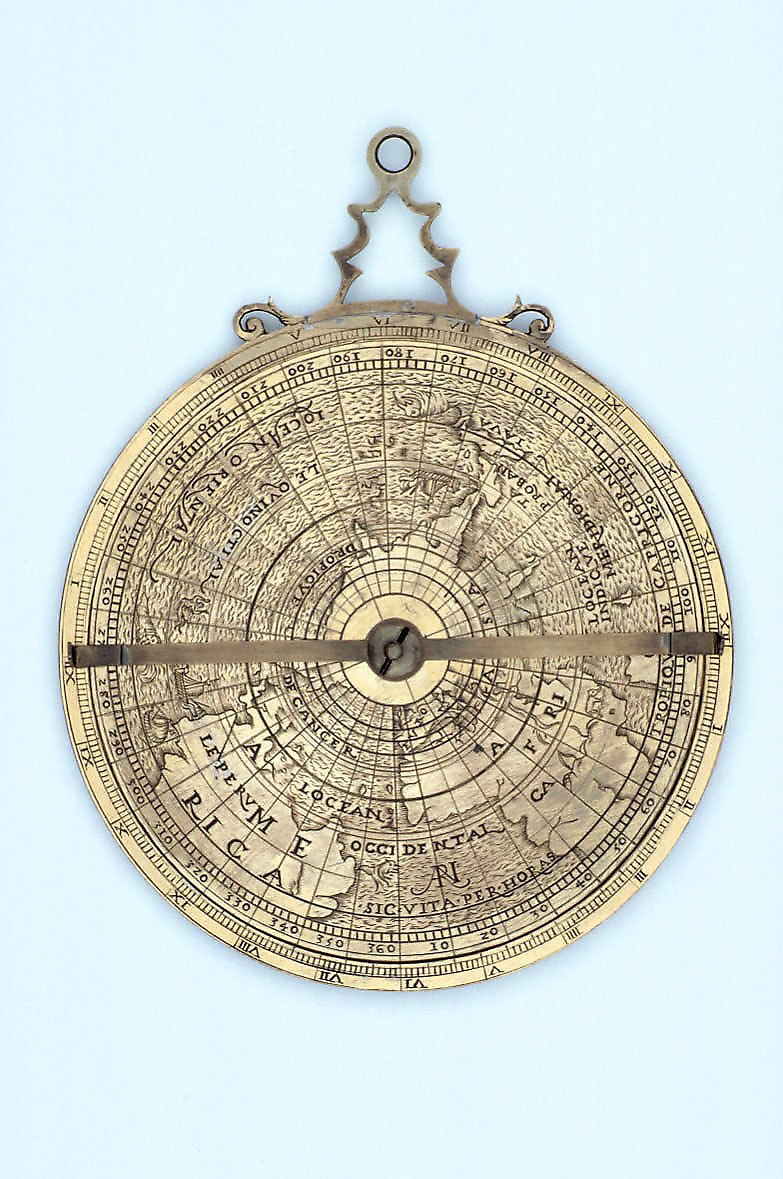
This gilt brass geographical astrolabe, measuring 108 mm in diameter, features a projection of the geographical sphere from the North Pole to the Tropic of Capricorn rather than the standard celestial sphere. Attributed to the late 16th century and signed 'ARN', the instrument consists of a mater with a pierced throne, a limb with an hour scale, and a rotating plate engraved with a terrestrial map. The map displays continents, oceans, and specific locations such as Peru and Java, alongside a monogram and the motto '?SIC ? VITA ? PER ? HORAS'. The back includes a degree scale, a zodiacal scale, an eccentric calendar, an unequal hour diagram, and a double shadow square, with an integrated lunar volvelle and aspectarium. The museum notes that the presence of errors in spelling, unusual scale divisions, and the absence of a rete suggest its authenticity is questionable.

Geographical astrolabe featuring a terrestrial map on the central plate, signed 'ARN', dated to the late 16th century.
Geographical astrolabe featuring a terrestrial map on the central plate, signed 'ARN', dated to the late 16th century. — Museum of the History of Science, Oxford. Rights pending — permission not yet requested. Original source

Catalogue identity

Source
www.mhs.ox.ac.uk
Category
Tool · French astrolabe
Maker / attribution
ARN
Reference
Not recorded
Catalogue / lot identifier
44359
Source-reported date
Late 16th century ?
Source-reported place
France

Source-reported attribution and specifications are not independent authentication. A listing does not establish present ownership, current display, availability or permission to reproduce.

Object description

Construction and Design

The instrument is constructed from gilt brass and measures 108 mm in diameter. It comprises a mater with a thin sheet of brass, a soldered, pierced throne, and an attached limb. The limb features an hour scale ranging from 0 to XII twice, rendered in Roman numerals, and includes subdivisions of 20 and 4 minutes.

The instrument incorporates a rotating plate engraved on one side with a terrestrial map, mapping the world from the North Pole to the Tropic of Capricorn. The design includes the names of various oceans and continents, including labels for Peru and Java, and incorporates figures alongside the monogram 'ARN' and a motto. The rete is missing.

Evidence for this section
  • “Gilt brass; 108 mm in diameter”
  • “The mater comprises a thin sheet of brass and attached limb. Soldered shaped and pierced throne”
  • “One plate engraved on one side only with a terrestrial map”
  • “Rete missing.”

Scales and Functions

The reverse of the astrolabe is highly complex, featuring an outermost degree scale and a zodiacal scale with symbols and names. The calendar scale is described as eccentric and is marked 'CERCLES EXENTRIQVE', while the degree scales are marked 'CERCLES CONCENTRIQVE'.

Additional features include an unequal hour diagram in two quadrants, a perpetual calendar, a lunar volvelle, and an aspectarium positioned in the central circle. The lower section of the reverse contains a double shadow square with scales divided to 3, alongside images of stars and a profile of the moon. Modern components include the screw, nut, alidade, and index.

Evidence for this section
  • “The back has an outermost degree scale, 90 to 0 to 90 to 0 to 90”
  • “Within this is a zodiacal scale with names and symbols for the signs”
  • “Within that is an eccentric calendar scale with the names of the months”
  • “In the centre of the shadow square is the same monogram and motto as on the geographical plate”

Authenticity and Condition

The holding museum reports that the instrument contains several inconsistencies. Specifically, there are identified mistakes in the spellings of text on the instrument, and the scale divisions are described as odd.

These internal discrepancies, combined with the presence of unusual markings, lead the museum to state that the authenticity of the object is doubtful. The instrument is documented in historical literature, specifically in the second volume of R. T. Gunther's 'The Astrolabes of the World'.

Evidence for this section
  • “there are other problems with this instrument, such as mistakes in spellings and odd scale divisions, that make its authenticity doubtful.”
  • “See R. T. Gunther, The Astrolabes of the World (2 vols, Oxford, 1932), vol. 2, p. 357”

Open research questions

  • What specific orthographic errors were identified that lead to doubts regarding the object's authenticity?
  • Are there other instruments known to feature the 'ARN' monogram that share similar construction characteristics?

Source evidence

Recorded claims and source quotations for Geographical Astrolabe
FieldSource-reported valueSource quotation
MakerARN“Signed 'ARN'”
MaterialGilt brass“Gilt brass”
Diameter108 mm“108 mm in diameter”
Inventory number44359“Inventory number 44359”
DateLate 16th century ?“Late 16th century ?”
OriginFrench“French”
ConditionMissing components“Rete missing.”

Visible details

  • Signed with monogram 'ARN'
  • Terrestrial map covering North Pole to Tropic of Capricorn
  • Lacks the original rete
  • Includes a double shadow square on the back

Research qualifications

  • Authenticity is described as doubtful due to orthographic errors and scale irregularities
  • Date is recorded as late 16th century with a question mark

Photograph identity and source facts were screened before import; rights clearance remains pending.

Consulted source

Astrolabe

Reviewed 2026-10-26 · Record cafb291017

Terms in this record

Glossary explanations for terms named in this object’s record.