
Skip to content
The Encyclopedia of Horology

Clock · Carriage clock

French gilt brass extreme rococo cased carriage clock

Partially verified

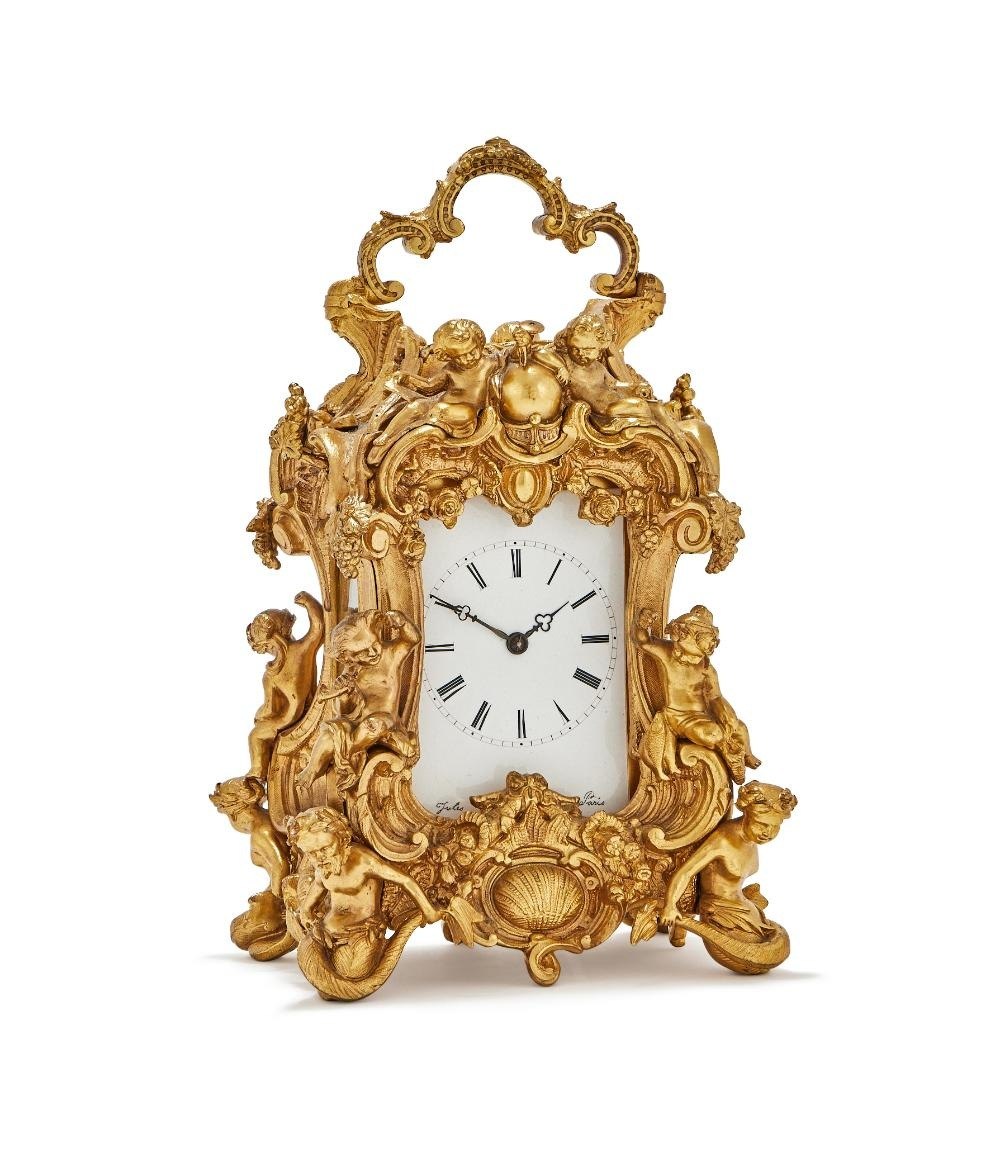
This carriage clock is constructed with a gilt brass case in an extreme rococo design. The clock features a rectangular eight-day, two-train movement that includes bell striking and a push-button repeat function. The escapement is a platform lever type, described as the 'Jules' type, which features a helical sprung bimetallic balance, adjusting screws, and wedge-shaped timing weights, all pivoting within a circular sub-carriage. The dial is made of white enamel with Roman numerals and pierced blued steel trefoil hands, and it is signed "Jules, Paris" on the lower margin. The clock stands 20cm high with the handle down, measuring 14cm wide and 12cm deep. The backplate is signed "JULES A PARIS" across the lower margin. The elaborate case is decorated with putti, mermaid figures, and various scrollwork motifs.

Front view of the gilt brass carriage clock showing the rococo case decoration, putti, and mermaid supports.
Front view of the gilt brass carriage clock showing the rococo case decoration, putti, and mermaid supports. — Dreweatts 1759 Fine Sales / Invaluable. Rights pending — permission not yet requested. Original source

Catalogue identity

Source
orbiscollectibles.com
Category
Clock · Carriage clock
Maker / attribution
Jules
Reference
Not recorded
Catalogue / lot identifier
205843792
Source-reported date
circa 1840
Source-reported place
France

Source-reported attribution and specifications are not independent authentication. A listing does not establish present ownership, current display, availability or permission to reproduce.

Object description

Case and Dial Design

The clock is housed in a gilt brass case characterized by elaborate, heavy rococo-style ornamentation. The overall profile follows an ogee outline. The top of the clock features a hinged triple C-scroll handle, while the main body incorporates cast figures of putti, including a pair flanking a globe on the upper section.

The front of the case is mounted with further putti and terminates in a base panel centered with a scallop shell, flanked by figures described as a mermaid and her companion. The dial is a rectangular white enamel plate with black Roman numerals and pierced blued steel trefoil hands, signed at the bottom.

Evidence for this section
  • “the elaborate case with hinged triple C-scroll handle above bevelled top glass to the ogee outline upstand applied with crest modelled as a pair of reclining putti”
  • “the rectangular white Roman numeral enamel dial with pierced blued steel trefoil hands and signed Jules, Paris to lower margin”

Movement and Escapement

The movement is an eight-day, two-train mechanism designed for bell striking. It features a specific platform lever escapement which the source identifies as the 'Jules' type. This escapement includes a helical sprung bimetallic balance equipped with screws and wedge-shaped timing weights.

The balance assembly pivots within a circular sub-carriage structure. This design is compared to examples by other makers like Bolvillier, which informs the dating of the object to approximately 1840.

Evidence for this section
  • “The rectangular eight-day two train bell striking movement with typical 'Jules' type platform lever escapement”
  • “An almost identical escapement to the one fitted to the current lot is illustrated in Allix, Charles and Bonnert, Peter CARRIAGE CLOCKS Their History and Development on page 73 (plate II/47).”

Signatures and Construction

The clock displays the signature 'Jules, Paris' on both the dial and the backplate of the movement. The rear of the case matches the front aesthetic, featuring a door cast with scrollwork and secured by a hinged clasp. The case also includes glazed inserts on the sides and behind the dial, protected by bevelled glass.

The source notes that there is no formal list of working dates for the maker known as Jules. The dating of this specific object is supported by technical similarities in the escapement found in comparable horological literature.

Evidence for this section
  • “the backplate signed JULES A PARIS across the lower margin”
  • “Allix/Bonnert do not list working dates for Jules however similarities between this escapement and those used by Bolvillier are noted”

Open research questions

  • What is the specific history of the clockmaker 'Jules' active in Paris during the mid-19th century?
  • How does the 'Jules' type platform lever escapement compare precisely to the known escapements of the Bolvillier workshop?

Source evidence

Recorded claims and source quotations for French gilt brass extreme rococo cased carriage clock
FieldSource-reported valueSource quotation
MaterialGilt brass“GILT BRASS”
Movement typeEight-day two train bell striking“The rectangular eight-day two train bell striking movement”
SignatureJules, Paris“signed Jules, Paris to lower margin”
EscapementPlatform lever“typical 'Jules' type platform lever escapement”
Dimensions20cm high, 14cm wide, 12cm deep“20cm high with handle down, 14cm (5.5ins) wide, 12cm (4.75ins) deep.”
Repeat functionPush-button“with plunger for the repeat function”

Visible details

  • The case displays an ogee outline with putti figures and mermaid-like supports at the base.
  • A hinged triple C-scroll handle is positioned above a bevelled top glass.
  • The white enamel dial features black Roman numerals and trefoil-shaped hands.
  • The rear of the case includes a door decorated with scrollwork and a hinged clasp.

Research qualifications

  • The maker 'Jules' does not have documented working dates, making the circa 1840 attribution suggested by the source tentative.
  • The identification of the 'Jules' type escapement relies on comparisons to other makers, specifically Bolvillier, rather than firm historical documentation.

Photograph identity and source facts were screened before import; rights clearance remains pending.

Consulted source

FRENCH GILT BRASS EXTREME ROCOCO CASED CARRIAGE CLOCK

Reviewed 2026-11-02 · Record 0ff7249254

Terms in this record

Glossary explanations for terms named in this object’s record.