
Skip to content
The Encyclopedia of Horology

Clock · Lantern clock

First period "potato head" lantern clock with half-hour strike

Partially verified

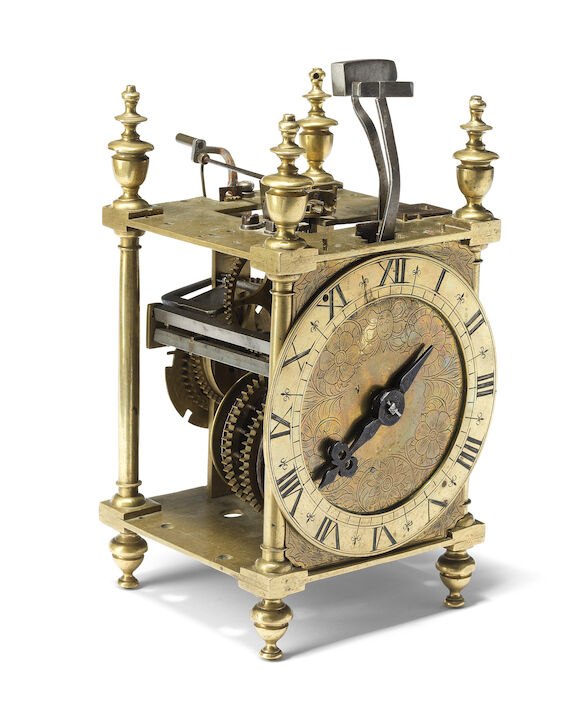
This unsigned brass lantern clock dates to the first half of the 17th century and features a dial associated with London's First Period production. The narrow chapter ring displays slender Roman numerals, fleur-de-lys half-hour markers, and an inner quarter-hour track framing an engraved dial centre with six flowerheads, including a human face beneath XII known as a 'potato head'. The brass frame incorporates turned Doric corner columns surmounted by squat urn finials on inverted acorn feet. According to the source, the striking train features an unusual passing strike on the half hour alongside a full hour strike.

Three-quarter view of the unsigned brass lantern clock showing the dial, side movement frame, and top strike hammers
Three-quarter view of the unsigned brass lantern clock showing the dial, side movement frame, and top strike hammers — Bonhams. Rights pending — permission not yet requested. Original source

Catalogue identity

Source
www.bonhams.com
Category
Clock · Lantern clock
Maker / attribution
Not established
Reference
Not recorded
Catalogue / lot identifier
69
Source-reported date
first half of the 17th century
Country
United Kingdom

Source-reported attribution and specifications are not independent authentication. A listing does not establish present ownership, current display, availability or permission to reproduce.

Object description

Physical Description

This unsigned brass lantern clock is constructed with an open frame supported by four turned Doric columns resting on inverted acorn feet. The upper section features four squat urn finials and a top-mounted strike hammer arm assembly.

The engraved brass dial plate includes a single central hand and floral corner spandrels. The dial comprises a narrow chapter ring with a single line border, slender Roman numerals, fleur-de-lys half-hour markers, and an inner quarter-hour track. The center is engraved with six flowerheads, with the uppermost flowerhead depicting a human face referred to as a 'potato head'.

Evidence for this section
  • “Surmounted by four squat urn finials above turned Doric columns on inverted acorn feet.”
  • “The narrow chapter ring with single line border, slender Roman hours, fleur de lys half-hour markers and an inner quarter hour track”
  • “set on a dial plate with floral engraved corners and an inner ring of six flowerheads, the one directly below XII further engraved with a so-called 'potato head'.”

Mechanical Features

The clock includes an atypical passing strike on the half hour via a small hammer and a full strike on the hour via a larger hammer. These are activated by a twelve-point star wheel on the back of the hour wheel.

The large return spring for the half-hour hammer is secured by a foot that is friction-fitted and hammered into the front bar. This front bar is noted for having an increased width around the great wheel pivot point, a practice associated with Ahasuerus Fromanteel.

Evidence for this section
  • “the striking train unusually with passing strike on the half hour via a small hammer, and full strike on the hour via a larger hammer”
  • “The two different strikes are both activated by the twelve-point star wheel on the back of the hour wheel”
  • “The front bar is furthermore of note in having an increased width around the great wheel pivot point, a practise sometimes used by Ahasuerus Fromanteel.”

Condition and Alterations

The movement has been modified from its original balance wheel escapement to a pendulum-driven verge escapement, with evidence of the original configuration remaining visible on the top plate.

The item lacks several original components, including the bell, bell strap, frets, doors, pendulum, weights, and alarm work.

Evidence for this section
  • “The movement now with a pendulum-driven verge escapement”
  • “Evidence of the original balance wheel escapement still visible on the top plate.”
  • “Bell strap, bell, frets, doors, pendulum, weights, alarm-disc and alarm work now lacking”

Open research questions

  • Are there other instances of the 'potato head' engraving documented beyond the known group of makers listed in the source?
  • Does any technical documentation confirm the unique nature of this specific passing half-hour strike system?
  • What specific archival records substantiate the attribution of the front bar design practice to Ahasuerus Fromanteel?

Source evidence

Recorded claims and source quotations for First period "potato head" lantern clock with half-hour strike
FieldSource-reported valueSource quotation
Height32 cm (12.5 in)“32cms (12.5ins) high”
EscapementPendulum-driven verge escapement (converted from original balance wheel)“The movement now with a pendulum-driven verge escapement”
Strike mechanismPassing half-hour strike and full hour strike“the striking train unusually with passing strike on the half hour via a small hammer, and full strike on the hour via a larger hammer”
Dial motifSix flowerheads with a 'potato head' face below XII“an inner ring of six flowerheads, the one directly below XII further engraved with a so-called 'potato head'”
Estimated DateFirst half of the 17th century“A rare first half of the 17th century first period "potato head" lantern clock”
Height32 cm (12.5 in)“32cms (12.5ins) high”

Visible details

  • Open brass lantern frame supported by four turned Doric columns on inverted acorn feet.
  • Four squat urn finials at the upper corners and top-mounted strike hammer arm assembly.
  • Engraved brass dial plate with a single central hand and floral corner spandrels.

Research qualifications

  • The bell, bell strap, frets, doors, pendulum, weights, alarm-disc, and alarm work are documented as lacking.
  • The movement has been altered from its original balance wheel escapement to a pendulum-driven verge escapement.

Photograph identity and source facts were screened before import; rights clearance remains pending.

Terms in this record

Glossary explanations for terms named in this object’s record.